
Comparing Heavy Equipment Warranty Suppliers: Coverage, Claims, and Downtime Risk
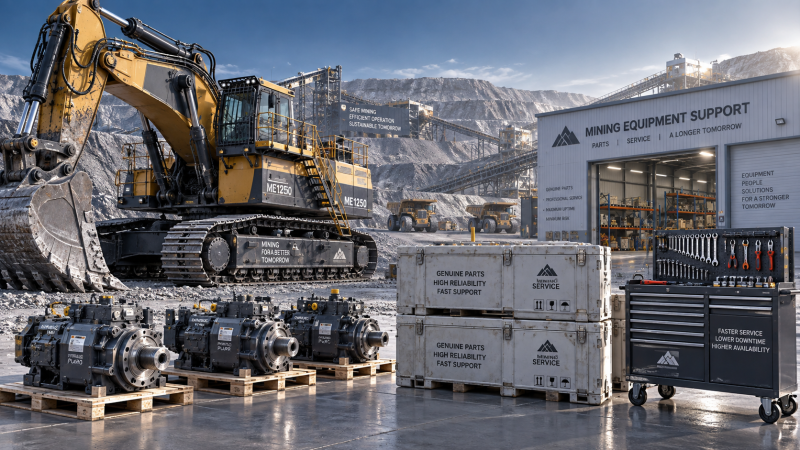
A warranty is only as valuable as the machine availability it preserves
For heavy equipment, the cheapest warranty supplier is not necessarily the lowest-cost option, and the broadest-looking coverage is not necessarily the most protective. A warranty agreement becomes valuable only when it converts a failure into an approved repair, obtains the required parts and labor, and returns the machine to service within a timeframe that the project can absorb.
That distinction matters most for tunnel boring machines, mining excavators, crawler cranes, road machinery, and haulage fleets. A failed hydraulic pump, slewing bearing component, power module, travel drive, control unit, or engine aftertreatment system can interrupt far more than one asset. It may stop a production sequence, delay a lift window, idle an operator crew, disrupt material flow, or force contractual discussions with a project owner. The warranty supplier comparison for heavy equipment warranty should therefore focus on coverage language, claim execution, and downtime exposure as a connected commercial question.
A supplier offering a lower warranty price but slow authorization, narrow parts access, or rigid repair rules can create a materially higher lifecycle cost than a supplier with a higher upfront premium and a dependable support structure. Procurement decisions should be based on the cost of an unresolved failure, not on the warranty fee alone.
Headline coverage can conceal major differences in protection
Warranty proposals often use broad terms such as “powertrain,” “full machine,” “extended protection,” or “major components.” These labels are not sufficient for comparison. The operative value lies in the covered-component schedule, the exclusions, the trigger conditions, and the obligations assigned to the equipment owner.
A powertrain warranty may cover an engine block, transmission casing, and axle housings, while excluding injectors, turbochargers, sensors, wiring harnesses, electronic control modules, filters, seals, hoses, and damage caused by a related cooling-system failure. On a modern machine, these excluded items can be central to fault diagnosis and repair. A coverage promise that protects the most expensive core component but excludes the failure pathway leading to its damage may provide less practical protection than expected.
For electrically driven or electronically controlled equipment, the scope needs even closer reading. The distinction between a failed high-voltage battery, a battery-management system fault, damaged cabling, software calibration, charging-interface failure, and loss of capacity is commercially significant. Some warranties cover a defined component failure but not performance degradation. Others require the owner to follow prescribed charging, inspection, or software-update procedures before a claim can be accepted.
Hydraulic coverage also varies considerably. One contract may include pumps, motors, cylinders, main control valves, and associated internal failures; another may exclude contamination-related damage, hoses, rotary unions, seals, or failures attributed to improper filtration. In mining and tunnelling applications, contamination disputes deserve particular attention because diagnosis may turn on oil-analysis evidence, maintenance records, and the supplier’s interpretation of the failure cause.
The practical question is not “Does it cover hydraulics?” It is: “Which components, which failure modes, which diagnostic and consequential repair tasks, and under which operating conditions?”
Compare the contract boundary, not just the component list
Every warranty has a boundary between a covered defect and an excluded operating risk. Suppliers define that boundary differently. A useful comparison separates at least five areas of exposure.
- Defect versus wear: Bearings, bushings, undercarriage parts, cutter tools, brake linings, tyres, tracks, seals, and other consumable items are frequently treated as wear items. The definition of “premature wear” should not be assumed to create coverage unless the agreement expressly says so.
- Primary damage versus consequential damage: A failed covered part may damage adjacent components. The warranty should clarify whether labor, fluids, cleanup, diagnostic work, and resulting damage are included or limited to replacement of the original failed part.
- Factory defect versus operating environment: Dust ingress, water contamination, corrosive conditions, extreme temperatures, overloading, shock loading, poor fuel quality, and unsuitable attachments may be cited as exclusions. The supplier should explain how it determines whether such conditions caused the failure.
- Machine configuration: Approved attachments, auxiliary hydraulic circuits, telematics installations, electrical modifications, aftermarket fire-suppression systems, and remote-control packages can affect eligibility. The risk is higher when machines are configured differently across sites or countries.
- Maintenance compliance: Warranties commonly depend on scheduled servicing, genuine or approved parts, qualified technicians, and documented inspection records. A contract with strict compliance requirements may be reasonable, but the evidence burden must be operationally manageable.
Coverage limits should also be normalized. Compare the duration in months, operating hours, kilometer limits where relevant, claim caps, aggregate limits over the contract term, and any maximum labor-rate allowance. A warranty extending to 8,000 operating hours can be less useful than one ending at 6,000 hours if the first includes a lower aggregate payout cap or excludes the systems most likely to generate high-cost repairs.
For long-duration infrastructure projects, calendar time and utilization pattern must be assessed together. A crane may accumulate hours slowly but remain contractually critical for years. An open-pit excavator may exhaust an hour-based limit quickly under continuous operation. A warranty that appears long on paper may expire before the period of highest operational stress.
Claims performance is the real test of a warranty supplier
Warranty documents describe entitlement; claim administration determines whether that entitlement can be used. Suppliers differ in how they receive fault notifications, assign technical responsibility, approve diagnostics, authorize repairs, validate parts, and close claims. Those differences directly affect downtime.
Before selecting a provider, the claims process should be mapped from first alarm to machine release. The supplier should provide clear answers to operational questions rather than generic assurances of “fast support.”
- Who must be contacted before teardown or repair work begins?
- Can the local dealer or service contractor diagnose the machine immediately, or is remote approval required?
- Who pays for fault finding if the claim is rejected?
- What evidence is required: fault codes, photos, fluid samples, damaged-part retention, maintenance history, telematics records, or technician reports?
- Can emergency work proceed outside normal business hours?
- What approval levels apply for high-value repairs?
- Is the decision-maker the OEM, an insurer, a third-party warranty administrator, a dealer network, or a reseller?
- How are disputes over root cause escalated and resolved?
A claims process that requires authorization before dismantling can protect the supplier against unsupported repairs, but it can also delay diagnosis when the equipment is in a remote mine, underground works, or an isolated energy project. The contract should define emergency authority: what repairs may be undertaken to protect the asset or restore safe operation, who must be notified, and what documentation preserves eligibility.
Another important distinction is between claim approval and repair completion. A supplier may approve a replacement transmission promptly, yet the machine remains unavailable if the part is not stocked regionally, freight arrangements are unclear, or no qualified technician can reach the site. Procurement should treat authorization time, parts lead time, and field-service mobilization as separate stages of one downtime event.
Service-network reach must match the equipment’s operating geography
Warranty suppliers often advertise international support, but international reach can mean very different things. It may indicate a formal dealer network with trained technicians and local parts warehouses. It may also mean that claims can be filed from multiple countries while repair capability remains concentrated in a few markets.
The relevant test is site-specific. A warranty should be evaluated against the actual operating location, not against the supplier’s general global footprint. For a cross-border fleet, that includes the countries in which the machine will be commissioned, temporarily transferred, serviced, and potentially resold.
Service capability is particularly important for specialized equipment. A general heavy-equipment workshop may be able to perform routine work on an excavator, but it may not have the diagnostic tools, lifting fixtures, software access, hydraulic test equipment, or certified personnel required for a large crawler crane, a high-capacity electric mining truck, or a TBM subsystem. The warranty provider should identify which repairs can be completed locally and which require OEM intervention or component shipment to a designated facility.
Parts planning deserves equal scrutiny. Ask whether covered parts are held in-country, in a regional hub, or only at the factory. Determine whether the agreement includes expedited freight, customs support, core-return logistics, and substitute-component approval. In remote jurisdictions, customs clearance, export-control rules, and local import procedures can extend downtime even after a claim is accepted. These are not always warranty obligations, but they are operational risks that must be allocated clearly.
Downtime risk should be priced as an exposure, not treated as an inconvenience
Warranty comparison often stops at repair cost. That overlooks the commercial impact of equipment unavailability. The loss from a machine being offline may include replacement hire, standby labor, delayed blasting or hauling cycles, missed lifting windows, idle downstream plant, liquidated damages exposure, or the cost of changing a construction sequence. Not every loss is recoverable under a warranty.
Most standard warranties cover repair costs, subject to terms and limits. They do not automatically cover production loss, rental of substitute equipment, project delay, transport of a replacement machine, operator costs, or penalties owed to a client. A supplier may offer optional downtime reimbursement or equipment-rental support, but these provisions need careful reading. The daily allowance, waiting period, maximum number of days, qualifying failure definition, and evidence requirements determine whether the benefit is meaningful.
A useful internal comparison is to estimate the financial effect of a critical machine being unavailable for one day, one week, and a longer disruption. That estimate need not pretend to be exact. Its purpose is to identify which assets justify stronger support commitments, local parts stock, duplicate capacity, or a more expensive warranty arrangement.
Not all equipment should receive the same warranty treatment. A fleet may contain units with low replacement cost and flexible deployment, alongside a small number of machines that form a project bottleneck. Warranty depth should follow criticality. For a non-critical support loader, a limited component warranty may be commercially sufficient. For a primary excavator in a continuous mining circuit or a crane assigned to a narrow installation window, claim speed and field support can matter more than an extended list of covered components.
OEM-backed, dealer-backed, and third-party warranties carry different control points
An OEM-backed warranty is often strongest where proprietary software, specialized parts, technical bulletins, and factory diagnostic authority are central to repair quality. It may provide clearer access to approved repair methods and original components. Its limitations may include higher cost, defined dealer territories, service scheduling constraints, or requirements that work be performed within the authorized network.
A dealer-backed warranty can be effective when the selling dealer has a capable workshop, committed field technicians, and local inventory. The key issue is whether the dealer retains authority to approve repairs or must seek approval from another entity. A dealer’s practical responsiveness can be valuable, but the contract should identify the legal obligor if the dealer changes ownership, loses a franchise, or exits the market.
Third-party warranty providers may offer flexibility across mixed fleets and brands, which can simplify procurement for contractors operating diverse equipment. Their value depends heavily on the administrator’s financial capacity, claims governance, repair-network quality, and understanding of the machine class. A third-party provider that handles commercial vehicles effectively may not have the technical infrastructure needed for complex heavy equipment. The comparison should therefore examine capability by asset type rather than relying on a provider’s broad portfolio.
For used equipment, the distinction becomes sharper. An OEM extended warranty may require a pre-coverage inspection and documented service history. A third-party product may accept a wider age or hour range but apply exclusions, waiting periods, inspection conditions, or lower payout limits. The right choice depends on the asset’s condition, remaining project role, parts availability, and the buyer’s tolerance for self-insured repair risk.
Commercial terms can shift risk back to the equipment owner
Warranty pricing should be assessed alongside deductibles, labor-rate limits, travel charges, diagnostic fees, freight costs, taxes, and mandatory inspection requirements. A low premium can be offset by a high deductible per claim, an hourly labor cap below local field-service rates, or excluded travel time for remote sites.
Some contracts require the owner to use a specified repairer, obtain prior authorization, retain failed components, or submit claims within a short period. These conditions are not inherently unreasonable. They become problematic when they conflict with the realities of a 24-hour operation or a remote project where the nearest authorized technician is far from site.
Currency and jurisdiction also deserve attention in international equipment procurement. If premiums are paid in one currency while claim reimbursement is capped or settled in another, exchange-rate exposure can emerge. The agreement should identify governing law, dispute forum, tax treatment, and the party responsible for cross-border transport and import costs. These provisions can become decisive when a high-value failure occurs outside the equipment’s original delivery market.
A disciplined comparison produces a better negotiation position
Before awarding a warranty supplier, convert proposals into a common decision record. List the critical machine systems, operating environment, project locations, planned annual utilization, service intervals, local repair resources, and the cost of losing each critical asset. Then test each supplier against the same failure scenarios: a hydraulic-system failure at a remote site, a control-system fault requiring software access, a major component requiring expedited shipment, and a disputed claim involving maintenance or contamination.
The preferred supplier is not necessarily the one that promises the most expansive protection. It is the one whose written obligations fit the equipment, the location, the maintenance model, and the financial consequence of downtime. Strong warranty procurement turns vague assurances into defined response paths: what is covered, who decides, who repairs, where the part comes from, who pays during the delay, and what happens when the original repair path fails.
That is the standard by which heavy equipment warranty suppliers should be compared. Coverage matters, but claims execution and downtime control determine whether the warranty actually protects project economics.
Related News
 Sep 21, 2026Industrial Supplier Evaluation: A Risk-Based Scorecard for Quality, Capacity, and DeliveryIndustrial supplier evaluation made practical: use a risk-based scorecard to assess quality, capacity, and delivery reliability, reduce project risk, and select suppliers with confidence.
 Sep 20, 2026Comparing Heavy Equipment Warranty Suppliers: Coverage, Claims, and Downtime RiskSupplier comparison for heavy equipment warranty: evaluate coverage, claims speed, service networks, and downtime risk to protect uptime and project costs.
 Sep 19, 2026Mining Truck Technology Trends: What Fleet Managers Should Prioritize for 2026Mining truck technology trends for 2026: prioritize electrification, autonomy, predictive maintenance, and road intelligence to improve fleet uptime, safety, and cost control.
 Sep 17, 2026How TBM Guidance Technology Maintains Alignment Through Curves and Variable GroundTunnel boring machine guidance technology helps teams maintain precise alignment through curves and variable ground, reducing risk, improving lining accuracy, and protecting schedules.
Ms. Elena Rodriguez
Weekly Insights
Stay ahead with our curated technology reports delivered every Monday.