
How TBM Guidance Technology Maintains Alignment Through Curves and Variable Ground
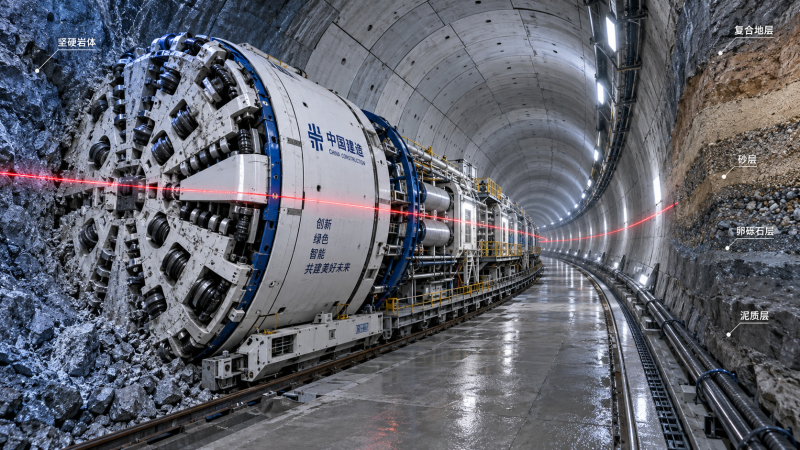
Maintaining precise alignment through curves, changing geology, and confined underground conditions is one of the toughest challenges in modern tunnelling. A tunnel boring machine may be designed to excavate a smooth circular profile, but its path is rarely simple: horizontal bends, vertical transitions, mixed faces, boulders, pressure changes, and uneven cutterhead loading can all push the machine away from the design line.
For project managers, the issue is not merely whether the TBM can be steered back. The real question is how early a deviation can be detected, how confidently the crew can interpret it, and whether corrective action will protect the final tunnel geometry without creating additional ground disturbance, lining stress, or schedule loss. Tunnel boring machine guidance technology provides the positioning intelligence that turns those decisions from reactive judgment into a controlled process.
Alignment is a moving target underground
A TBM advances in an environment where direct visibility is limited and external reference points do not exist. On the surface, a survey team can occupy known points, observe a machine from multiple directions, and visually check a route. Inside a tunnel, the machine is enclosed by the excavation it has created. Its steering decisions must be made relative to a virtual design axis that may extend for kilometres through rock, soil, groundwater zones, and urban utility corridors.
The target is usually defined by a three-dimensional alignment: horizontal position, vertical level, heading, pitch, roll, and chainage. A machine can appear to be travelling acceptably in plan view while slowly drifting in elevation. It can also remain close to the centerline at one location but carry a heading error that will become significant several metres ahead. This is why effective guidance is not a single coordinate reading. It is continuous interpretation of where the TBM is, where it is pointing, and where it will likely be after the next stroke.
That distinction becomes critical on tight-radius curves. A small heading error at the beginning of a curve can compound rapidly. On a long straight drive, a controlled correction may be gradual and forgiving. In a curve, the available room for correction is often narrower, especially where the finished tunnel has strict clearance requirements for rail systems, utilities, or segmental lining tolerances.
What a modern guidance system actually measures
Most TBM guidance arrangements combine several layers of information rather than relying on one instrument alone. The configuration varies between hard-rock, slurry, and Earth pressure balance machines, but the underlying principle is consistent: establish a dependable tunnel reference, determine the machine’s real-time pose, and compare it with the planned alignment.
- Survey control networks establish the baseline coordinate framework from portal to breakthrough. These networks must be extended underground with disciplined control procedures as the drive progresses.
- Laser guidance systems project a reference beam along the tunnel alignment. A target or detector mounted within the TBM receives the beam and indicates lateral and vertical offset from the intended path.
- Total stations and prism measurements provide periodic or continuous checks of machine position, shield articulation, and installed ring geometry. Robotic stations can reduce manual observation demands in suitable conditions.
- Inertial measurement units (IMUs) monitor changes in orientation, including pitch, roll, yaw, and acceleration. They are particularly useful when line-of-sight laser conditions are interrupted.
- Stroke, articulation, and cylinder sensors translate machine movement into operational insight. They show how thrust cylinders are extending, how the articulation joint is behaving, and whether steering corrections are being applied as intended.
- Ring-build and segment data connect excavation control with the lining process. The TBM may be on line at the cutterhead while the installed segment ring begins to accumulate a separate positional trend.
No individual sensor should be treated as unquestionable. Lasers can be obstructed, prisms can be damaged or poorly installed, and inertial systems can accumulate drift over time. Good tunnel boring machine guidance technology is therefore a system of cross-checks. It highlights disagreement between reference sources instead of hiding it behind a single, convenient display.
Curves require predictive steering, not late correction
When a TBM enters a curve, the operator must manage more than the current offset. The cutterhead needs to follow a path that allows the shield and trailing gear to negotiate the curve without excessive contact, while the segmental lining must be built within the permitted envelope. Guidance software commonly presents design line, actual machine position, direction vector, and projected path together because these values answer different questions.
Consider a machine that is slightly inside a horizontal curve but pointing too far toward the outside. A simple “move toward centerline” correction may not be the right action. Depending on the shield geometry and the next ring build, the machine may need a measured heading adjustment first, followed by a controlled positional recovery over several strokes. An aggressive correction can produce overcut on one side, uneven contact pressure on the shield, or a ring that is difficult to build within tolerance.
The same principle applies to vertical curves. A TBM climbing into a rising grade may experience a tendency to sag or pitch differently as ground conditions change. If the crew responds only to the current level reading, the correction can lag behind the real trajectory. Guidance data should therefore be reviewed as a trend: actual position, target position, recent steering inputs, and expected location at the end of the next advance cycle.
The role of advance length and steering authority
Not every machine has the same ability to correct alignment. Shield length, articulation design, cylinder arrangement, cutterhead diameter, segment ring width, and ground resistance all influence steering authority. A project team should understand this envelope before reaching the first demanding curve, rather than discovering it during production.
Shorter advances may offer more frequent opportunities to reassess alignment, but they can affect cycle efficiency. Longer advances can preserve production rhythm, yet leave less room for fine control if conditions shift unexpectedly. The operational choice should be based on the curve radius, tolerances, ground behavior, and the confidence level of the available guidance data—not on a fixed rule applied across the whole drive.
Variable ground changes the meaning of a steering command
A guidance display may show exactly where the machine should go. It cannot, by itself, guarantee that the ground will respond evenly. This is where geology and machine control must be read together.
In homogeneous competent rock, the cutterhead may react predictably to a planned steering input. In mixed ground, one side of the face can be harder, more abrasive, more fractured, or more permeable than the other. The result may be asymmetric cutter wear, uneven penetration, differential face pressure, or a persistent tendency for the TBM to roll or yaw. A machine that repeatedly drifts in the same direction is not always suffering from poor operator control; it may be revealing a ground-machine interaction that requires a different response.
For EPB and slurry TBMs, pressure management is especially tied to alignment. A local pressure imbalance can alter face support conditions and affect how the shield advances. Excessive steering force may be a warning sign that the team is trying to overcome a ground issue mechanically when pressure, conditioning, slurry parameters, or excavation mode also need review.
Hard-rock TBMs face a different but equally demanding set of influences. Fault zones, squeezing ground, blocky rock, and abrupt strength contrasts can increase friction around the shield or cause localized cutterhead deflection. In these conditions, the guidance record becomes valuable not just for navigation but for diagnosis. It helps distinguish a one-time steering event from a recurring geological trend.
From coordinates to decisions: the control loop that matters
The most useful guidance systems do not simply place a red or green marker on a screen. They support a practical control loop between survey, machine operation, ring building, and geological observation.
- Verify the reference. Before acting on an apparent deviation, confirm that the laser, total station, target, and control points are valid. A false reference can lead to a very real steering error.
- Read the full position state. Review offset, level, heading, pitch, roll, and recent trend. A lateral deviation without heading context is incomplete information.
- Compare machine behavior with ground conditions. Check thrust distribution, articulation, torque, penetration, face pressure, and recent geology. The cause of deviation may sit outside the guidance system.
- Set a measured correction plan. Define the desired change over one or several strokes, including limits for articulation and cylinder imbalance. The plan should be clear enough for the operator and shift team to execute consistently.
- Confirm the ring outcome. After ring installation, compare the as-built ring position with the target geometry. A correction that improves cutterhead position but compromises the lining is not a successful correction.
For managers, this loop is also a communication discipline. Guidance information should be visible across shifts, with deviations, corrective actions, and outcomes recorded in a form that surveyors, operators, engineers, and planners can interpret. When knowledge remains only in the mind of an experienced operator, consistency is vulnerable during shift changes and critical production periods.
Accuracy depends on calibration, not only technology
Projects sometimes invest in sophisticated navigation equipment but underestimate the field discipline needed to sustain trustworthy output. The quality of TBM guidance depends on calibration routines, survey control integrity, instrument maintenance, and data governance.
Laser alignment should be checked after events that may disturb the reference, including equipment impacts, tunnel convergence, relocation of stations, or major operational interruptions. Instrument mounting points need protection from vibration, dust, water ingress, and accidental contact. A detector that is slightly misaligned on the machine may generate a persistent bias that appears to be a steering problem.
Underground survey control deserves the same attention. As the tunnel lengthens, small network errors can propagate. Gyroscopic checks, independent control observations, and breakthrough planning become increasingly important on long drives or where multiple headings must meet. The required verification frequency should reflect the project’s geometry, risk profile, and contractual tolerance requirements.
Data timestamps also matter. A guidance coordinate, a machine parameter reading, and a geological log are only truly comparable when teams know when each was recorded. In modern projects, synchronized data streams can reveal whether a deviation began after a pressure change, a cutter intervention, a ring-build adjustment, or entry into a mapped ground transition.
Common alignment mistakes that create avoidable risk
Chasing the centerline stroke by stroke is one of the most common errors. It can create an oscillating path, with corrections repeatedly overshooting the intended alignment. Trend-based steering is usually more stable than reacting to every small fluctuation.
Treating the machine and lining as separate systems is another problem. The TBM’s path, tail clearance, segment ring orientation, and backfill or annular grouting behavior are connected. A tunnel can accumulate lining geometry issues even when daily machine reports appear acceptable.
Assuming a guidance deviation is always operational can waste valuable time. Before increasing steering force or changing advance practice, teams should validate the reference system and inspect for sensor faults. Conversely, dismissing repeated deviations as “instrument noise” can conceal a developing geological or mechanical issue.
Using generic steering limits in every ground type can also be risky. The correct balance between correction speed and ground protection changes with cover depth, face stability, rock mass behavior, and surrounding assets. Urban settlement-sensitive sections deserve a more conservative steering philosophy than open, competent-rock drives with wider tolerance envelopes.
What project managers should ask before and during the drive
Technical procurement discussions should go beyond asking whether a TBM has laser guidance or an IMU. The more useful questions concern system resilience and operational integration: How is position verified when line of sight is lost? Which measurements are independent? Can the system display predicted trajectory as well as current offset? How are steering records connected to segment ring data and survey checks? Who has authority to define a correction plan when guidance, geology, and production targets conflict?
During execution, alignment should be reviewed as a leading indicator, not a monthly quality statistic. A short daily review of trend plots, ring geometry, steering effort, and ground observations can identify drift before it becomes a recovery operation. Where the route includes sharp curves, complex interchanges, sensitive structures, or variable ground, managers should ensure that survey and TBM teams have enough time in the cycle to validate data rather than being forced to make decisions under production pressure.
Guidance technology is part of tunnel risk management
The value of tunnel boring machine guidance technology lies in its ability to make the invisible visible. It converts the TBM’s underground movement into a shared, measurable picture of position, direction, and developing risk. Through curves, it supports controlled trajectory management. In variable ground, it provides evidence that helps teams separate navigation error from changing ground response. At critical interfaces, it creates a common language for operators, surveyors, engineers, and project leadership.
For infrastructure teams responsible for cost, quality, and delivery certainty, alignment control should not be treated as a small surveying function at the edge of the operation. It is central to excavation stability, lining accuracy, equipment wear, and schedule resilience. The strongest projects combine reliable sensors and references with disciplined calibration, geological awareness, and a crew that understands when a small deviation is simply a reading—and when it is the first signal of a larger problem.
Related News
 Sep 17, 2026How TBM Guidance Technology Maintains Alignment Through Curves and Variable GroundTunnel boring machine guidance technology helps teams maintain precise alignment through curves and variable ground, reducing risk, improving lining accuracy, and protecting schedules.
 Sep 16, 2026Infrastructure Equipment Market Reference: Demand, Pricing, and Supplier BenchmarksInfrastructure equipment market reference for buyers: assess demand signals, total cost, pricing risks, and supplier benchmarks for tunnels, mining, cranes, and road projects.
 Sep 15, 2026How to Evaluate Infrastructure Equipment Suppliers for Complex Project RequirementsInfrastructure equipment solutions supplier evaluation guide for complex projects: assess technical fit, lifecycle cost, reliability, local support, and contract risk.
 Sep 14, 2026What Drives Surface Mining Equipment Cost Across a Mine’s Operating Life?Surface mining equipment cost depends on fleet matching, fuel, wear, maintenance, availability, and rebuild timing. Explore lifecycle strategies that protect output and margins.



Ms. Elena Rodriguez
Weekly Insights
Stay ahead with our curated technology reports delivered every Monday.