
Nuclear Lifting Equipment Cost: Budgeting for Compliance, Testing, and Lifecycle Risk
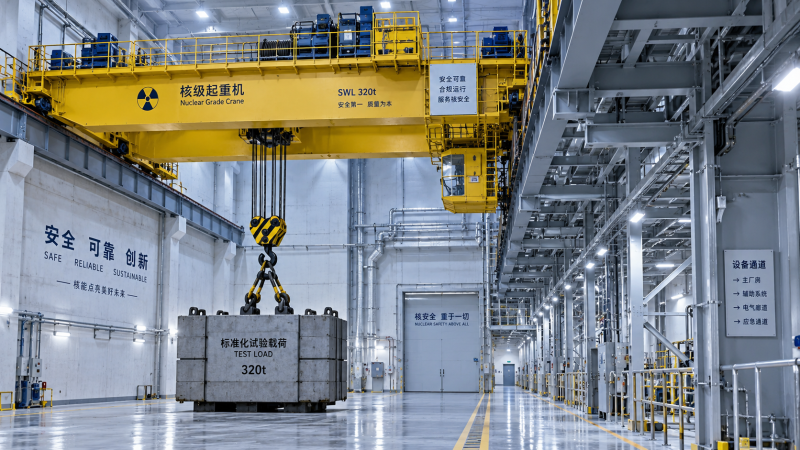
Nuclear lifting equipment cost should be approved as a controlled lifecycle commitment, not treated as the price of a crane, hoist, or lifting beam. In a nuclear environment, the visible equipment price may be only one part of the financial exposure. Engineering verification, quality records, proof-load testing, installation constraints, inspection access, specialist maintenance, spare parts, and the consequence of unavailable lifting capacity can all materially affect the business case.
The practical question is not, “Which supplier has the lowest quotation?” It is, “Which option can perform the required lifts, retain its compliance evidence, and remain supportable throughout its intended service life without creating avoidable outage or project risk?” A defensible capital request answers that question before comparing unit prices.
Separate the purchase price from the committed cost
Nuclear lifting equipment can include overhead travelling cranes, gantry cranes, jib cranes, monorails, hoists, lifting beams, spreader beams, rigging assemblies, handling fixtures, and remotely operated lifting systems. Their costs vary widely because the equipment is usually configured around a particular facility, load path, environmental condition, and assurance requirement.
For budgeting purposes, divide the investment into four categories. This makes it easier for finance, engineering, operations, and quality teams to see what is being approved and what has merely been left outside the quotation.
A lower bid can be valid when the lifting duty is modest, the design is conventional, and the purchaser has a capable internal maintenance and quality system. It becomes misleading when it excludes evidence, testing, or support that the owner will still need to procure later. The most common budget failure is not selecting an expensive unit; it is approving an incomplete scope and discovering the missing work when the schedule is already constrained.
Why nuclear applications change the cost logic
Industrial lifting equipment is generally priced around capacity, span, duty cycle, controls, and installation conditions. Nuclear service adds another layer: the lifting system may handle equipment whose drop, collision, misplacement, or delayed movement has consequences beyond ordinary production loss. The needed assurance is therefore tied to the lift’s safety significance, operational role, and recovery options.
This does not mean every item in a nuclear facility requires the same design or documentation burden. Treating all lifts as if they were equally critical can over-specify routine handling work and consume budget without reducing meaningful risk. The opposite mistake is more serious: applying a commercial-duty solution to a lift where failure, loss of control, or prolonged unavailability would create an unacceptable operational exposure.
Financial approval should therefore begin with a lift classification discussion, not a vendor shortlist. Define what is being lifted, where it travels, what sits beneath or beside it, whether personnel may be nearby, the frequency of use, and whether an alternative lifting route exists. This establishes the level of redundancy, control integrity, inspection depth, and documentation that the equipment must carry.
Cost drivers that deserve early scrutiny
Capacity is only the starting point
Rated load is easy to compare but does not fully describe the requirement. Load geometry, center of gravity, attachment points, clearance, travel path, and the need for precise positioning may require purpose-built lifting devices or more capable control systems. A heavy component with awkward geometry can create more engineering effort than a higher-capacity but straightforward lift.
Ask whether the quote includes the below-the-hook equipment required for the real job. A crane may have adequate rated capacity while the lifting beam, spreader, grapples, or fixture needed to handle the component safely remains outside scope. Those accessories require their own design basis, identification, inspection regime, and storage arrangements.
Proof-load testing and acceptance evidence
Testing is not a ceremonial final step. It is a defined package of planning, test loads or methods, calibrated instruments where relevant, inspection, records, corrective actions, and approval. Physical access can be a major cost driver: moving test weights through a constrained building or arranging an alternative test method may require temporary works, additional rigging, or schedule coordination.
Budget holders should distinguish between a supplier stating that equipment is “tested” and a complete acceptance package that matches the facility’s requirements. The latter should make clear what will be tested, when, under whose procedure, what records will be delivered, and what happens if the first test does not pass. Ambiguity here often produces disputed variation costs.
Documentation has operating value
Traceable records can appear administrative until a repair, modification, inspection finding, or component replacement occurs. Then the ability to establish material identity, original design assumptions, maintenance history, and approved changes becomes operationally valuable. Missing records may force extra engineering assessment, restricted use, replacement of otherwise serviceable parts, or extended equipment downtime.
Approvers should request a document deliverables register rather than accepting generic wording such as “standard documentation.” It should identify drawings, manuals, inspection records, test certificates, parts lists, control-system information, maintenance instructions, and configuration records. The goal is not to buy paperwork for its own sake. It is to ensure that future ownership is possible without reconstructing the asset’s history.
Controls, redundancy, and recovery provisions
More complex controls can improve positioning, monitoring, fault indication, or remote operation, but they also introduce commissioning effort, software support needs, and potential obsolescence exposure. The right question is whether each function reduces a credible lifting or availability risk in the intended application.
Similarly, redundancy has value when a single failure would prevent a time-critical movement or leave a load in a difficult condition. It is less compelling when an alternate route, spare hoist, or manageable recovery plan already exists. Specify the recovery objective before paying for duplicate systems. “Redundant” is not a complete requirement unless the failure modes and required response are understood.
Budget the installation as a project, not freight and labor
Large lifting systems are frequently installed in locations where access is restricted and interfaces are already fixed. Existing building steel, runway condition, electrical supply, seismic or structural considerations, ventilation, access platforms, radiological controls, and coordination with other work can dominate the installation cost. A unit that is economical to manufacture may be expensive to introduce into an operating facility.
For replacement projects, the removal of the existing equipment deserves the same attention as the new installation. The plan may require temporary lifting arrangements, staged dismantling, protection of adjacent equipment, and a carefully managed period without the original handling capability. These are business-continuity costs even when they appear in different contracts.
A useful approval package identifies assumptions that can alter the installed budget: structural modifications, rail repairs, access equipment, cable routing, commissioning windows, temporary power, lifting plans, and site acceptance testing. Funding a contingency is more credible when it is tied to these identifiable uncertainties rather than added as an unexplained percentage.
Compare ownership models against the actual duty
Buying a dedicated asset is usually appropriate when the facility needs frequent access, the lift supports critical maintenance or fuel-handling activity, or the equipment must remain available across a long operating horizon. Ownership gives the site direct control over configuration, inspection planning, and readiness, but it also creates responsibility for maintenance competence and lifecycle support.
Rental or specialist contract lifting can make sense for isolated construction lifts, large component replacements, or infrequent work that does not justify a permanent installation. The apparent saving should be tested against mobilization, site preparation, availability during the required window, and the consequences of schedule disruption. A rented crane is not necessarily a lower-risk option simply because capital expenditure is lower.
Refurbishment can be financially sound when the existing structure is suitable and the work resolves known reliability, control, or support issues. It is a weak option when asset records are incomplete, the remaining structure cannot support the required duty, or proprietary parts are no longer reliably obtainable. A refurbishment proposal should state what remains in service, what is replaced, and how the resulting configuration will be documented and maintained.
Use lifecycle risk to challenge the lowest bid
Financial reviewers do not need to become lifting engineers, but they should challenge assumptions that shift cost or risk outside the proposal. A quotation that is materially lower than competing bids may be based on a different interpretation of scope, a shorter support commitment, fewer included tests, less complete documentation, or exclusions for site interfaces. Price comparison only works after those differences are normalized.
Ask suppliers to separate firm included scope, owner-provided items, exclusions, optional items, and assumptions. Then compare each bid against a common requirements matrix. This protects both the budget and procurement team from approving a figure that cannot deliver the required operating state.
- What lifts must the equipment perform, and what makes any of them critical?
- Which documents and test records are needed at handover and throughout service?
- What site work, temporary works, and access constraints are included?
- Who provides inspections, repairs, spare parts, and control-system support after warranty?
- What failure would stop an outage, a maintenance campaign, or a regulated handling activity?
- Which costs are fixed, and which depend on site discoveries or schedule access?
Build the approval around a decision gate
Before committing funds, require a short basis-of-decision document that links the chosen solution to the lifting duty, facility interfaces, evidence requirements, and lifecycle plan. It should include a normalized comparison of options, the cost of completing each option to an operational state, principal uncertainties, and the consequence of delay or unavailability.
This changes the internal conversation. Instead of defending a premium for “nuclear-grade” equipment as a vague label, the project team can show which specific costs purchase traceability, testability, recoverability, supportability, or reduced outage exposure. It also exposes cases where the requirement is heavier than the risk justifies.
For large crane and heavy-lift procurement, market intelligence is useful when it connects equipment specifications with project method and delivery constraints. TF-Strategy’s coverage of crawler cranes and major infrastructure machinery reflects this wider procurement reality: the equipment decision, lift plan, site conditions, and lifecycle economics must be assessed together.
The strongest budget is neither the cheapest initial quote nor the most heavily specified package. It is the option whose complete cost is visible, whose assurance level matches the lift’s consequences, and whose maintenance and documentation can be sustained for as long as the facility depends on it.
Related News
 Oct 04, 2026Nuclear Lifting Equipment Cost: Budgeting for Compliance, Testing, and Lifecycle RiskNuclear lifting equipment cost explained: budget for compliance, proof-load testing, installation, documentation, and lifecycle risk to make confident procurement decisions.
 Oct 03, 2026How to Assess TBM Manufacturers for Hard-Rock Tunneling Projects?Choose the right tunnel boring machine manufacturer for hard-rock projects. Explore key criteria for design, lifecycle cost, factory quality, and service support.
 Oct 02, 2026How to Evaluate Heavy Equipment Technology Suppliers for Fleet Uptime and SupportHeavy equipment technology suppliers can make or break fleet uptime. Learn how to assess diagnostics, data access, parts, service coverage, and support terms before you buy.
 Oct 01, 2026How to Use Technical References to Benchmark Industrial Equipment PricesIndustrial equipment technical reference pricing: learn how to normalize specifications, scope, service life, and operating costs to benchmark quotes accurately and choose the best-value equipment.
Ms. Elena Rodriguez
Weekly Insights
Stay ahead with our curated technology reports delivered every Monday.