
How to Assess TBM Manufacturers for Hard-Rock Tunneling Projects?
How to Assess TBM Manufacturers for Hard-Rock Tunneling Projects?
Selecting a tunnel boring machine manufacturer for a hard-rock project is not a matter of comparing machine diameter, installed power, and quoted price on a spreadsheet. Those figures matter, but they do not tell a procurement team whether the machine will cope with abrasive granite, mixed-strength formations, long logistics chains, restricted launch conditions, or an unexpected cutterhead intervention hundreds of metres underground.
In hard-rock tunneling, the most expensive problems rarely begin with an obviously unsuitable TBM. More often, they emerge from gaps between geological assumptions and cutterhead design, between promised availability and actual field support, or between a low equipment price and the real cost of keeping the machine advancing. A sound sourcing process therefore tests the manufacturer’s engineering depth, delivery discipline, support model, and willingness to make technical assumptions visible.
For procurement teams, the practical question is not simply, “Who can build a TBM?” It is, “Which supplier can take responsibility for a machine-package and support plan that fits this particular tunnel’s risks?”
Start with the Ground Model, Not the Supplier Long List
A manufacturer assessment should begin before the request for quotation is issued. Hard rock is not one condition. Competent rock can be highly abrasive; fractured rock can create instability and overbreak; fault zones may introduce water, fines, squeezing ground, or sudden changes in support requirements. Even along a route described broadly as “hard rock,” the machine may need to work through several geologically distinct environments.
The procurement package should give bidders more than a geological summary. It should include available borehole logs, rock strength testing where available, abrasivity information, expected groundwater conditions, tunnel alignment, overburden, cross passages, permissible settlement, and the planned excavation and lining method. If the owner or contractor has unresolved geological uncertainties, state them. Hiding uncertainty does not remove it; it merely encourages suppliers to price assumptions differently, making bids difficult to compare.
This early work also clarifies whether a conventional open-type hard-rock TBM, a single-shield machine, a double-shield TBM, or a more specialized configuration deserves consideration. A manufacturer that simply confirms the preferred machine type without challenging the ground model may be convenient in tender meetings, but that is not necessarily a positive sign. Good suppliers ask uncomfortable but relevant questions about expected penetration, support installation, cutter-change access, and the consequences of unstable zones.
Look Beyond the Cutterhead Diameter
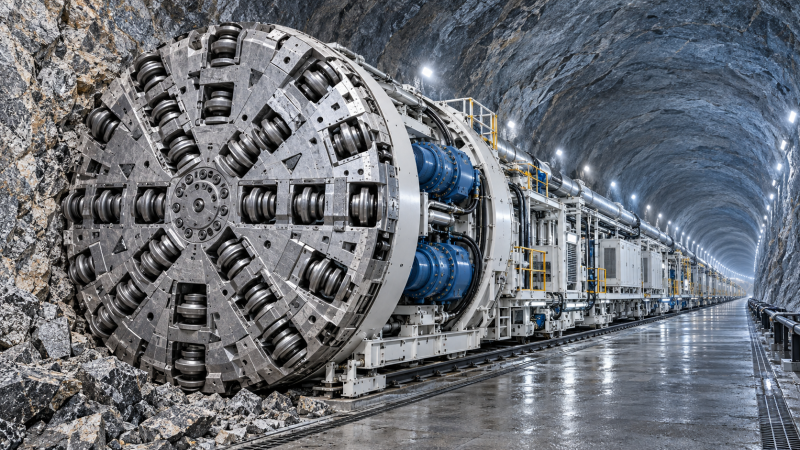
The cutterhead is often treated as the headline item in a TBM proposal. It should be examined closely, but in context. A procurement review needs to understand how the cutterhead layout, disc cutter size and spacing, opening ratio, muck flow path, and wear protection relate to the anticipated geology. The right design is not always the one with the most dramatic-looking cutterhead or the highest published installed power.
Ask the manufacturer to explain the design logic in project-specific terms. How was the cutter layout selected? What assumptions were made about rock abrasivity and rock mass condition? Can cutters be inspected and changed from within the cutterhead where the configuration requires it? How will boulders, blocky ground, or fines affect muck removal? Where are the likely wear points, and how are they protected or made replaceable?
The same discipline applies to the main bearing, thrust system, gripper arrangement, shield structure, backup system, conveyors, ventilation interfaces, and segment or support-handling equipment. A TBM is a system, not a rotating head attached to a drive. The backup train deserves particular scrutiny because congested logistics, insufficient storage, poor hose routing, or awkward maintenance access can reduce production even when the cutterhead is performing well.
Procurement teams should request a clear interface matrix. It should identify what the manufacturer supplies, what the contractor supplies, and who is responsible for integration with power distribution, ventilation, dewatering, rail or conveyor logistics, communication systems, and emergency arrangements. Interface ambiguity is a familiar source of late redesign and change-order disputes.
Evaluate Relevant Experience, Not Just an Impressive Reference List
Most established TBM suppliers can present an extensive project history. The useful question is whether that history is genuinely comparable. A large-diameter metro machine operating in variable urban ground may demonstrate valuable engineering capability, yet it does not automatically prove that the supplier is the best fit for a long mountain tunnel in abrasive, high-strength rock.
Ask for references that are close to the proposed project in the ways that matter: machine type, diameter range, tunnel length, rock conditions, water pressure where relevant, site remoteness, and support method. Do not demand identical geology; that is rarely realistic. Instead, look for evidence that the manufacturer has dealt with comparable operational consequences, such as high cutter consumption, long advance distances between access points, difficult probe drilling, or constrained muck handling.
Reference discussions should go beyond whether the TBM was delivered. Useful questions include whether factory acceptance testing identified significant issues, how quickly field modifications were engineered, how the supplier handled non-conforming components, and whether critical spares arrived when needed. If permitted, speak with project personnel who operated and maintained the machine rather than relying only on senior commercial references.
A tunnel boring machine manufacturer should also be willing to distinguish between performance attributable to the machine and performance affected by ground, logistics, power interruptions, workforce readiness, or contractual constraints. Overconfident production promises are not reassuring. Mature suppliers normally explain the conditions behind their estimates.
Treat Factory Capacity and Quality Control as Procurement Risks
A technically strong proposal can still fail the project if manufacturing capacity is overloaded or quality control is poorly managed. Delivery schedules should be tested against the supplier’s current order book, fabrication plan, long-lead components, and subcontracting strategy. Major assemblies, bearings, gearboxes, drives, hydraulic components, and electrical systems may involve separate supply chains with different lead-time risks.
During due diligence, procurement teams should ask where critical components are manufactured, which components are sourced externally, and how incoming quality is controlled. The answer does not need to imply that all parts must be made in-house. In heavy equipment, specialized external suppliers are normal. What matters is whether the TBM manufacturer retains technical control, traceability, inspection authority, and a credible recovery plan if a key component is delayed or rejected.
Factory acceptance testing should be defined in the contract rather than left as a broad promise. Confirm what can be tested before shipment, who may witness the testing, which documents must be delivered, how defects are recorded, and what happens when an item cannot be fully tested until site assembly. For an international project, packaging, transport splits, customs documentation, and site assembly sequencing can be as consequential as fabrication itself.
Price the Machine as a Lifecycle System
The initial purchase price is visible and easy to compare. It is also incomplete. The commercial evaluation should consider total cost of ownership across manufacturing, transport, assembly, commissioning, operation, maintenance, critical spares, cutter consumption, demobilization, and potential refurbishment or resale. Not every item can be estimated precisely before excavation starts, but uncertainty can be made explicit.
A low-priced proposal can become expensive if it leaves the contractor holding large commissioning gaps, limited spares, or costly overseas call-outs. Conversely, the highest-priced machine is not automatically the lowest-risk option. The goal is a transparent comparison of scope, risk allocation, and operating assumptions.
Cutter consumption deserves careful treatment. No responsible supplier can guarantee a precise consumption rate in uncertain ground without qualifications. Procurement should be wary of bids that present very favorable wear assumptions without linking them to geological data, cutter specifications, and operating practices. It is more useful to compare the supplier’s methodology, available wear-monitoring approach, recommended stock levels, and ability to replenish cutters during the drive.
Service Coverage Is Part of the Machine Specification
For a hard-rock tunnel, especially a remote or cross-border project, after-sales support is not a generic service promise. It is a production variable. A supplier may have capable engineers at headquarters but still struggle to provide rapid intervention if visas, customs clearance, language barriers, or regional inventory constraints delay deployment.
Request a named support structure: commissioning personnel, remote technical contacts, escalation management, regional service partners where applicable, and the expected approach to major breakdowns. Clarify whether the manufacturer will train operators, mechanics, electricians, and maintenance planners. Training should be practical and machine-specific, covering fault diagnosis, safe cutter replacement, lubrication routines, hydraulic and electrical troubleshooting, and the recordkeeping needed to spot developing failures.
Digital monitoring can be useful, particularly for drive parameters, cutterhead condition indicators, hydraulic performance, and maintenance planning. But remote data access is not a substitute for a competent field-response plan. Confirm data ownership, cybersecurity requirements, site connectivity limitations, and who is expected to interpret alarms. Raw machine data without an agreed decision process often creates more emails than useful action.
Use the Tender Process to Test How the Supplier Thinks
The quality of a manufacturer’s tender response is itself evidence. A good proposal identifies open issues, states assumptions, flags interface risks, and explains alternatives without turning every uncertainty into an exclusion. It should be detailed enough for engineers to validate and structured enough for commercial teams to compare.
A useful evaluation workshop brings procurement, tunnel engineering, construction operations, maintenance, logistics, commercial, and safety personnel into the same room. Ask each shortlisted supplier to walk through a difficult scenario: a faulted section ahead of the face, unexpectedly rapid cutter wear, delayed delivery of a critical drive component, or a backup-system bottleneck. The point is not to catch the bidder out. It is to see whether the team understands the operational chain and can define ownership under pressure.
Contract terms should reflect this practical reality. Acceptance criteria, warranty scope, liquidated damages where appropriate, change-control procedures, spare-parts commitments, documentation, training, and site-support obligations need to align with the project schedule. Avoid clauses that sound firm but cannot be administered in a tunnel. A requirement for “prompt support,” for example, is weaker than an agreed contact route, response framework, and mobilization responsibility.
Make the Final Decision on Evidence, Not Familiarity
Procurement teams often face pressure to select the best-known brand, the lowest compliant bidder, or the supplier used on a previous project. Familiarity can reduce risk, but only when the prior experience is relevant and the present delivery conditions remain credible. Hard-rock tunneling punishes assumptions carried over from another alignment, another contractor, or another decade of equipment design.
A disciplined decision combines technical fit, project-specific references, factory capacity, commercial completeness, and service readiness. It also records the assumptions that support the selection. That record matters later if geology changes, because it separates an unavoidable ground risk from a preventable procurement omission.
For intelligence-led procurement, platforms such as TF-Strategy can help teams connect machine parameters with construction methods, supplier developments, material trends in cutter technology, and broader equipment supply conditions. The value is not in collecting more headlines. It is in turning fragmented technical and commercial information into questions that a tunnel boring machine manufacturer must answer before the contract is signed.
The strongest supplier is usually not the one with the most polished presentation. It is the one whose machine concept, evidence, support commitments, and commercial assumptions still make sense after the project team has tested them against the ground and the realities of underground work.
Related News
 Oct 03, 2026How to Assess TBM Manufacturers for Hard-Rock Tunneling Projects?Choose the right tunnel boring machine manufacturer for hard-rock projects. Explore key criteria for design, lifecycle cost, factory quality, and service support.
 Oct 02, 2026How to Evaluate Heavy Equipment Technology Suppliers for Fleet Uptime and SupportHeavy equipment technology suppliers can make or break fleet uptime. Learn how to assess diagnostics, data access, parts, service coverage, and support terms before you buy.
 Oct 01, 2026How to Use Technical References to Benchmark Industrial Equipment PricesIndustrial equipment technical reference pricing: learn how to normalize specifications, scope, service life, and operating costs to benchmark quotes accurately and choose the best-value equipment.
 Sep 30, 2026What Does an Ultra-Large Excavator Really Cost Over Its Service Life?Ultra-large excavators cost far more than purchase price. Explore lifecycle expenses, uptime risks, energy use, maintenance, and cost-per-tonne insights.
Ms. Elena Rodriguez
Weekly Insights
Stay ahead with our curated technology reports delivered every Monday.