
What Drives Heavy Haulage Cost on Oversized Construction Equipment Moves?
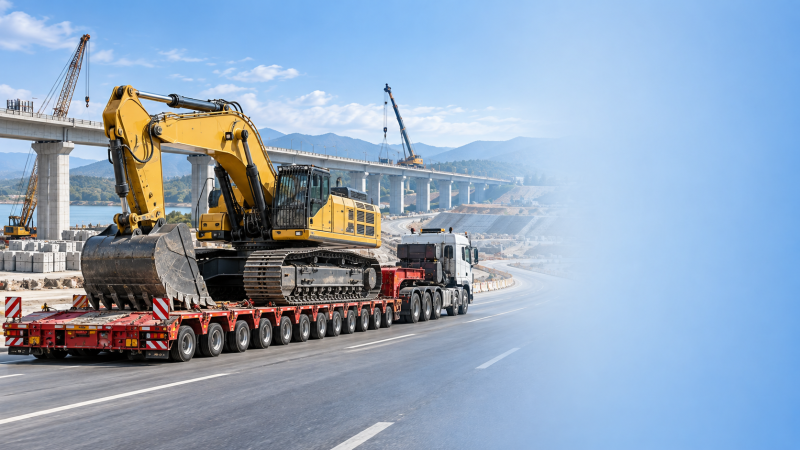
A heavy haulage cost is rarely determined by mileage alone. Moving an oversized excavator, crawler crane section, TBM component, mining truck, or road-paving machine is a controlled engineering operation that happens to use transport equipment. The final price reflects the physical load, the route’s constraints, the permits required, the equipment needed to load and unload it, and the consequences of a delay.
The most expensive surprises usually appear when transport planning begins after the machine has already been purchased, assembled, or committed to a delivery date. A low initial freight quote can become far more costly once bridge restrictions, clearance conflicts, escort requirements, limited site access, or additional lifting work are discovered. The practical aim is not simply to secure the lowest rate. It is to obtain a haulage plan that is technically feasible, priced against the real scope, and aligned with the construction sequence.
Load characteristics set the transport method
The first pricing question is not “How far does it need to travel?” It is “What exactly is being moved?” Weight matters, but it is only one part of the answer. Overall length, width, height, centre of gravity, axle distribution, lifting points, and whether the item can be dismantled all affect the trailer configuration and handling plan.
A machine that is heavy but compact may travel on a conventional multi-axle low-loader. A lighter but unusually wide counterweight frame or a long crane boom section can require more road space, route controls, and escorts. A tall TBM drive component may create clearance problems under bridges, power lines, gantries, or tunnel approaches even when its gross weight is manageable. In these cases, dimensions can drive cost more aggressively than tonnes.
Hauliers also price the uncertainty attached to a load. Clearly documented weights, certified lifting points, accurate drawings, and known transport dimensions make it easier to select equipment and plan safe restraint. Incomplete information creates contingency because the carrier must allow for changed trailers, extra engineering review, or on-site adaptation.
Disassembly can reduce one cost while adding others
Breaking a machine into transportable modules often lowers permit complexity and expands the number of usable routes. It can also reduce the need for specialist trailers. That does not automatically make it the cheaper option.
Disassembly introduces labour, lifting equipment, packing, preservation, reassembly, testing, and a longer interface between logistics and site works. Hydraulic lines, electrical systems, precision components, and tracked undercarriages may require particular protection and inspection. A transport plan should compare the total delivered cost of each option, including the impact on the installation programme, rather than comparing only the road freight charge.
Route engineering is where budgets often change
For oversized equipment moves, the nominal route shown by a mapping tool is only a starting point. The workable route must accommodate the loaded vehicle’s turning radius, gross mass, axle loads, width, height, and braking requirements. It must also account for bridge capacities, road geometry, overhead clearances, temporary works, local restrictions, and locations where the convoy can wait safely.
A route survey is therefore more than a formality. It identifies the physical and administrative constraints that determine whether a proposed move can proceed as quoted. The survey may reveal that a tight junction needs temporary street furniture removal, a bridge needs a different axle arrangement, or a narrow site entrance requires a separate unloading point. Each finding can add cost, but discovering it early gives the project team choices. Discovering it after permits are submitted or equipment is already en route usually leaves only expensive choices.
Distance still matters because it affects fuel, driver time, trailer utilisation, and exposure to delay. However, a shorter route with difficult bridges, urban constraints, or repeated utility conflicts can cost more than a longer route that allows a stable convoy configuration. Freight comparisons should therefore state the proposed route and assumptions, not only a point-to-point distance.
Permits, escorts, and traffic controls are separate work packages
Oversize and overweight moves frequently need permits from several authorities or road operators. The approvals process may include route-specific conditions, movement windows, escort arrangements, notice periods, and requirements for utility or traffic coordination. These tasks consume time as well as money, and they should not be treated as minor administration.
Escort requirements are particularly easy to underestimate. Depending on the load and jurisdiction, the move may need one or more escort vehicles, police support, road closures, rolling traffic control, or personnel at specific conflict points. The number of escorts is only part of the cost. Their availability can determine when the move can take place, which may create idle time for transport crews, cranes, or the receiving site.
Ask each bidder to distinguish permit fees, permit management, escort vehicles, traffic-management labour, utility attendance, and temporary removal or reinstatement works. A lump-sum proposal is not inherently poor, but its exclusions must be explicit. A quote that appears lower because it assumes no utility intervention or no temporary traffic controls cannot be compared fairly with one that includes them.
Loading and receiving-site conditions can outweigh road freight
Heavy equipment moves begin and end at sites, not at a carrier’s depot. The loading area may need ground preparation, crane mats, lifting studies, exclusion zones, and room for a multi-axle trailer to manoeuvre. The destination may be even more demanding if it is an active mine, tunnel portal, wind-farm staging area, refinery, or constrained urban construction site.
A transport contractor cannot compensate for an unsuitable unloading zone with better driving. Soft ground, limited turning space, overhead obstructions, unfinished access roads, or an unavailable crane can stop the operation after the convoy arrives. Standby charges then become a schedule problem as much as a logistics problem.
The receiving site should be reviewed as early as the public-road route. Confirm access-road geometry, bearing capacity, final placement location, crane position, required lifting radius, weather limitations, and whether the equipment can be unloaded directly where it will be assembled. Moving a load twice on site, or storing it temporarily because installation works are not ready, can add handling risk and cost without improving the outcome.
The lifting plan deserves its own review
Loading and unloading large components may require mobile cranes, gantries, jacking systems, skidding equipment, or a combination of methods. Pricing depends on the load weight, lifting radius, ground conditions, rigging arrangement, available headroom, and the need to coordinate multiple lifting operations. The least expensive crane on paper may not be suitable if it needs extensive ground improvement or cannot maintain the required radius.
For crawler cranes, TBM modules, and other high-value components, the handling method should also protect the machine. A rushed lift can lead to damaged attachment points, distorted structures, contaminated systems, or lengthy inspection work. The lowest handling price is only useful when the method is compatible with the equipment manufacturer’s transport and lifting requirements.
Schedule pressure has a direct price
Heavy haulage capacity is specialised. Suitable trailers, experienced crews, escort resources, cranes, and permit windows must align at the same time. When a move is planned around a fixed installation date with little float, contractors may need to reserve equipment early, maintain standby coverage, or use premium operating windows. The resulting price reflects the loss of flexibility.
Schedule pressure also increases the likelihood of poor decisions: selecting a route before a survey is complete, dispatching components before the site is ready, or accepting a quote with broad assumptions to protect an internal deadline. These decisions often shift risk into variation charges later.
For critical-path equipment, it is useful to separate the transport date from the required-on-site date. That distinction allows time for permits, route modifications, weather disruption, inspections, and controlled handover. It may also make consolidation possible when several components can travel under a coordinated plan rather than as isolated urgent moves.
How to compare haulage quotations properly
Comparing a single all-in figure is unreliable unless every bidder has priced the same technical basis. A workable request for quotation should include equipment drawings, verified weights, transport dimensions in the proposed configuration, centre-of-gravity information where relevant, loading and unloading locations, desired delivery window, site-access details, and whether dismantling or reassembly is within scope.
The commercial review should then test the assumptions behind each offer. Focus on these questions:
- Which trailer type, axle configuration, and number of transport units are included?
- Has the route been surveyed, preliminarily assessed, or simply assumed?
- Which permits, escorts, traffic measures, and utility activities are included?
- Who supplies cranes, rigging, lifting supervision, ground preparation, and packing?
- What waiting time, site delay, weather delay, or permit delay provisions apply?
- Does the price include dismantling, reassembly, preservation, inspections, and final positioning?
- What information or site conditions must be provided before mobilization?
A detailed quote is not necessarily more expensive; it is often more useful because it makes risk allocation visible. Conversely, a low price with vague language around permits, route acceptance, site readiness, or lifting support may be an estimate rather than a dependable delivery commitment.
Common cost-saving decisions that create larger exposure
Choosing the smallest trailer that appears to carry the load can be a false economy. If axle loads are too concentrated, route options shrink and bridge restrictions become harder to manage. A more capable modular or steerable trailer may have a higher hire rate but reduce route intervention, improve manoeuvrability, and avoid a later replan.
Another mistake is treating transport, civil works, and installation as separate procurement packages with no shared planning. Each supplier may price its narrow responsibility efficiently while the overall operation becomes fragmented. A trailer arrives before the crane; a crane is booked before the access road is complete; a load reaches site before the laydown area is available. The combined cost of these gaps is rarely visible in the original freight price.
It is also risky to assume that a past move establishes the price of the next one. Two nominally similar excavators can differ in transport width, dismantling requirements, route destination, site condition, and timing. The same crane component may travel efficiently to an open industrial yard but require a much more complex operation at a congested urban project.
Build the logistics decision before the purchase order is fixed
Transport feasibility should influence equipment procurement, especially for machinery delivered across borders, to remote locations, or into constrained sites. The selected machine configuration, shipping split, delivery sequence, and supplier packaging approach all affect total logistics cost. A lower equipment purchase price can lose its advantage if the chosen configuration requires exceptional road moves, repeated handling, or long site standby.
This is where intelligence on machine physical parameters and construction methodology becomes commercially useful. TF-Strategy’s coverage of TBMs, ultra-large excavators, crawler cranes, road machinery, and mining transport equipment reflects a practical point: logistics planning works best when equipment data, site method, and infrastructure constraints are assessed together. Procurement decisions are stronger when transport is considered as part of total cost of ownership and delivery risk, rather than a late-stage freight line item.
Before awarding a heavy haulage contract, establish a single transport basis covering load data, route, permits, handling method, site readiness, schedule, and responsibility boundaries. That document gives bidders a common scope and gives the project team a defensible basis for evaluating price. The heavy haulage cost then becomes easier to control because the work has been defined before the convoy reaches the road.
Related News
 Sep 26, 2026How to Select Wind Rotor Lifting Equipment for Safe Blade and Hub InstallationWind rotor lifting equipment selection guide: ensure safe blade and hub installation with the right lift method, load control, crane compatibility, wind limits, and compliance.
 Sep 25, 2026What Drives Heavy Haulage Cost on Oversized Construction Equipment Moves?Heavy haulage cost explained: discover how load dimensions, route surveys, permits, escorts, lifting plans, and scheduling shape reliable oversized equipment transport budgets.
 Sep 24, 2026Supplier Management Frameworks That Reduce Delays on Large Construction ProjectsLarge-scale construction projects supplier management frameworks help prevent costly delays with risk-based controls, milestone tracking, quality oversight, and escalation plans for critical packages.
 Sep 23, 2026How to Evaluate a Paving Equipment Manufacturer for Highway ProjectsPaving equipment manufacturer evaluation guide for highway projects: compare reliability, paving quality, service support, compliance, and total cost of ownership.

Ms. Elena Rodriguez
Weekly Insights
Stay ahead with our curated technology reports delivered every Monday.