
What Drives Surface Mining Equipment Cost Across a Mine’s Operating Life?
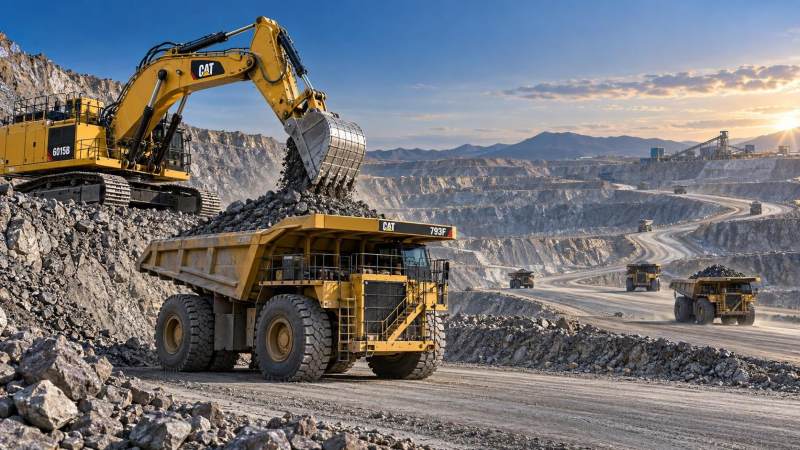
The purchase order is only the opening entry in surface mining equipment cost. A loading unit, haul truck, drill, dozer, grader, or support machine earns or loses money through the relationship between its design, the mine plan, material conditions, maintenance response, and remaining useful life. A lower acquisition price can become expensive when it brings shorter component intervals, excessive fuel burn, unavailable parts, or production losses that force the rest of the fleet to wait. A higher initial outlay can be justified when it removes a persistent bottleneck, fits the haul profile, and remains productive through rebuild cycles.
The useful comparison is therefore lifecycle cost per productive tonne, per operating hour, or per metre drilled, aligned with the mine's own production model. Neither purchase price nor advertised hourly capacity gives that answer alone. The model has to connect capital cost with availability, utilization, payload, fuel or energy use, consumables, labour, planned rebuilds, unplanned repairs, and the economic consequence of lost production.
Equipment Size Must Match the Production System
Oversizing and undersizing create different cost problems. An excavator with a bucket too small for the truck body requires more passes, lengthening loading time and raising fuel use per tonne. An excessively large bucket can overload trucks, accelerate tyre and suspension wear, create spillage, and reduce the consistency needed for efficient haulage. The apparent cost of an individual machine may look attractive while the loading-hauling system performs poorly as a whole.
Truck selection is especially sensitive to matching. Payload rating is only a design limit; actual economic performance depends on material density, body configuration, haul-road grade, rolling resistance, loading accuracy, queue time, and dumping conditions. Wet ore, low-density overburden, blasted rock with large voids, and sticky clay can all prevent a nominal payload from being reached. Conversely, repeated overloading transfers expense into tyres, frames, driveline components, braking systems, and road maintenance.
Cycle time deserves the same scrutiny as rated capacity. A haul truck can have adequate payload but deliver disappointing output because the route includes sharp turns, poor intersections, lengthy waiting at loading faces, or an uphill return that keeps the engine at high load. Adding trucks may conceal a loading or road-design constraint while increasing capital tied up in idle assets. Before approving fleet additions, separate travel time, loading time, spotting time, queue time, dumping time, and delay time. Each has a different owner and remedy.
Fuel, Energy, and the Shape of Work
Fuel is often treated as a variable cost calculated from a single litres-per-hour assumption. That shortcut misses how strongly duty cycle changes consumption. Engine load rises on long grades, deep soft ground, poor road surfaces, repeated acceleration, high rolling resistance, and aggressive digging. Idling adds cost without moving material, yet it can be hidden inside a fleet average that appears acceptable.
A machine operating near a stable design load is not comparable with the same model assigned to intermittent, high-resistance work. For excavators, bench height, fragmentation, bucket fill factor, swing angle, and truck position affect both tonnes per hour and fuel per tonne. For trucks, the meaningful pairing is fuel with tonne-kilometres and route profile, rather than fuel alone. A shorter route with severe grade may consume more fuel and impose greater retarding and braking demand than a longer, smoother route.
Electrified or hybrid equipment changes the cost structure rather than removing operating cost. Energy price, charging or power-delivery infrastructure, peak demand, charging downtime, battery replacement assumptions, ambient temperature, and service capability become part of the economic case. The comparison should include the availability of the supporting system. A low energy cost has little value when charging access constrains dispatch or when power interruptions stop a critical production circuit.
Wear Is Driven by Material, Not Just Machine Hours
Two fleets with identical hour-meter readings can face very different repair exposure. Abrasive quartz-rich rock, high-impact fragmented material, corrosive water, extreme heat, and fine dust act on different components. Ground-engaging tools, bucket lips, adapters, teeth, track shoes, undercarriage rollers, body liners, tyres, and crusher-feed systems wear according to the actual material and operating technique.
Wear-part procurement should be linked to the mine's geology and loading practice. A high-abrasion application may justify a more durable liner or tooth system when the added life reduces changeouts and keeps the loading unit available. In a low-abrasion but high-impact setting, resistance to cracking and secure retention can matter more than hardness alone. Selecting a component by unit price without considering its installation interval, lost operating time, and collateral damage risk distorts the result.
Tyres illustrate the same principle. Their cost is not governed solely by size or purchase price. Heat buildup, speed, payload, haul distance, road camber, sharp rock, wheel alignment, and pressure management all influence tyre life. A truck assigned beyond the thermal or load limits of its tyre application can consume tyres rapidly even when its mechanical condition appears sound. Haul-road maintenance is therefore an equipment-cost control: drainage, surface material, crossfall, berms, grades, and removal of sharp debris affect both speed and component survival.
Maintenance Cost Is a Timing Problem
Scheduled maintenance is visible and can be budgeted. The larger cost exposure often comes from deferred actions that turn a controlled intervention into a failure with consequential damage. A worn pin and bushing, contaminated hydraulic oil, restricted cooling package, or delayed driveline inspection can progress into a longer outage requiring additional parts, labour, lifting arrangements, and production recovery.
Maintenance plans must reflect access as well as service intervals. A remote pit with limited workshop bays, difficult weather, and long parts lead times cannot carry the same repair strategy as a site close to a major service centre. The inventory decision should distinguish between high-value items that are mission-critical and components whose failure can be managed with short lead times. Keeping every part on site ties up unnecessary capital; holding none of the components that can immobilize a primary loading unit creates a different and often larger exposure.
Condition monitoring is valuable when the response path is clear. Oil analysis, vibration trends, temperature data, fault codes, and inspection findings should lead to a defined decision: continue monitoring, schedule a repair window, reduce load, order a component, or stop the machine. Collecting data without integrating it into planning creates reports but does not reduce downtime.
Availability and Utilization Are Often Misread
High availability does not automatically mean productive use. A machine can be mechanically ready but waiting for a blast release, truck allocation, fuel service, shift change, operator changeover, or a clear dumping point. Low utilization may be appropriate for standby equipment, but it is costly when a major production asset spends scheduled hours waiting on a constraint elsewhere in the system.
Likewise, low availability can be caused by poor reliability, but it can also reflect a maintenance schedule deliberately timed to prevent major failure. The distinction matters when comparing fleets. A record that labels every non-operating hour as downtime makes a disciplined rebuild program look similar to uncontrolled breakdowns. Equipment records should preserve the reason code and the duration, then reconcile those records with production dispatch data.
The cost of a stopped primary excavator is broader than its repair invoice. Trucks may queue or be reassigned, crushers may receive inconsistent feed, stockpile plans may be disrupted, and a backup unit may operate at a less efficient loading point. The economic model should identify assets whose interruption constrains the entire material flow and assign greater value to their reliability, access to critical spares, and service support.
Rebuild, Replacement, or Life Extension
The decision to rebuild or replace should not be based on age alone. A rebuild can restore useful life when the base machine remains structurally sound, the application is stable, qualified labour and components are available, and the planned outage can be absorbed. It becomes less attractive when repeated repairs are driven by a fundamental mismatch between machine and duty, when frame or structural concerns emerge, or when the mine plan requires a different capacity class.
Lifecycle forecasts should show component events explicitly rather than spreading them into a smooth annual average. Engine, transmission, hydraulic pump, final drive, undercarriage, and structural work occur on different intervals and have different outage requirements. A fleet that appears inexpensive over several years may face clustered rebuild events that strain maintenance capacity and cash requirements in the same period.
Residual value also requires caution. Resale potential depends on hours, condition history, rebuild quality, configuration, remaining component life, and the future usefulness of that size class. Specialized bodies, unusual attachments, or modifications suited to one deposit may reduce redeployment options. A conservative residual assumption is preferable to using an optimistic disposal value to make a weak operating case appear acceptable.
The Procurement Record Should Preserve the Operating Assumptions
A sound capital request makes its assumptions inspectable. It states expected annual hours, production duty, haul distance and grade, material characteristics, payload target, fuel or energy basis, maintenance approach, parts lead times, overhaul events, and the expected role of the unit in the fleet. These assumptions matter as much as the quoted machine specification because they determine whether projected cost translates to the actual mine.
- A vendor quote should be normalized for included bodies, tyres, ground-engaging tools, onboard systems, commissioning, warranty terms, training, and freight. Omissions often surface after a seemingly lower bid is selected.
- Transport and assembly deserve their own allowance for oversized equipment. Site access, lifting capacity, assembly area, commissioning support, and the timing of first production can affect both project cost and schedule exposure.
- Warranty comparison needs operating-hour limits, exclusions for wear items, required maintenance documentation, response commitments, and the practical location of service personnel and parts.
- Fleet commonality has value when it reduces diagnostic tools, technician training, spare holdings, and software complexity, but it should not override a clear production mismatch.
The most credible surface mining equipment cost estimate is not the one with the lowest single line item. It is the estimate whose physical assumptions can be traced through the mine plan, operating conditions, maintenance calendar, and production constraints. When those links remain visible, later deviations can be diagnosed rather than explained away, and replacement or rebuild decisions can be made before cost pressure becomes an emergency.
Related News
 Sep 14, 2026What Drives Surface Mining Equipment Cost Across a Mine’s Operating Life?Surface mining equipment cost depends on fleet matching, fuel, wear, maintenance, availability, and rebuild timing. Explore lifecycle strategies that protect output and margins.
 Sep 13, 2026Crawler Crane Application Analysis for Wind Farms, Bridges, and Confined SitesCrawler crane application analysis for wind farms, bridges, and confined sites—optimize lift paths, ground conditions, access, and schedules for safer project delivery.
 Sep 12, 2026Open-Pit Mining in North America: Key Project Risks and Planning PrioritiesOpen-pit mining North America: uncover key risks and planning priorities for geology, permitting, water, fleet strategy, and resilient project delivery.
 Sep 11, 2026TBM Systems in Southeast Asia: Key Selection Factors for Variable Ground ConditionsTBM systems Southeast Asia: discover key selection factors for variable ground, pressure control, monsoon resilience, and safer tunnel delivery.


Ms. Elena Rodriguez
Weekly Insights
Stay ahead with our curated technology reports delivered every Monday.