
Open-Pit Mining in North America: Key Project Risks and Planning Priorities
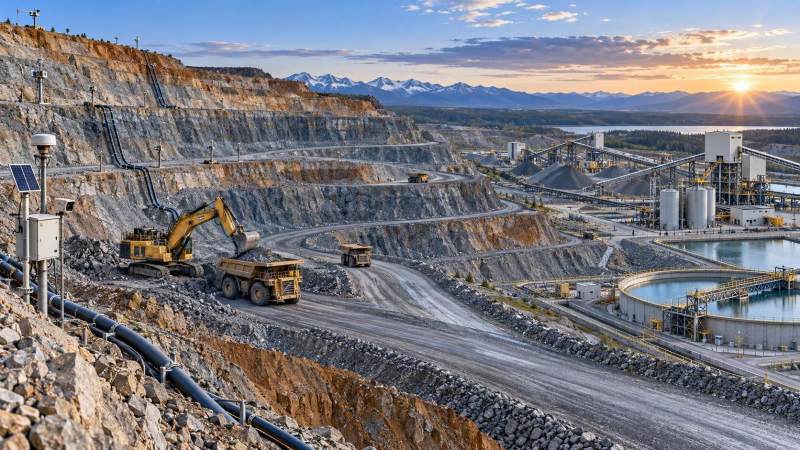
Open-Pit Mining in North America: Key Project Risks and Planning Priorities
Open-pit mining in North America is rarely constrained by a single engineering question. A project may have an attractive orebody, a credible processing route, and access to major equipment suppliers, yet still lose time or capital because the operating plan did not adequately account for water, permitting, haul-road performance, workforce availability, or the practical limits of a regional supply chain.
For project managers, the central task is not simply to design a mine that works under average conditions. It is to create an operation that remains controllable when geology varies, weather disrupts access, equipment availability falls below plan, or stakeholders require new information before a permit milestone can proceed. That is especially relevant across the United States and Canada, where mines operate in very different climatic, regulatory, logistical, and community settings.
The strongest planning decisions connect the pit design, fleet selection, infrastructure layout, environmental commitments, and operating philosophy early. Treating them as separate workstreams often produces expensive interfaces later: a haul fleet that does not match road geometry, a dewatering system sized for routine inflows rather than peak events, or a power plan that leaves little room for electrification and automation.
Geological uncertainty must be translated into operating decisions
Every surface mine model is an interpretation. Drill spacing, sample quality, structural complexity, weathered zones, groundwater conditions, and ore-control practices all affect how closely the operating pit will resemble the planning model. The risk is not limited to reserve confidence. Variability can influence slope performance, blasting response, dilution, fragmentation, excavator productivity, crusher feed consistency, and waste placement.
A common planning weakness is to carry geological uncertainty into the schedule as a generic contingency rather than assigning it to specific operational controls. More useful questions include: Which benches are most likely to encounter altered rock or faulting? Where could ore boundaries shift enough to affect short-term feed? Which sectors need additional geotechnical drilling before a pushback begins? What information must be collected during mining to update the model before the next phase is committed?
Slope design requires the same discipline. Overall pit slopes may appear acceptable in a high-level study, but localized structures, weak contacts, weathering profiles, and groundwater pressure can govern the actual stability outcome. A credible plan links geotechnical domains to catch-bench configuration, depressurization measures, radar or prism monitoring, trigger-action-response plans, and mine sequencing. Monitoring is not a substitute for sound geometry; it is a way to verify whether the assumptions behind that geometry remain valid.
Permitting is a project workstream, not a gate at the end
Permitting timelines for open-pit mining North America developments can be difficult to predict because approvals commonly involve several levels of government, technical agencies, land-use requirements, water-related obligations, and consultation processes. The precise pathway depends on jurisdiction, mine location, land status, planned disturbance, tailings strategy, water withdrawals or discharges, and potential effects on nearby communities, ecosystems, and cultural resources.
The planning priority is to avoid designing a project in isolation and then asking whether it can be permitted. Environmental baseline studies, mine layout alternatives, closure concepts, and stakeholder engagement should inform one another. If a waste-rock facility, access road, transmission line, or water-management pond becomes contentious or technically unsuitable, the impact can extend far beyond that individual facility. It may alter stripping schedules, fleet travel distances, capital sequencing, and the construction window.
Closure planning deserves early attention for the same reason. A closure concept affects landform design, drainage controls, material segregation, progressive reclamation opportunities, and long-term water management. Leaving these issues until late-stage engineering can create a plan that is technically workable in production but difficult to defend over the full mine life. Requirements should always be confirmed against applicable local rules and project-specific permit conditions rather than inferred from another jurisdiction.
Water management can determine production continuity
In dry regions, water availability may constrain processing, dust suppression, and camp or site services. In high-rainfall, snowmelt, or freeze-thaw environments, the larger issue may be managing runoff, pit inflow, pond capacity, and safe access during changing weather. Both conditions demand a water balance that is treated as a live operational model, not merely a permitting document.
A practical water plan distinguishes between contact water, non-contact water, groundwater, process water, and stormwater. It identifies where each stream is generated, how it is monitored, where it can be stored, and what happens when infrastructure is temporarily unavailable. Pump sizing alone does not solve the issue. Pump stations need redundancy where loss of dewatering could affect pit safety or access, while pipelines, sumps, electrical supply, communications, and maintenance access must be designed for the environment in which they will operate.
Seasonal conditions can expose weak assumptions quickly. Frozen lines, spring runoff, extreme heat, wildfire-related access constraints, and intense storm events all require response planning. The mine schedule should show how production changes if a lower bench is inaccessible, a ramp is temporarily restricted, or material movement must be diverted. A resilient plan does not assume constant conditions; it defines how the operation returns to control after disruption.
Fleet selection is a system-design decision
Large excavators and mining dump trucks are often evaluated through nominal payload, bucket capacity, engine power, and purchase price. Those metrics matter, but they do not define the performance of the mining system. Match factor, material density, fragmentation, loading height, truck spotting time, road grade, rolling resistance, tire support, fuel or charging availability, and maintenance capability can have a greater influence on tonnes moved per operating hour.
For a new or expanding pit, fleet decisions should be tested against the actual mine plan rather than a single representative haul profile. Haul distances change as the pit deepens. Road gradients may increase. Waste destinations may move. A shovel that is well matched to initial benches may become constrained by working-room geometry or selective-mining needs later. Similarly, a truck class that performs well on broad early ramps may impose operating penalties if future roads are narrow, steep, or difficult to maintain.
The decision between diesel, trolley-assist, hybrid, or battery-electric haulage needs equally careful sequencing. Electrified haulage may support emissions and energy objectives, but it changes infrastructure planning, power demand, maintenance skills, fleet dispatch logic, and ramp design. Its value depends on duty cycle and site conditions, not on a broad technology label. A staged approach is often more credible than assuming a complete fleet transition without confirming power supply, charging or trolley infrastructure, equipment support, and production impacts.
Roads, maintenance, and material handling are often underestimated
A mine road is productive infrastructure, not just a route between loading and dumping points. Road width, crossfall, drainage, running-surface material, intersection design, berm condition, and maintenance frequency affect truck speed, fuel use, tire life, operator fatigue, and safety margins. Poor road conditions also create secondary losses: longer loading queues, increased mechanical stress, reduced payload confidence, and more frequent intervention by maintenance crews.
Road construction and upkeep therefore need to be integrated with mine scheduling. The plan should identify when major ramps are built, how drainage changes as the pit expands, which equipment maintains running surfaces, and whether the mine has reliable access to aggregates, water, and grading capacity. In remote locations, the availability of suitable road-building materials may deserve as much attention as the specification itself.
Maintenance planning should also reflect the reality of high-utilization equipment. A fleet can look adequate on paper while becoming vulnerable because critical components, trained technicians, workshop bays, lifting equipment, or diagnostic capability are not available when needed. Major components may require specialized transport or crane support. Decisions around crawler cranes, workshop lifting arrangements, and field-repair access are not peripheral details when downtime on an ultra-class excavator or haul truck affects the entire production chain.
Digital systems help only when they improve mine control
Fleet management, high-precision positioning, condition monitoring, slope radar, drone survey, and remote operating technologies can improve visibility across a large mine. Yet digitalization should be connected to decisions that site teams can act on. Data without ownership often becomes another reporting burden.
Useful implementation begins with a limited set of operational questions: Are trucks waiting because of loading, dumping, road conditions, or dispatch logic? Is fuel burn rising because of grade, payload variance, idling, or mechanical condition? Are geotechnical alerts reaching the people authorized to change access? Can maintenance teams identify degradation before it becomes a production event? The required sensors, communications coverage, data architecture, and training should follow from those questions.
Remote and semi-autonomous functions also require operational redesign. Communications reliability, exclusion zones, emergency response, operator roles, and mixed-fleet interaction must be addressed before technology is deployed at scale. North American mines may face different labour availability and safety expectations by region, so a technology roadmap should remain site-specific rather than copied from another operation.
Build the project around decision gates, not optimistic averages
The most durable open-pit mining plans make uncertainty visible. They define which assumptions are sufficiently mature for commitment, which require field confirmation, and what action follows if a result differs from expectation. This approach is more practical than trying to eliminate every unknown before construction. It turns uncertainty into a managed sequence of surveys, trials, monitoring, procurement decisions, and contingency measures.
Before major capital is locked in, project teams should test the interfaces that are hardest to change later: pit phase design against geotechnical domains; fleet size against realistic haul profiles; power strategy against future demand; water infrastructure against peak conditions; and closure commitments against material-handling plans. These are the points where an apparently small assumption can reshape lifecycle cost.
TF-Strategy examines these interfaces through the connected lens of heavy machinery, construction methods, and project strategy. Its Strategic Intelligence Center follows developments in ultra-large excavators, mining dump trucks, remote-controlled excavation, heavy lifting, and energy-transition technologies because equipment capability only has value when it fits the mine plan around it. For engineering leaders assessing open-pit mining in North America, the next useful step is usually not a broader equipment shortlist. It is a disciplined review of the geological, infrastructure, operational, and regulatory assumptions that will govern how that equipment performs over the life of the mine.
Related News
 Oct 27, 2026Construction Equipment Efficiency: How to Reduce Idle Time on JobsitesBoost construction equipment efficiency with smarter scheduling, telematics, and safe shutdown practices. Discover how to reduce idle time and fuel waste on your jobsite.
 Oct 26, 2026How TBM Electrical Systems Distribute Power and Protect Against FaultsExplore how TBM equipment electrical systems distribute power, coordinate fault protection, and maintain essential services. Learn what to check for safer, more reliable tunneling.
 Oct 25, 2026Comparing Industrial Equipment Suppliers: Lead Times, Warranties, and ServiceMake a smarter industrial equipment supplier comparison. Explore lead times, warranty coverage, and service support to reduce downtime risk and choose with confidence.
 Oct 24, 2026Choosing Lifting Equipment for Middle East Petrochemical Plants in Hazardous AreasExplore petrochemical lifting equipment Middle East plants can rely on. Compare hazardous-area certification, capacity, and heat limits to make informed procurement decisions.
Related News

Ms. Elena Rodriguez
Weekly Insights
Stay ahead with our curated technology reports delivered every Monday.