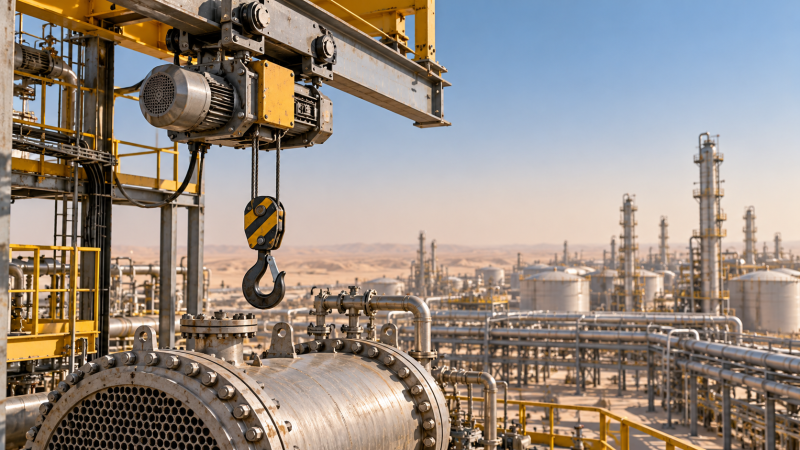
Choosing Lifting Equipment for Middle East Petrochemical Plants in Hazardous Areas
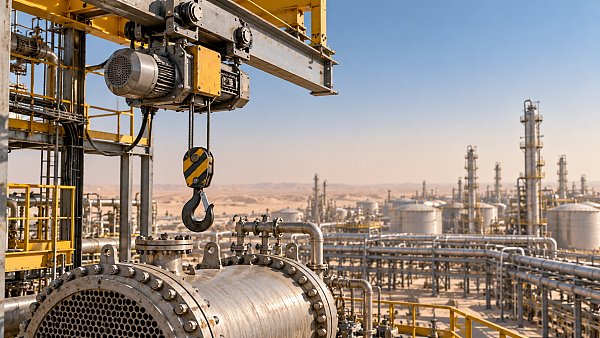
Selecting lifting equipment for Middle East petrochemical plants begins with two questions: can it perform the lift, and can it operate safely at the intended location?
Capacity alone cannot answer either question. Hazardous-area classification, ignition sources, ambient temperature, ground conditions, and operating restrictions can eliminate an otherwise capable machine.
For technical evaluators researching petrochemical lifting equipment Middle East projects require, the strongest shortlist connects verified protection measures with actual lifting performance and maintainability.
This TF-Strategy guide explains how to compare equipment, challenge certification claims, and build a defensible technical specification before procurement decisions become difficult to reverse.
Start with the lifting task and its hazardous-area boundaries
First define the load, lifting points, center of gravity, required travel, installation elevation, operating radius, and frequency. Separate routine maintenance from shutdown construction lifts.
Then obtain the current hazardous-area classification drawings and supporting assessment. Identify where the crane, hoist, controls, power supply, and suspended load will actually move.
For gas hazards, Zones 0, 1, and 2 describe the likelihood and persistence of an explosive atmosphere. They do not describe its potential consequences.
A machine positioned outside a classified area may still place its hook, trolley, cable, or attachments inside one. Evaluate the complete operating envelope accordingly.
Also examine temporary conditions: opening process equipment, draining hydrocarbons, cleaning vessels, and abnormal ventilation can change the exposure assumptions used for a particular lift.
Record the applicable substances, gas groups, required temperature limits, ambient range, and any combustible dust hazards. These inputs should precede requests for equipment quotations.
Which explosion-protection evidence should evaluators accept?
Require suppliers to identify the certification scheme, protection marking, equipment protection level, gas group, temperature class, and certified ambient range for each relevant item.
For gas atmospheres, equipment protection levels Ga, Gb, and Gc generally correspond to suitability for Zones 0, 1, and 2 respectively, subject to installation requirements.
IECEx certification and ATEX documentation can support assessment, but neither automatically establishes acceptance throughout the Middle East. Confirm national requirements and the plant owner's specifications.
Check certificate numbers against the issuing body's records where available. Match the certified model, options, drawings, and accessories to the equipment actually being offered.
A certificate covering an electric motor does not establish suitability of the complete hoist or crane. Integration, wiring, brakes, controls, and mechanical ignition sources remain relevant.
Read any special conditions of use, commonly associated with an “X” certificate suffix. These may impose installation, impact protection, temperature, or operating restrictions.
Relevant references may include the IEC 60079 series and ISO 80079-36 and ISO 80079-37 for non-electrical equipment. Specify applicable editions and project requirements explicitly.
Evaluate every credible ignition source, including mechanical components
Explosion protection extends beyond electrical enclosures. Hot surfaces, friction, impact sparks, electrostatic discharge, and engine systems can influence whether equipment is suitable for the task.
Request an ignition hazard assessment covering intended service and the malfunctions relevant to the required protection level. Check whether proposed operating restrictions are practical.
For hoists, review brake heating, bearing failure, rope or chain contact, hook materials, lubrication, and overload behavior. Assess attachments and replacement parts within the same scope.
Describing a hook as spark resistant does not demonstrate suitability of the complete assembly. Material selection must address credible contact conditions and mechanical strength requirements.
For mobile cranes, examine engines, exhaust surfaces, electrical equipment, battery systems, and potential hydrocarbon intake. Any protective modifications require competent engineering and manufacturer involvement.
Gas detection, permits, and shutdown procedures support operational control. They do not independently convert unsuitable equipment into equipment acceptable for a classified location.
Choose the equipment type around the actual operating pattern
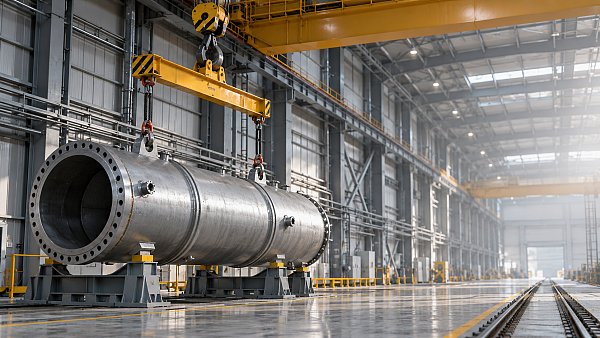
Fixed overhead cranes and monorails often suit repetitive maintenance lifts along defined routes. Their value depends on structural support, coverage, headroom, and maintainable access.
Electric hoists offer controlled movement and convenient integration, provided the complete installation meets the required protection concept and the site's electrical and inspection requirements.
Pneumatic hoists may suit certain hazardous-area duties, but they still need ignition assessment. Verify air quality, pressure at demand, exhaust arrangements, and compressor capacity.
Manual hoists can serve occasional tasks where capacity, effort, and access permit. Their mechanical components and operating method still require assessment for the classified environment.
Crawler cranes can support heavy modules and major shutdown work where ground preparation, assembly space, and mobilization are justified. Large capacity does not guarantee site accessibility.
Mobile cranes may provide faster deployment for dispersed lifts. Compare setup space, outrigger reactions, access routes, and permissible positioning relative to live process equipment.
Verify capacity at the required radius and configuration
Compare the proposed lift against the manufacturer's chart for the exact boom, jib, counterweight, reeving, support arrangement, and operating sector. Nominal crane capacity is insufficient.
Calculate total suspended weight using the chart's definitions. Include applicable hook blocks, slings, spreader beams, lifting frames, attachments, and other required capacity deductions.
Use the greatest credible operating radius throughout the lift path. Allow for surveyed geometry, load dimensions, boom deflection, and the installation sequence where applicable.
For installed hoists, verify rated capacity alongside duty classification, starts per hour, lifting speed, travel requirements, and expected load spectrum over the service life.
Assess load control separately from capacity. Brake performance, controlled lowering, fine positioning, emergency stopping, and power-loss behavior matter when working beside live process equipment.
Ground bearing and structural reactions need independent verification. Underground services, pipe trenches, elevated slabs, and recently backfilled areas can restrict otherwise feasible crane positions.
Require a documented lifting study for critical operations, addressing clearances, exclusion zones, communications, and recovery arrangements. Additional capacity cannot compensate for an incomplete lifting plan.
Check whether heat, wind, and corrosion invalidate the proposal
Middle East projects can combine high ambient temperatures, solar exposure, airborne sand, coastal salt, and humid conditions. Establish site design values instead of regional averages.
Distinguish explosion-protection temperature limits from operating-performance limits. A certified ambient range does not, by itself, confirm full lifting duty at its highest temperature.
Ask the manufacturer for applicable derating and duty restrictions covering motors, drives, brakes, hydraulics, cooling systems, and lubricants. Do not extrapolate beyond documented operating limits.
Temperature class concerns maximum equipment surface temperature under specified conditions. Confirm suitability for the substances present and the actual certified ambient range at the site.
Wind assessment should consider gusts, lift height, load shape, and projected area. Large vessels and modules may reach operating limits before their weight approaches chart capacity.
Specify corrosion protection, enclosure performance, seals, cable entries, and inspection access for the exposure. An IP rating addresses ingress protection; it does not establish explosion protection.
Sand and salt can accelerate wear and impair cooling. Evaluate cleaning intervals, filter accessibility, protected storage, and replacement procedures alongside the original equipment specification.
Define site controls before accepting the equipment configuration
Establish how lifting will interact with live operations, nearby maintenance, vehicle movements, and emergency routes. Simultaneous activities can determine when an otherwise suitable machine may operate.
The permit process should define isolation requirements, gas testing, monitoring locations, weather limits, communications, and authority to stop work. Assign responsibilities before equipment arrives.
For lifting above or beside operating systems, assess dropped-load consequences and collision exposure. Consider whether shutdown, isolation, shielding, or an alternative lifting route is required.
Remote controls can improve operator positioning, but require review of hazardous-area suitability, radio coverage, interference, emergency stopping, and behavior following communication loss or power failure.
Confirm how personnel will inspect, lubricate, repair, and recover the equipment safely. An inaccessible brake or emergency release can turn a manageable fault into extended downtime.
Any proposed temporary use under special conditions needs documented acceptance through the site's engineering and operating procedures. Commercial urgency should not determine technical suitability.
Build a procurement comparison that exposes missing evidence
Issue suppliers a common technical schedule containing classification data, environmental conditions, lift geometry, duty requirements, utilities, and documentation expectations. Comparable inputs produce more useful bids.
Use mandatory acceptance criteria before commercial scoring. Unresolved protection suitability, inadequate capacity, or unsupported temperature performance should prevent an offer from entering the compliant shortlist.
For each requirement, record the supplier's response, supporting document, deviation, and responsible reviewer. Mark unsupported statements as open issues rather than treating them as compliance.
Request load charts, general arrangements, certificates, operating limits, maintenance instructions, inspection requirements, and spare-parts information. Identify which documents must be approved before manufacture or mobilization.
Define factory and site acceptance checks around relevant functions, markings, protective devices, and configuration. Testing should follow applicable standards, manufacturer instructions, and the agreed inspection plan.
Where specialized hazardous-area competence is needed, include it in technical review and inspection planning. A procurement checklist cannot replace the engineering judgment behind acceptance.
Compare lifecycle cost only after technical suitability is established
Purchase or rental price captures only part of the cost. Include transport, assembly, foundations, utilities, inspections, operator training, maintenance access, and expected downtime during ownership.
For shutdown cranes, mobilization reliability and schedule fit can outweigh small rate differences. Evaluate transport permits, assembly resources, local support, and contingency availability before award.
For permanent equipment, compare spare-parts lead times, service coverage, inspection intervals, and repair capabilities. Confirm whether local providers can preserve the required explosion-protection integrity.
Calculate energy and consumable costs using the actual duty cycle. Pneumatic systems, electric drives, and diesel equipment have different infrastructure and operating requirements that affect economics.
TF-Strategy's evaluation approach links these costs to verified engineering constraints. The objective is a documented selection that remains workable throughout installation, operation, maintenance, and replacement.
Make the final decision against a defined operating envelope
The right lifting solution satisfies three connected tests: hazardous-area suitability, verified lifting performance, and practical support under the site's environmental and operating conditions throughout service.
Approve equipment against a stated configuration, location, duty, and set of restrictions. Changes to any of these inputs should trigger review before the next lift.
A defensible shortlist therefore contains more than compliant-looking certificates and attractive prices. It shows exactly where each option can operate, what it can lift, and why.