
Tunnel Boring Machines in Southeast Asia: EPB vs. Slurry for Soft Ground
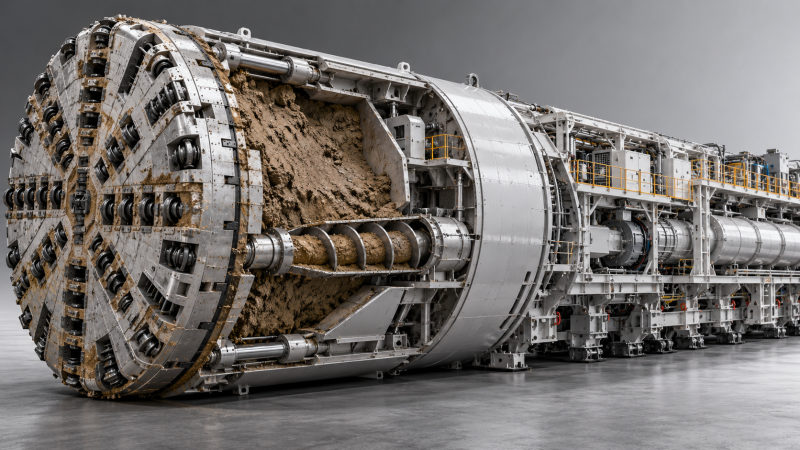
For soft-ground tunnels in Southeast Asia, EPB is a strong candidate where excavated soil can be conditioned into a plastic, low-permeability mass that reliably transmits face pressure and passes through the screw conveyor. Slurry shields deserve stronger consideration where permeable sands, gravel lenses, and groundwater pressure make that pressure-retaining soil plug difficult to maintain. Neither choice follows automatically from the description “soft ground.”
The decisive question is whether the complete excavation system can maintain a safe pressure window through the most difficult credible ground conditions—not merely the average borehole profile. Ground variability, settlement sensitivity, spoil treatment, and access for maintenance can outweigh differences in machine purchase price.
Regional geology provides context, not a machine specification
Southeast Asian alignments can encounter alluvial clay, loose sand, reclaimed fill, estuarine deposits, and weathered material within the same drive. River crossings and buried channels can introduce permeable layers into otherwise fine-grained ground. Conditions also differ substantially between cities and between contracts within one metropolitan area; a machine choice from a neighboring project is not a substitute for an alignment-specific assessment.
A clay-dominated investigation summary can conceal a sand lens that controls water inflow and face stability. Conversely, classifying an alignment as sandy does not establish that EPB is unsuitable: fines content, grading, groundwater head, and achievable conditioning performance determine whether a pressure-retaining muck can be produced.
The geological model should therefore describe conditions at the scale of the tunnel face. Layer boundaries crossing the face, hydraulic connections to rivers or aquifers, and transitions between treated ground and natural deposits deserve explicit attention. Averaging these features into one representative soil description removes information needed for machine selection.
The pressure-control difference becomes critical at the discharge system
An EPB machine supports the face with excavated material held under pressure in the excavation chamber. Advance, cutterhead excavation, and screw-conveyor discharge must remain balanced. Conditioning agents—including foam, water, polymers, or fine mineral additions where appropriate—modify the material so it can transmit pressure, flow through the chamber, and discharge without uncontrolled groundwater loss.
The screw conveyor is central to this system. It must reduce pressure along the discharge path while transporting spoil. If the material is too permeable or cannot form an effective plug, water and soil can escape uncontrollably. If it is excessively sticky or resistant to flow, torque, blockage, and pressure fluctuations can restrict production. Longer or staged screw arrangements can extend capability, but they do not eliminate the need to demonstrate suitable material behavior.
A slurry shield supports the face using a pressurized fluid suspension, commonly bentonite-based, while excavated material travels through a hydraulic circuit to a separation plant. Support depends on the interaction between slurry and ground: a filter cake or an appropriately limited penetration zone must allow fluid pressure to act effectively on the soil skeleton.
Slurry support is therefore not simply a matter of setting pump pressure above groundwater pressure. Coarse, highly permeable deposits may permit excessive slurry penetration or loss. Fine-grained, cohesive deposits can create a different difficulty: excavated clay enters the circuit, changes slurry properties, and increases separation and treatment demands.
Permeability and groundwater must be assessed together
Groundwater pressure alone is not a reliable dividing line between EPB and slurry. A suitably designed EPB system can operate under substantial pressure if conditioned muck retains that pressure and discharge remains controlled. A slurry system can also encounter difficulty at modest head if open gravel or connected voids cause unacceptable fluid losses.
The relevant assessment combines permeability, hydraulic head, grading, and the continuity of permeable layers. Laboratory permeability measurements should be interpreted alongside field investigations and the geological model. A thin connected sand layer may matter more to operational risk than its proportion of the overall excavated volume suggests.
There is no universal fines-content or permeability threshold that safely selects the machine. Published applicability charts are useful for screening, but soil mineralogy, grading, conditioning chemistry, machine configuration, and pressure requirements can shift the workable envelope. A selection close to an apparent boundary needs stronger testing, not greater confidence in the chart.
Settlement limits test the whole tunneling system
Neither EPB nor slurry inherently guarantees lower settlement. Surface movement can arise from face loss, over-excavation, shield passage, tail-void closure, grouting deficiencies, and groundwater changes. Machine selection must address these mechanisms rather than equating stable chamber pressure with complete ground-loss control.
The face-support pressure window must be established for the alignment: sufficient support to limit instability and inflow, without causing heave, hydraulic fracture, or slurry breakout. Shallow cover, weak overburden, and hydraulic connections to the surface can narrow that window. Pressure also varies with elevation across the face, so a single chamber reading is not a complete description of support conditions.
For sensitive buildings, utilities, or existing tunnels, compare pressure-control performance during starts, stops, ring building, and ground transitions—not only steady excavation. EPB assessment should examine chamber filling and screw-control response. Slurry assessment should examine circuit response, pressure regulation, and interruption procedures. Both require compatible tail sealing, annular grouting, instrumentation, and defined responses when movement approaches project limits.
Test the excavated material before committing to the system
Routine classification tests do not establish whether soil will behave correctly inside a TBM. For an EPB option, conditioning trials should investigate workability, permeability, segregation, clogging tendency, and pressure-retaining discharge behavior across representative soils. Tests should include unfavorable mixtures, not just separately prepared samples from each geological layer.
The important result is a workable operating range. A formulation that performs only at one tightly controlled dosage may be difficult to sustain when moisture content or sand fraction changes. Assess the required dosing capacity, mixing effectiveness, chemical availability, and the effect of conditioned spoil on transport and disposal.
For slurry, testing should examine support-fluid compatibility, filtration and penetration behavior, clay dispersion, separation performance, and residual-sludge dewatering. Groundwater chemistry can affect both bentonite behavior and conditioning products; using representative water avoids an unrealistically favorable laboratory result.
Particle size also matters beyond face support. Gravel and cobbles must pass through the cutterhead openings and the selected muck-handling system, or be reduced by suitable equipment. Slurry circuits need compatible crusher, pump, and pipeline capacities. EPB machines need compatible intake and screw arrangements. Oversize handling should be resolved as an integrated material path, not left as an isolated cutterhead specification.
The worksite and disposal route can reverse an apparent advantage
For slurry tunneling, the separation plant is part of the production system. Screens and hydrocyclones remove different particle fractions, while fine solids may require additional treatment and dewatering. If the incoming soil contains a high proportion of difficult-to-separate fines, excavation capacity can exceed treatment capacity even when the TBM itself has adequate power.
Plant assessment should use the expected range of excavated solids and circulating flow, with provision for maintenance and changing ground. Storage, replacement slurry, residual sludge, water management, and power demand belong in the site layout. A remote plant can relieve shaft congestion, but introduces pipeline routing, pumping, access, and pressure-loss constraints.
EPB avoids this full separation circuit, but its spoil is not automatically dry or ready for disposal. Conditioning can produce wet, sticky material requiring controlled loading, treatment, or stabilization. The accepted waste classification and receiving-facility requirements must be checked locally; neither bentonite slurry nor conditioned EPB spoil should be assumed acceptable without characterization.
Dense urban sites can therefore favor EPB where conditioning is demonstrably reliable and spoil can leave efficiently. Where ground conditions strongly favor slurry support, limited space is a logistics problem to solve—not a sound reason to accept an inadequately controlled EPB discharge risk.
Abrasivity and interventions can dominate availability
Soft ground can still be highly abrasive. Quartz-rich sand can wear cutters, cutterhead openings, screw flights, slurry pumps, and pipelines. The wear locations differ, so comparing cutter consumption alone understates the exposure. Mineralogy and abrasivity testing should inform wear protection, monitoring, replacement intervals, and spare-parts provision.
Tool access requires equal attention. The pressure needed for an intervention, face stand-up behavior, access arrangements, and any ground treatment determine whether maintenance is practicable. High-pressure interventions introduce specialist health and safety requirements and may materially affect the construction method. Neither shield type removes this constraint.
A machine with attractive nominal advance capability may deliver poorly if wear components cannot be replaced within the available access strategy. Intervention assumptions should therefore be challenged alongside face-support calculations, before the machine configuration is fixed.
Make the selection against credible difficult conditions
A defensible comparison evaluates both systems against the same ground scenarios: the main production ground, the most permeable credible interval, the stickiest clay, abrasive zones, and significant transitions. Each scenario should connect ground behavior to pressure control, material transport, surface treatment, maintenance, and recovery from interruption.
Supplier submissions should identify the evidence behind their proposed operating envelope. For EPB, this includes conditioning assumptions, screw pressure-reduction capability, torque margins, and responses to loss of a reliable muck plug. For slurry, it includes pressure-control arrangements, permissible fluid losses, particle-handling limits, and separation capacity for the actual soil grading. Guarantees based on undefined “suitable ground” provide little basis for comparison.
Total cost should then reflect those scenarios rather than a single assumed advance rate. Relevant differences include conditioning consumption, slurry treatment, wear, energy, spoil disposal, intervention requirements, and downtime. The lower-cost machine is not necessarily the lower-cost tunneling system if its performance depends on optimistic ground assumptions.
EPB is a defensible choice when testing supports a robust conditioned-muck operating range and the discharge system can retain pressure through critical intervals. Slurry is a defensible choice when hydraulic face support offers better control in permeable ground and the project can sustain the associated treatment circuit. Where neither option has demonstrated a workable margin, further investigation, targeted ground treatment, or a specifically engineered variable-mode configuration is needed. A machine label cannot substitute for a verified construction method.
Related News
 Oct 22, 2026Tunnel Boring Machines in Southeast Asia: EPB vs. Slurry for Soft GroundCompare tunnel boring machines Southeast Asia projects rely on: EPB vs. slurry for soft ground. Discover how groundwater, settlement risks, and spoil handling shape the right choice.
 Oct 21, 2026Choosing Tunneling Equipment for the Middle East: Rock, Soil, and GroundwaterCompare underground tunneling equipment Middle East projects need. Explore rock, soil, groundwater, and TBM options to reduce risk and make confident procurement decisions.
 Oct 20, 2026Which Heavy Machinery Maintenance Standards Apply to Your Construction Fleet?Discover which heavy machinery maintenance standards apply to your fleet. Clarify legal duties, OEM requirements, and inspection rules to reduce risk and keep equipment ready for work.
 Oct 19, 2026Sizing Industrial Hydraulic Power Packs: Pressure, Flow, and Duty CycleSize industrial hydraulic power packs with confidence. Learn how pressure, flow, and duty cycle affect performance, energy costs, and heat control—and avoid costly sizing mistakes.
Related News

Ms. Elena Rodriguez
Weekly Insights
Stay ahead with our curated technology reports delivered every Monday.