
Choosing Tunnel Boring Machines for Hard Rock: Key Geological Factors
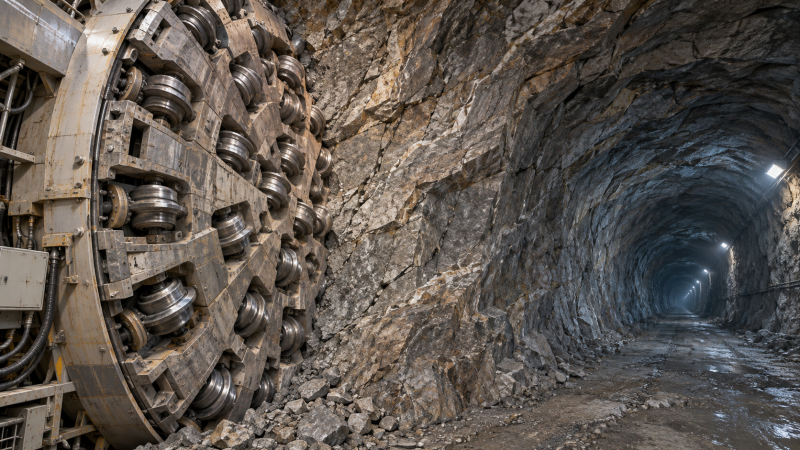
Selecting tunnel boring machines for hard rock requires more than matching cutterhead power to rock strength. Abrasivity, fracture patterns, groundwater pressure, in-situ stress, and the potential for rockbursts can influence machine design, penetration rates, cutter wear, and project risk. For technical evaluators, the difficult question is not simply whether a machine can excavate the strongest rock on the alignment. It is whether the proposed configuration can cope with the full range of ground conditions, including transitions that may occur with limited warning.
A defensible selection therefore starts with a geological model, not a preferred machine type. Strength and abrasivity testing matter, but so do the orientation of discontinuities, the expected behavior of faults under cover, water inflows, and the time needed to install support. These factors interact with machine geometry and construction methodology throughout the drive.
Start with the rock mass, not just the rock sample
Uniaxial compressive strength (UCS) is a useful starting point for assessing hard-rock excavation. It gives an indication of the force needed to break intact rock and informs discussion of cutter loading, thrust, and likely penetration. Yet a laboratory specimen represents only a small piece of the tunnel face. It does not describe the spacing, persistence, orientation, or condition of the discontinuities that divide the rock mass.
Two alignments with similar intact strength can behave very differently. Massive, strong rock may demand high cutter loads and produce modest penetration per revolution. A fractured rock mass may break more readily but create unstable blocks around the crown or within the face. Those blocks can interrupt excavation, damage equipment, or require immediate support.
For selection purposes, combine intact-rock properties with core logging, discontinuity mapping, rock quality designation, and an appropriate rock mass classification. Treat classification scores as inputs to engineering judgment rather than machine-selection rules. Their value is in revealing where ground behavior may change and where the machine must accommodate a different support or operating response.
Geological factors that change the machine specification
Strength, brittleness, and penetration
Hard-rock TBMs generally use disc cutters to induce fractures in the rock. The cutterhead must provide sufficient thrust to load those cutters, while torque and drive capacity must suit the anticipated operating conditions. Evaluators should ask manufacturers how proposed cutter loads, cutter spacing, and available thrust relate to the project’s rock properties and excavation diameter.
Strength alone does not determine penetration. Rock brittleness, existing fractures, cutter geometry, and operating parameters also affect how chips form. A high UCS value should trigger closer examination of cutter loading and performance assumptions, not an automatic conclusion that one machine is unsuitable. Compare predicted penetration using a consistent set of geological inputs, and review the basis of each prediction rather than treating a single advance-rate figure as a guarantee.
Abrasivity and cutter consumption
Abrasive minerals can turn an apparently workable penetration rate into a costly drive if disc cutters need frequent replacement. Quartz content, grain characteristics, rock fabric, and testing such as the Cerchar Abrasivity Index help assess wear potential. Results should be interpreted alongside cutter load, disc material, operating practice, and the variability of the rock along the route.
The selection implications extend beyond the choice of disc cutter. Ask how cutters will be inspected and changed, whether face access is practical, what lifting arrangements are provided, and how worn cutters will be transported out of the tunnel. Gauge cutters and other exposed components deserve attention because wear at the tunnel perimeter can affect bore geometry and machine progress.
A machine with an attractive nominal excavation rate may be less competitive if its maintenance arrangement makes cutter changes slow or difficult. In a long, abrasive drive, maintenance access is part of the geological response.
Discontinuities, faults, and unstable ground
Joint orientation relative to the tunnel axis affects the shape and stability of blocks exposed at the face and around the opening. Closely spaced fractures can aid breakage, but they may also produce overbreak, loose rock, and irregular loading on the cutterhead. Persistent faults and shear zones introduce another concern: ground that behaves less like competent rock and more like a mixture of broken rock, gouge, and water.
Investigate not only where these zones are expected, but also their possible width, frequency, and uncertainty. The machine must be able to manage the transition into and out of poor ground. Relevant questions include:
- How quickly can the crew inspect the exposed ground and install the specified support?
- Does the machine provide access for probe drilling, forepoling, or pre-excavation treatment where required?
- Can the proposed gripper or shield arrangement operate safely in the anticipated rock mass?
- What is the recovery plan if loose material accumulates or the machine becomes trapped?
These are construction-method questions as much as equipment questions. They should be answered with the ground-support designer and contractor, not left until procurement is complete.
Groundwater pressure and inflow
Water can enter through permeable rock, joints, and fault zones, sometimes under substantial pressure. Its consequences range from pumping and muck-handling difficulties to face instability, erosion of infill, and greater risk during intervention. Water chemistry may also affect equipment corrosion and discharge treatment requirements.
For a hard-rock TBM evaluation, review expected inflow rates and pressures as ranges, including credible high-consequence scenarios. Consider probe-drilling reach and coverage, pre-grouting capability, drainage, pumping redundancy, and arrangements for treating or containing water. An open machine does not provide the same level of ground and water isolation as a shielded configuration, but a shield alone is not a water-pressure control system. Where pressurized face support may be necessary, the suitability of a pressure-capable or convertible machine requires a separate, project-specific assessment.
In-situ stress, squeezing, and rockburst potential
Deep cover or a high-stress geological setting can produce conditions that are not apparent from strength testing alone. In brittle, highly stressed rock, rapid stress redistribution may cause spalling or rockbursts. In weaker or more deformable ground, time-dependent convergence can squeeze the opening and, in a shielded machine, increase the risk of the shield becoming trapped.
Stress orientation, rock mass behavior, and excavation geometry all matter. The technical evaluation should consider shielding and protection for personnel, ground-support installation close to the face, monitoring, and contingency measures for convergence or high-energy events. Shield length, overcut provisions, and methods for freeing a trapped machine should be reviewed against the project’s ground model rather than assumed adequate by default.
Matching TBM configuration to the ground
Machine categories are useful for narrowing the discussion, but none is inherently the best choice for every hard-rock tunnel. The following comparison highlights the geological trade-offs that deserve scrutiny.
A double-shield arrangement may allow excavation and lining activities to overlap in suitable conditions, but that potential should not be applied uniformly across the alignment. Weak or fractured rock may limit gripper use, while deformation can affect shield movement. Similarly, an open gripper machine may offer good access for certain support operations, yet its suitability depends on stable reaction surfaces and an acceptable strategy for exposed ground.
Machine diameter, tunnel length, lining requirements, and access logistics also influence the decision. Geology does not act independently of project constraints: a configuration must fit both the ground and the way the tunnel will be built.
Turn geological uncertainty into comparable bids
Technical evaluators often receive proposals that appear straightforward until their assumptions are compared. One supplier may base cutter consumption on an average abrasivity value; another may include a wider range. One may report penetration during excavation only, while another presents an advance rate that includes selected stoppages. Without a common basis, the comparison can reward optimistic assumptions rather than a suitable machine.
Divide the alignment into geological domains and provide bidders with the same baseline information, including known gaps. For each domain, request their assumptions about penetration, utilization, cutter wear, support installation, water management, and operating mode. Ask them to identify which parameters most strongly affect the result and where additional investigation would change their recommendation.
Then test at least three coherent ground scenarios: a baseline interpretation, a less favorable but credible case, and a case focused on a significant geological hazard. The point is not to predict every event. It is to see whether the preferred machine remains workable when strength, wear, inflow, or ground-support demand differs from the central estimate.
Cost comparisons should cover more than purchase or rental. Include cutter replacement, scheduled maintenance, ground support, treatment capability, energy, crews, logistics, and time-related costs. Keep excavation penetration separate from overall advance: a machine that cuts quickly but spends more time on inspections, support, or repairs may deliver a lower average advance over the drive.
What to resolve before making the selection
Before approving a specification for tunnel boring machines for hard rock, check that the geological interpretation and construction plan support the same decision. In particular, confirm that the evaluation addresses:
- Representative investigation: Are boreholes, laboratory tests, mapping, and geophysical interpretations sufficient to characterize critical sections, including portals, faults, and deep-cover areas?
- Ground variability: Are rock strength, abrasivity, fracture conditions, stress, and water presented as ranges by domain rather than as a single alignment average?
- Machine capability: Are cutter loading, thrust, torque, wear protection, probing, support installation, and maintenance access linked to documented ground conditions?
- Operational response: Can the proposed crew and equipment recognize adverse ground, change operating procedures, and carry out treatment or recovery?
- Commercial assumptions: Are performance forecasts and lifecycle costs comparable across bids, with exclusions and geological dependencies visible?
The strongest selection is not necessarily the machine with the greatest installed power or the highest predicted rate in favorable rock. It is the configuration whose capabilities, support systems, and operating strategy are proportionate to the ground that is most likely—and to the ground that would be most consequential if encountered. That distinction gives the project team a clearer basis for managing uncertainty before the cutterhead reaches it.
Have questions about this sector analysis, or seeking best practices specific to your niche? Drop us a line below and let the senior consultants at TF-Strategy assist you.
Related News
 Nov 20, 2026Choosing Tunnel Boring Machines for Hard Rock: Key Geological FactorsChoosing tunnel boring machines for hard rock? Discover how geology, abrasivity, groundwater, and rock stress shape machine selection and reduce project risk.
 Nov 19, 2026Selecting TBM Electrical Systems: Power Supply and Tunnel ConstraintsExplore how to select TBM equipment electrical systems for your power supply and tunnel constraints, reduce downtime risks, and make smarter procurement decisions.
 Nov 18, 2026Underground Tunneling Equipment: Types and Uses by Ground ConditionExplore this underground tunneling equipment guide to compare TBMs, roadheaders, and conventional methods by ground condition and choose with confidence.
 Nov 15, 2026Heavy Haulage Equipment for Construction: Choosing by Load and RouteChoose heavy haulage equipment for construction with confidence. Compare load capacity, route restrictions, site access and delivered costs.
Ms. Elena Rodriguez
Weekly Insights
Stay ahead with our curated technology reports delivered every Monday.