
Heavy Haulage Equipment for Construction: Choosing by Load and Route
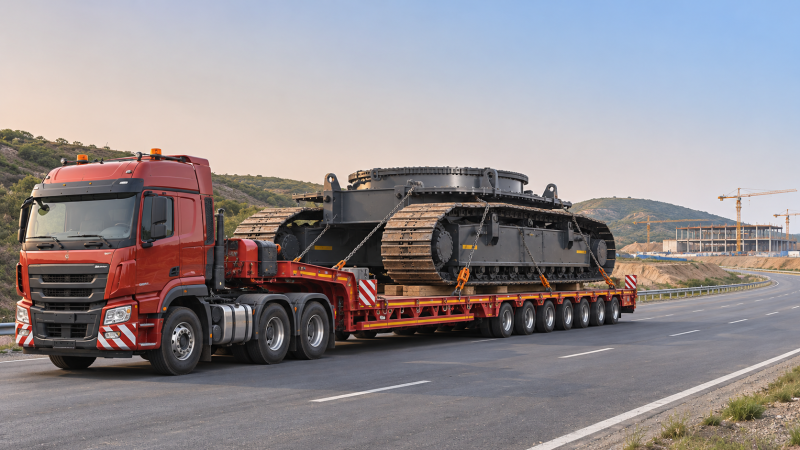
Choosing the right heavy haulage equipment for construction starts with more than load capacity. Project managers must also account for cargo dimensions, axle limits, road gradients, bridge clearances, ground conditions, and permit requirements along the proposed route. A mismatch can lead to delays, higher costs, or safety risks. The best configuration is the one that can carry the actual load, negotiate the whole route, and deliver it to a site that is ready to receive it.
Start with the transport load, not the machine’s operating weight
The weight shown in a machine brochure is a useful starting point, but it is not necessarily the weight that will travel. A crawler crane may be split into a base machine, boom sections, counterweights and other components. A tunnel boring machine may move as several large assemblies. Attachments, transport frames, lifting gear, remaining fluids and temporary protection can all change the load that the carrier must handle.
Ask the equipment supplier or engineering team for a transport breakdown: the weight and dimensions of each piece, its centre of gravity, approved support points and lifting points, and any restrictions on orientation. Where documentation is incomplete, establish how the weight and centre of gravity will be verified before the move. A guessed centre of gravity is not a sound basis for trailer loading or lifting design.
Then add the transport equipment to the picture. The relevant gross weight includes the cargo, trailer, tractor units and associated equipment. A trailer rated for the cargo weight alone may still be unsuitable once axle loads, deck strength or the weight of the full combination are considered. Concentrated loads matter too: a heavy component resting on a small footprint may require engineered load spreading, even if the trailer has sufficient overall capacity.
Disassembly deserves an early commercial discussion. Removing a boom, counterweight or crawler assembly may make the road move practical, but it also adds crane time, labour, reassembly work and potential testing at the destination. The cheapest-looking transport configuration is not always the cheapest delivery.
Choose the route before committing to a trailer
A route that works for a normal construction delivery may be unusable for an abnormal load. The critical restriction is often not obvious from a map: a turning island, a low utility line, a bridge with load restrictions, or a temporary work zone can dictate the whole move.
A route survey should follow the proposed combination from loading point to final set-down area, including port gates, private roads and the last turn inside the site. It needs to consider the loaded dimensions and vehicle geometry, not just the trailer’s nominal length. On tight bends, the rear of a long load can sweep beyond the path of the tractor; on crests and dips, deck clearance can become the limiting factor.
For bridges and other structures, do not assume that a posted limit tells the full story for an abnormal vehicle. The relevant authority or asset owner may require details of total weight, axle loads, axle spacing and vehicle configuration for an assessment. Adding axles can help distribute weight, but it also makes the combination longer and does not automatically make every bridge crossing acceptable.
Gradients require more than a check of engine power. The carrier needs to assess traction, braking, the direction of travel, road surface, weather exposure and whether additional tractor units or a controlled descent are necessary. A steep approach to a construction site can be more demanding than the highway section that precedes it.
Survey information also has a shelf life. Construction activity, overhead works and seasonal ground conditions can change between planning and transport. Agree who will recheck critical restrictions and when, particularly if the permit is obtained well ahead of the move.
Compare equipment against the controlling constraint
There is no universally best trailer for heavy construction loads. The useful question is which configuration resolves the route’s controlling constraint without creating an unacceptable problem elsewhere.
Low-bed and low-loader trailers
A low deck can help when transporting tall excavators, plant or large machine assemblies under overhead restrictions. It can also provide a lower loading height for some cargo. The trade-off is ground clearance: a low trailer that passes beneath an obstruction may struggle over a sharp crest, ramp or uneven site entrance. Check the loaded deck height and underbody clearance for the actual route, not simply the advertised deck height.
Extendable trailers
Extendable configurations can accommodate long loads such as crane components or structural members. Their challenge is manoeuvrability, along with the need to support the cargo at approved points. A longer deck does not remove restrictions on load overhang, turning geometry or the cargo’s own structural capacity. Review the proposed support arrangement with the cargo owner before assuming that an extra-long trailer is the answer.
Hydraulic modular trailers
Modular trailers can be configured with multiple axle lines for exceptionally heavy or large components. Hydraulic suspension and steering arrangements can help manage difficult loads and manoeuvres, subject to the equipment’s design and operating limits. They also bring planning complexity: the configuration, ballast or tractor requirements, axle reactions and route approvals must be worked out for the specific move.
For a large TBM component, for example, a modular arrangement may address weight distribution while the component’s width still makes a road section impractical. The alternative might be a different route, further disassembly, a waterborne leg or a change in delivery sequence. Each option should be assessed as a complete transport and handling plan rather than as a trailer quotation alone.
Self-propelled modular transporters
Self-propelled modular transporters are particularly useful for controlled moves in ports, fabrication yards and construction sites where precise positioning matters. Their suitability for any public-road movement depends on the equipment, route and local requirements; it should not be assumed. They also need a competent ground and load-spreading assessment, especially during turns or when the cargo is transferred on or off the transporter.
The final metres can decide the whole plan
A successful highway move can still end in a costly wait outside the gate. Site access must accommodate the full combination, including escorts and any supporting equipment. Check gate width, turning space, overhead services, underground utilities, slopes and the proposed waiting area. If the trailer needs to reverse, confirm that there is a safe, workable path and an agreed traffic-control arrangement.
Ground bearing is often misunderstood. A firm-looking surface is not proof that it can carry concentrated wheel loads or crane outrigger loads. The civil or geotechnical team should assess the relevant areas using the expected loads and ground information, then specify any mats, temporary works or access improvements. Conditions can change after rain or other site activity, so the plan should include a pre-delivery inspection.
Unloading needs the same attention as transport. A crane may be able to lift the component in isolation but lack room to rig, set outriggers or place it at the required radius. Alternatively, the transporter may need to lower the load onto stools before the crane can connect. Resolve the sequence, lifting responsibilities and temporary support details before the vehicle arrives.
Treat permits and interfaces as schedule risks
Oversize and overweight transport rules vary by jurisdiction and route. Depending on the move, approvals may involve road authorities, bridge owners, utilities, police or other parties. Requirements can cover axle loading, travel times, escorts, signs, traffic management and temporary removal or protection of roadside infrastructure. Confirm the applicable conditions with the responsible authorities and the carrier; do not carry assumptions from one region into another.
Permit work should run alongside engineering, not after the purchase order. A change in trailer configuration, cargo weight or route can require a revised assessment or approval. Give the carrier a controlled set of load information, and agree how changes will be communicated. This is especially important when the machinery supplier, freight forwarder, haulier and construction contractor are different organisations.
The same applies to cargo securing. Tie-down points on a machine are not automatically suitable lifting points, and lifting points are not automatically suitable for restraint during transport. The securing arrangement should reflect the cargo manufacturer’s instructions, the carrier’s engineering and the rules applicable to the journey. Protective packing must not conceal an insecure load or prevent inspections at planned stops.
Make the decision on delivered cost and workable risk
Compare options using a common scope. One quote may include route surveys, escorts and unloading support; another may price only the road movement. Ask for assumptions and exclusions in writing, including responsibility for permits, road modifications, storage, waiting time, weather delays, insurance and reassembly. A lower transport rate can be outweighed by additional crane hire or a missed installation window.
The most useful comparison is often between two or three complete scenarios: a larger assembled load on a more demanding route, a more disassembled load with additional handling, or a multimodal move with transfers at a port or rail terminal. For each, identify the constraint that could stop the move and the evidence needed to clear it. A preliminary route assessment is valuable, but it is not a substitute for confirmed permissions and a final transport plan.
This is where machinery intelligence and transport planning need to meet. TF-Strategy’s focus on TBMs, crawler cranes, mining equipment and large construction machinery reflects a practical reality: transport decisions depend on the machine’s physical design as much as on the road network. Before reserving equipment, bring the supplier, carrier, lifting team and site team together around the same load drawings, route survey and delivery sequence. If one critical interface remains unverified, treat it as an open decision—not as a detail to solve when the convoy arrives.
Have questions about this sector analysis, or seeking best practices specific to your niche? Drop us a line below and let the senior consultants at TF-Strategy assist you.
Related News
 Nov 15, 2026Heavy Haulage Equipment for Construction: Choosing by Load and RouteChoose heavy haulage equipment for construction with confidence. Compare load capacity, route restrictions, site access and delivered costs.
 Nov 14, 2026What Is an Equipment Reference Database and What Data Does It Contain?Discover what an equipment reference database contains, from model specifications to source data, and learn how to compare machinery with confidence.
 Nov 13, 2026Tunnel Boring Machine Safety Certification: What Must Be Verified?Tunnel boring machine safety certification: discover what to verify, from risk assessments and safety systems to site interfaces and commissioning.
 Nov 11, 2026Choosing Equipment Capacity for Different Workloads and ApplicationsExplore equipment application by capacity to match machines to real workloads, reduce bottlenecks and choose cost-effective solutions with confidence.

Ms. Elena Rodriguez
Weekly Insights
Stay ahead with our curated technology reports delivered every Monday.