
Smart Mining Equipment Trends: Automation and Fleet Monitoring in Mines
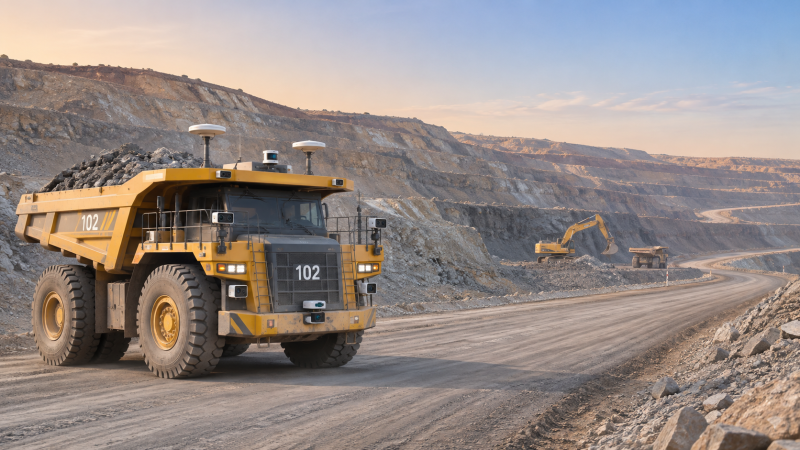
Smart mining equipment trends are reshaping how mining companies manage productivity, safety, and operating costs. Connected equipment can improve visibility, but business value depends on execution.
From autonomous haulage and remote-controlled excavators to real-time fleet monitoring, these technologies give decision-makers greater insight into equipment performance and site operations.
Successful adoption requires more than investing in new machines: it demands a clear understanding of infrastructure readiness, integration, workforce needs, and total cost of ownership.
For most operators, the strongest first step is to identify a costly operational constraint, establish a reliable baseline, and select technology that addresses it.
Which Smart Mining Investments Deliver Business Value?
Smart equipment creates value when it reduces measurable losses: unplanned downtime, waiting time, excess fuel consumption, inconsistent loading, or exposure to hazardous operating conditions.
Fleet monitoring often provides an accessible starting point because it reveals how existing machines are used. Automation can offer greater value where operating conditions support repeatable processes.
For example, a mine with frequent truck queues may benefit more from dispatch improvements than from adding vehicles. Better utilization can release capacity already owned.
Conversely, a remote site struggling to staff a consistent haulage operation may find a stronger case for automation, provided its production plan justifies the investment.
Decision-makers should compare opportunities using the same framework: expected production benefit, implementation cost, operational risk, workforce impact, and time required to realize value.
A technology that performs well at one mine may disappoint elsewhere. Orebody characteristics, equipment condition, haul distances, climate, and mine life all affect the outcome.
How Is Autonomous Haulage Changing Open-Pit Operations?
Autonomous haulage systems coordinate equipped trucks through defined routes and operating rules. They can support consistent driving, predictable traffic flow, and continuous operations between planned interruptions.
The potential business case includes improved asset utilization and fewer variations in driving behavior. Actual results depend on road quality, dispatch discipline, maintenance, and site design.
Automation also moves personnel away from some vehicle operating hazards. However, autonomous trucks introduce different risks involving vehicle interactions, communications failures, and access to controlled areas.
Before investing, assess whether haul routes are stable enough for automation and whether mixed traffic can be managed safely. Frequent route changes may increase operating complexity.
Mine planners should examine how autonomous trucks interact with loading equipment, crushers, workshops, and manually driven vehicles. Bottlenecks at these interfaces can limit fleet-wide gains.
Infrastructure requirements may include positioning systems, communications coverage, traffic management, and control facilities. Their cost must be included alongside vehicles, software, and implementation services.
For existing fleets, retrofitting may reduce replacement spending, but compatibility varies by machine model and condition. Validate vendor support, warranty effects, and integration requirements early.
Where Do Remote-Controlled Excavators Make Sense?
Remote operation allows personnel to control equipment from a location away from the machine. This can reduce exposure around unstable ground, blasting areas, or difficult access points.
For large excavators, the strongest applications typically involve a clear safety or staffing need and operating conditions that can support dependable video, control, and communications.
Remote operation does not automatically improve digging performance. Camera visibility, network latency, operator familiarity, and the physical characteristics of the work can affect cycle times.
Evaluate a proposed deployment against both safety outcomes and productivity. Compare tonnes loaded, truck waiting time, operator workload, and recovery procedures under representative site conditions.
Some applications may combine remote control with operator assistance, such as payload guidance or machine health alerts. These functions should support, rather than overwhelm, the operator.
Decision-makers should also budget for control rooms, ergonomic design, cybersecurity, training, and backup procedures. A remote workstation is only one part of the operating system.
What Should Fleet Monitoring Actually Improve?
Fleet monitoring turns machine and operational data into information for dispatchers, maintenance teams, and managers. Its value depends on decisions made from that information.
A useful system can reveal idle time, location, payload, fuel use, equipment status, and fault codes. Available data varies by manufacturer, machine age, and connectivity.
Start with a question such as why trucks wait at a shovel, why an excavator misses production targets, or which failures cause recurring downtime.
Then identify the minimum data needed to answer it. Collecting every available signal can increase integration costs without improving decisions or accountability.
For haulage, compare loading time, travel time, queue time, dumping time, and delays by shift. This separates traffic constraints from equipment availability problems.
For excavators, examine utilization, loading cycles, payload consistency, and maintenance interruptions together. High machine availability alone does not guarantee that equipment is producing effectively.
Managers should agree on common definitions before comparing sites or suppliers. Terms such as availability, utilization, delay, and operating hour can otherwise produce misleading results.
Can Predictive Maintenance Reduce Downtime?
Condition monitoring uses information such as temperatures, pressures, vibration, fluid analysis, and fault codes to identify developing equipment problems before they cause a breakdown.
More advanced predictive tools use historical data and models to estimate failure risk. Their usefulness depends on data quality, failure history, and the specific component.
A practical first application is monitoring high-consequence components with known failure patterns, such as haul truck drivetrains or critical excavator hydraulic systems.
Start by measuring unplanned downtime, repair costs, and parts consumption. Then test whether alerts provide enough warning for maintenance teams to act effectively.
An alert has limited value if the mine lacks technicians, replacement parts, or a suitable maintenance window. Planning and inventory processes must change alongside technology.
Track false alarms and missed failures as well as avoided downtime. Excessive alerts can erode confidence, while missed failures can create a false sense of security.
Where evidence is limited, treat vendor forecasts as assumptions rather than guaranteed savings. Pilot results should establish which components and operating conditions justify expansion.
What Infrastructure and Data Integration Are Required?
Connected fleets depend on reliable communications across active work areas. Coverage plans should account for pit expansion, elevation changes, weather, equipment movement, and signal obstructions.
Depending on site conditions, operators may use private cellular, Wi-Fi, radio, satellite links, or combinations of these. No single network architecture suits every mine.
Specify what happens when connectivity degrades. Critical functions may require local processing, controlled stopping behavior, data buffering, and tested procedures for restoring normal operation.
Integration is equally important. Fleet data may need to flow between dispatch, maintenance, production reporting, enterprise systems, and equipment supplied by different manufacturers.
Before procurement, ask vendors which data and interfaces are available, how frequently data is updated, and whether access requires additional licenses or proprietary hardware.
Contract terms should define data access, retention, export formats, and responsibilities when a supplier is replaced. These details affect future flexibility and integration costs.
Cybersecurity should cover equipment, networks, remote access, software updates, and incident response. Assign clear responsibilities across the mine operator, equipment suppliers, and service providers.
How Should Leaders Calculate Total Cost of Ownership?
The purchase price is only the beginning. A credible total cost of ownership calculation includes capital expenditure, recurring fees, implementation, support, and operational disruption.
For automation, include vehicle modifications, control systems, network upgrades, positioning infrastructure, site preparation, training, and any changes to roads or traffic management.
For fleet monitoring, account for sensors, connectivity, software subscriptions, data integration, analytics, ongoing administration, and the people needed to turn findings into action.
Estimate benefits against a documented baseline. Relevant measures may include additional productive hours, lower maintenance expenditure, reduced energy use, or production unlocked by fewer delays.
Avoid counting the same benefit twice. For example, improved truck utilization and additional tonnes moved may describe the same operational gain unless the calculation distinguishes them.
Also test whether the mine can sell or process additional output. Higher equipment capacity creates limited financial value if the plant or market is constrained.
Build conservative, expected, and optimistic scenarios for adoption speed, commodity prices, equipment performance, and mine life. Include the cost of delays and implementation overruns.
Compare discounted cash flows over a consistent period and examine payback alongside operational risk. For safety benefits, document expected outcomes without assuming unsupported financial savings.
How Can Mining Companies Pilot and Scale Successfully?
Choose a pilot area with a material problem, reliable baseline data, and enough operational stability to interpret results. Assign one accountable business owner.
Set a pilot duration that captures relevant shifts and operating conditions. Agree in advance on success measures, data access, safety controls, and decision gates.
Useful measures might include queue time, productive hours, unplanned maintenance, payload variation, or operator exposure. Select indicators that match the original business problem.
Compare results with a suitable baseline or control group where feasible. Adjust for changes in haul distance, ore conditions, weather, and production plans.
Involve operators, dispatchers, maintenance personnel, and safety teams from the start. Their knowledge helps identify impractical workflows and builds confidence in new procedures.
Training should cover routine use, abnormal situations, handovers, and recovery after system failures. Supervisors also need to understand how responsibilities change across shifts.
Before scaling, confirm that results persist beyond initial vendor support. Review integration costs, staffing requirements, cybersecurity, and whether the next deployment faces different constraints.
A phased rollout allows teams to refine processes while limiting exposure. It also gives leadership opportunities to stop or redirect spending when evidence falls short.
Which Trends Should Decision-Makers Watch Next?
Equipment suppliers are expanding machine assistance, remote operation, and automated workflows. The practical question is whether these capabilities fit the mine’s operating model and existing fleet.
Analytics are also becoming more accessible, including tools that combine maintenance and operational data. Their value still depends on trustworthy inputs and clear intervention processes.
Electrification adds another layer to fleet decisions. Battery charging, power supply, duty cycles, and haul profiles can affect dispatch strategy and infrastructure investment.
As fleets become more connected, interoperability will matter more. Buyers should assess whether new equipment can share useful data with current systems throughout its service life.
Smart mining equipment trends point toward more coordinated operations, but the best investment remains site-specific. Prioritize measurable constraints, validate results, and scale when the business case holds.
Have questions about this sector analysis, or seeking best practices specific to your niche? Drop us a line below and let the senior consultants at TF-Strategy assist you.
Related News
 Nov 17, 2026Smart Mining Equipment Trends: Automation and Fleet Monitoring in MinesExplore smart mining equipment trends, from automation to fleet monitoring, and discover how to assess costs, improve productivity, and scale with confidence.
 Nov 12, 2026Predictive Maintenance for Tunneling Equipment: Sensors That Detect WearExplore tunneling equipment innovations predictive maintenance teams use to detect wear, interpret sensor trends and plan timely TBM inspections.
 Nov 04, 2026Mining Industry Developments: Automation, Electrification and Operating CostsExplore mining industry developments in automation and electrification, and learn how to evaluate fleet investments, productivity and operating costs.
 Oct 29, 2026Middle East Heavy Haulage Equipment Market: Energy and Infrastructure DemandExplore the heavy haulage equipment Middle East market for energy and infrastructure demand, route challenges, and fleet investment insights to make smarter buying decisions.
Prof. Marcus Chen
Weekly Insights
Stay ahead with our curated technology reports delivered every Monday.