
Heavy Machinery Standards Guide: Key ISO, CE, and Safety Requirements for Equipment Evaluation
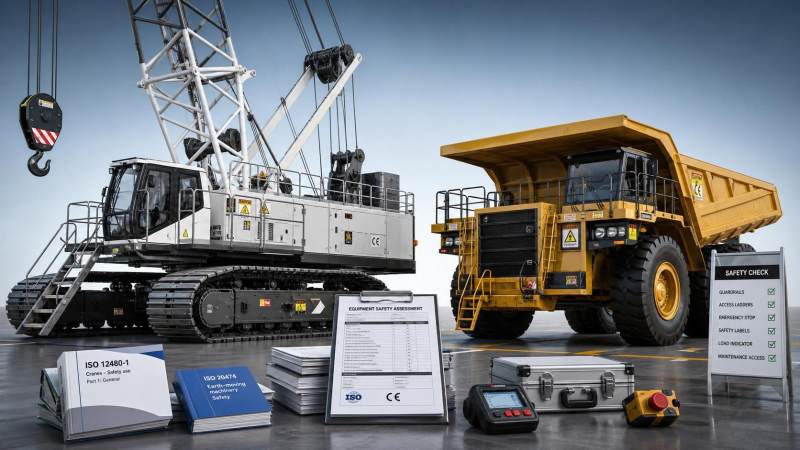
Why does a heavy machinery standards guide matter before equipment approval?
A useful heavy machinery standards guide does more than list rules. It creates a practical filter for judging whether a machine is safe, documented, and fit for demanding work.
That matters even more in TBM projects, open-pit mining, crawler crane lifting, road machinery fleets, and mining haulage operations. In these environments, small compliance gaps can become major project risks.
In real evaluations, the problem is rarely a missing logo on a nameplate. More often, the weakness sits in incomplete risk assessment, unclear guarding logic, or mismatched documentation.
This is where a heavy machinery standards guide helps. It connects ISO requirements, CE conformity expectations, and site-level safety controls into one review path.
TF-Strategy follows this connection closely across global infrastructure equipment. The value is not abstract. Physical parameters, operating methods, and compliance evidence must align before equipment can be trusted.
When people ask about ISO and CE, what are they really checking?
Usually, they are asking three different questions at once. Is the machine designed against recognized standards? Has conformity been formally declared? Can the safety logic survive actual field conditions?
ISO standards generally provide the technical framework. They define methods, terminology, risk reduction principles, testing approaches, and safety performance expectations for machinery and subsystems.
CE marking is different. It is not a general quality badge. It signals that applicable European requirements have been addressed, supported by technical files and a Declaration of Conformity.
A heavy machinery standards guide should therefore separate design standards from market-access obligations. Mixing them creates false confidence during inspection or procurement review.
For heavy equipment, the most commonly checked areas include machinery safety principles, electrical safety, hydraulic integrity, noise, emergency stops, guarding, and control system reliability.
In practice, a machine may reference ISO standards correctly yet still fail a conformity review if documentation, language, labels, or risk files are incomplete.
A quick distinction table helps avoid that confusion
Which standards usually drive equipment evaluation in heavy industry?
The exact list depends on machine type, region, and use case. Still, most heavy machinery standards guide reviews start from a familiar group of baseline references.
- ISO 12100 for risk assessment and risk reduction principles.
- ISO 13849 or IEC 62061 for safety-related control systems.
- ISO 4413 for hydraulic fluid power safety.
- ISO 13850 for emergency stop function design.
- ISO 14120 and ISO 14119 for guards and interlocking devices.
- Relevant machine-specific standards for cranes, earth-moving equipment, road machinery, or mining systems.
For crawler cranes, lifting charts, overload protection, stability logic, and assembly instructions become central. For TBM systems, rotating cutters, electrical isolation, hydraulic redundancy, and confined-space servicing deserve stronger review.
Open-pit excavators and mining dump trucks bring another layer. Brake systems, slope operation limits, fire suppression, visibility, and remote monitoring interfaces often become decisive.
A heavy machinery standards guide should therefore be machine-specific after the baseline check. One universal checklist is not enough for earth engineering at global project scale.
What documents should be on the table before anyone accepts the machine?
This is where many reviews become shallow. Inspectors may see certificates, but they do not always test whether the paperwork explains the actual machine configuration.
A stronger heavy machinery standards guide treats documentation as evidence, not decoration. The file set should support traceability from design assumptions to operating controls.
- General arrangement drawings and key technical specifications.
- Risk assessment with hazard list, residual risks, and applied controls.
- Electrical and hydraulic schematics matching delivered configuration.
- Functional description of safety circuits and interlocks.
- Test reports, load tests, brake tests, and commissioning records.
- Operation, maintenance, and lockout instructions in the required language.
- Declaration of Conformity where CE obligations apply.
Need extra caution with modified equipment. Retrofit controls, new attachments, software updates, and derated components can invalidate old paperwork without obvious visual signs.
TF-Strategy often highlights this point when tracking equipment evolution. Digitalization, remote control, and new-energy platforms change compliance evidence requirements, not just operating performance.
Where do evaluations most often go wrong, even when the machine looks compliant?
The most common error is relying on labels instead of system behavior. A machine can carry markings and still expose operators or maintenance teams to avoidable hazards.
Another weak point is unclear intended use. If a machine will work at high altitude, in corrosive conditions, inside tunnels, or on steep haul roads, standard checks must reflect that reality.
Control system integration is also a recurring problem. Emergency stop response, restart prevention, and fault diagnostics may perform differently once third-party devices are added onsite.
A practical heavy machinery standards guide should flag these review traps:
- Assuming CE marking covers local operating risks.
- Accepting generic manuals that do not match the delivered model.
- Ignoring access hazards during service, isolation, or rescue.
- Treating software updates as non-safety changes.
- Overlooking compatibility between attachments and base machine limits.
More often than not, incidents grow from combined weaknesses. A missing guard alone may not cause failure, but paired with poor signage and unclear maintenance steps, the risk rises fast.
How should a heavy machinery standards guide shape an actual evaluation workflow?
The most effective workflow moves from paper review to physical verification, then to functional testing. That order saves time and exposes contradictions early.
A lean but disciplined sequence often works best:
- Confirm machine identity, configuration, and intended use conditions.
- Map applicable standards and conformity obligations by region.
- Review documentation for traceability and revision consistency.
- Inspect guards, controls, warnings, access points, and energy isolation.
- Run functional safety checks, including stops, alarms, and fail-safe states.
- Record deviations with severity, corrective action, and closure evidence.
For large fleets or multinational projects, standardization of the review form becomes critical. It keeps evaluations consistent across suppliers, regions, and machine categories.
That is also where intelligence platforms such as TF-Strategy become useful in the background. Cross-border project data, equipment trends, and evolving safety expectations help reviewers avoid outdated assumptions.
A compact decision table for field use
What is the sensible next step after the checklist is complete?
A heavy machinery standards guide is most valuable when it leads to a clearer acceptance decision. The point is not paperwork volume. The point is defensible judgment.
If the machine passes, keep the evidence set organized for audits, insurance reviews, and future modifications. If gaps remain, rank them by operating risk rather than administrative convenience.
For complex assets such as TBMs, crawler cranes, ultra-large excavators, and mining trucks, revisit the evaluation after commissioning changes or control upgrades. Compliance is not frozen at delivery.
A solid heavy machinery standards guide should finally help compare machines on more than price or capacity. It should support safer deployment, lower lifecycle disruption, and better confidence in strategic infrastructure work.
The practical next move is simple: define intended use, map applicable standards, verify the technical file, and test real safety functions under site-relevant conditions. That sequence usually reveals what labels alone cannot.
Related News
 Oct 06, 2026Selecting Petrochemical Overhead Cranes for Hazardous Areas and Heavy Process LoadsPetrochemical overhead cranes for hazardous areas: learn how to match capacity, duty, controls, corrosion protection, and maintenance access for safer, reliable lifts.
 Oct 05, 2026Tunneling Equipment Specification Planning: Key Criteria for Ground and Project RisksEquipment specification planning tunneling: learn how to match TBM systems to ground risks, geometry, safety, logistics, and lifecycle cost for more reliable project delivery.
 Oct 04, 2026Nuclear Lifting Equipment Cost: Budgeting for Compliance, Testing, and Lifecycle RiskNuclear lifting equipment cost explained: budget for compliance, proof-load testing, installation, documentation, and lifecycle risk to make confident procurement decisions.
 Oct 03, 2026How to Assess TBM Manufacturers for Hard-Rock Tunneling Projects?Choose the right tunnel boring machine manufacturer for hard-rock projects. Explore key criteria for design, lifecycle cost, factory quality, and service support.

Ms. Elena Rodriguez
Weekly Insights
Stay ahead with our curated technology reports delivered every Monday.