
How to Assess a High-Altitude Mining Equipment Manufacturer for Remote Projects
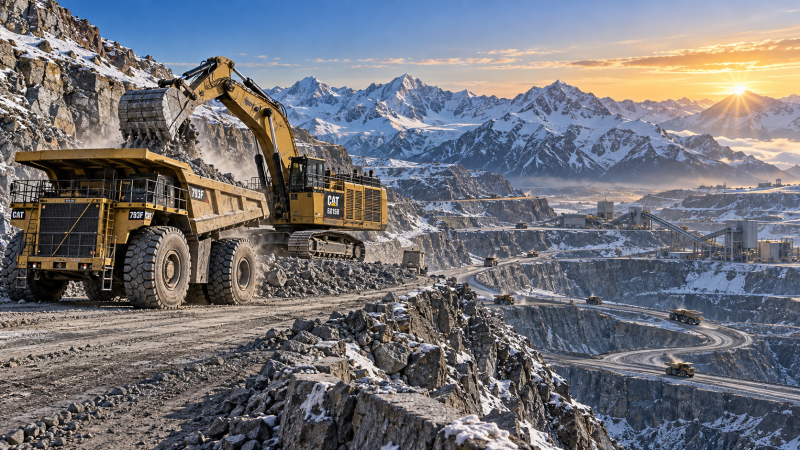
A high-altitude mining equipment manufacturer should be assessed as a remote-site operating partner, not merely as a machine supplier. At elevation, lower air density reduces engine output and cooling capacity; cold starts, steep haul roads, abrasive dust, limited fuel quality control, and long supply lines compound the problem. A machine that meets nominal payload, digging force, or cycle-time specifications at a test site may not deliver the same result at an exposed mine with limited maintenance infrastructure.
The central procurement question is therefore not whether a manufacturer offers a “high-altitude model.” It is whether the proposed equipment configuration, support model, documentation, and supply chain are credible for the exact altitude, climate, geology, logistics route, and production plan of the project. The strongest assessment separates proven capability from broad marketing claims and prices the operational consequences of any uncertainty before a contract is signed.
Start with the operating envelope, not the catalogue specification
“High altitude” is not a single technical condition. The effect on equipment depends on the actual elevation range, daily temperature variation, grade profiles, haul distances, dust loading, humidity, fuel characteristics, and required production continuity. A mine operating at a relatively stable elevation with maintained roads presents a different equipment problem from a remote operation where units travel between lower and higher benches, face long ramps, and experience severe overnight freezing.
Procurement requirements should convert site conditions into an operating envelope that each manufacturer must address in writing. This should include:
- minimum, normal, and maximum operating elevations;
- ambient temperature range, including cold-start conditions and solar heat exposure;
- road gradients, rolling resistance assumptions, and typical haul profiles;
- material density, fragmentation, moisture, abrasiveness, and expected bucket or body fill factors;
- dust, snow, rain, wind, and access-road conditions;
- fuel availability, fuel cleanliness controls, electrical supply, and communications reliability;
- site access constraints for transport, assembly, cranes, workshops, and storage.
This is more than an engineering exercise. Without a common operating envelope, suppliers can submit technically compliant proposals based on different assumptions. One manufacturer may quote payload performance on a short level haul; another may account for grade, altitude derating, and thermal limits. The lower initial bid can then conceal a lower effective production rate or higher operating burden.
Examine derating as a system issue
At altitude, naturally aspirated engines are particularly sensitive to reduced oxygen availability, while turbocharged engines still face limits related to air density, turbocharger performance, exhaust temperatures, and cooling-system capacity. The relevant question is not simply whether the engine is turbocharged. It is how the entire powertrain performs at the stated elevation and duty cycle.
Request manufacturer-specific data for net engine power, torque, fuel consumption assumptions, cooling capacity, and permissible duty cycle at the required operating altitude. The data should identify the applicable machine configuration, emissions package, cooling package, fan arrangement, and ambient temperature conditions. Generic engine maker literature is not enough if the installed machine has different intake routing, aftertreatment layout, radiator sizing, hydraulic demand, or transmission calibration.
For haul trucks, the interaction between payload, gradeability, retarder capacity, braking performance, and ambient temperature matters as much as peak horsepower. For excavators and loaders, hydraulic response under sustained load, cooling performance during repetitive loading, and fuel-system behavior in cold conditions deserve close attention. Drills, crushers, and auxiliary power equipment require the same scrutiny because a production bottleneck may sit outside the primary loading-and-hauling fleet.
A credible high altitude mining manufacturer should be able to explain where its stated performance limits come from: engineering calculations, component ratings, controlled validation, installed-base operating data, or a combination of these. The answer does not need to disclose confidential design details, but it should distinguish between guaranteed capability and expected performance under assumptions.
Ask for evidence that matches the equipment and the site
Reference lists alone are weak evidence. A supplier may have delivered machines to a highland region without having supported comparable duty, payload class, climate, or remoteness. The relevant evidence is specific: the same or closely related machine family, comparable elevation, similar production intensity, and a service arrangement that resembles the planned project.
Useful diligence questions include:
- Which installed units operate at comparable elevation, and what configuration differences exist from the proposed machine?
- What recurring technical issues have been identified in those environments, and what design or maintenance changes were made?
- Are altitude-related restrictions reflected in operating manuals, maintenance schedules, or warranty conditions?
- Can the manufacturer provide technical records showing cooling, powertrain, brake, and hydraulic system suitability for the declared conditions?
- Which local dealer, branch, or contracted service organization supports the reference fleet?
Reference calls can be valuable, but they should focus on measurable operating questions rather than general satisfaction. Ask about parts lead times, frequency of field-service visits, technical escalation speed, availability of trained technicians, accuracy of maintenance forecasts, and whether the supplier maintained support during weather disruptions or transport constraints. A reference from a well-connected mine near a regional center does not validate support capability for a project reached only by seasonal roads or difficult cross-border freight routes.
Remote support is part of the equipment specification
In remote mining, downtime is rarely caused by a single failed component alone. It becomes expensive when diagnosis is slow, the required part is not stocked, the technician cannot reach site, or the site lacks the tooling and lifting capacity to complete the repair. A manufacturer’s remote-support model should therefore be evaluated with the same discipline applied to machine capacity.
The proposal should identify the service footprint in practical terms: named service locations, resident or fly-in technical personnel, local language capability where relevant, workshop coverage, available diagnostic tools, and the escalation path to factory engineering. Statements such as “global service network” have limited value unless translated into response commitments and named delivery channels.
Digital monitoring can improve fault detection and maintenance planning, but it does not replace physical support. Telematics require reliable connectivity, clear data ownership, trained users, and an agreed process for converting alerts into site action. Where communications are intermittent, assess whether the machine can store diagnostic data locally and whether technicians can retrieve it without depending on continuous network access.
For critical fleet packages, the contract should define the boundary between supplier responsibility and site responsibility. This includes remote diagnostics, call-out procedures, on-site intervention, warranty labor, software updates, calibration tools, special tooling, and major component change-out support. Ambiguity in these areas often surfaces only after a failure occurs.
Evaluate parts resilience rather than quoted parts availability
“Parts available” is not a meaningful procurement metric unless it identifies which parts, at what stock level, from which location, and under what transport assumptions. Remote projects need a recommended commissioning stock, scheduled maintenance stock, and critical-failure stock based on the actual fleet, operating hours, and replenishment lead time.
Review the proposed initial spare-parts package line by line. It should reflect high-altitude and cold-weather risks where applicable: filters suited to dust conditions, fuel-system components, hoses, seals, electrical connectors, batteries, starter-related parts, cooling-system items, sensors, and wear components. For large equipment, long-lead items such as powertrain assemblies, hydraulic pumps, control modules, wheel-end components, or structural parts require a separate risk discussion rather than a generic recommended-parts list.
Parts planning must also account for customs procedures, import permits, hazardous-goods restrictions, road closures, airport capacity, and the possibility that a component’s country of origin creates trade or compliance exposure. A manufacturer with an excellent central warehouse may still be a weak choice if the route from that warehouse to the mine is fragile.
One useful test is to ask suppliers to model a small number of failure scenarios: a cooling-system failure during peak production, a failed electronic control module, a major hydraulic leak, or an engine-starting issue after prolonged cold exposure. Their response should show expected diagnosis, parts source, transport method, required personnel, site resources, and likely recovery sequence. The point is not to obtain an unrealistic guarantee of zero downtime; it is to reveal whether the organization has a workable recovery mechanism.
Do not treat cold climate and altitude as separate options
High elevation frequently coincides with low temperatures, large diurnal swings, and strong solar radiation. These conditions affect lubricants, batteries, cab heating, fuel handling, elastomers, electrical systems, and operator visibility. A cold-weather package designed for moderate winter use may not be adequate for a remote site where machines remain outdoors and cannot be moved easily into heated maintenance bays.
Review the equipment configuration at component level. Relevant details may include battery capacity and protection, starter system rating, fuel heating or water separation, lubricant viscosity recommendations, coolant concentration limits, insulated or protected lines, cab pressurization, HVAC performance, defrosting capability, lighting, access steps, and emergency shutdown systems. The manufacturer should also state any restrictions on starting, idling, loading, or operating at particular temperatures.
Thermal management deserves special attention because both cold and heat can create risk. Cold ambient conditions may complicate start-up and fluid behavior, while lower air density and high solar load can reduce cooling margins during sustained work. The correct configuration depends on the combined environment, not on selecting every available “extreme climate” option.
Compare lifecycle exposure, not acquisition price
Purchase price is visible and comparable; lost production, emergency freight, premature component wear, and unplanned rental equipment are less visible but can dominate the commercial result. A sound comparison uses a lifecycle cost model built around the project’s own assumptions rather than supplier-provided headline operating-cost figures.
The model should consider fuel or energy consumption at altitude, expected maintenance labor, planned parts consumption, wear-life assumptions, stockholding cost, technician mobilization, training, warranty coverage, rebuild options, and residual value or redeployment potential. It should also distinguish between costs that are fixed by the purchase decision and those that remain under site control, such as operator practice, road maintenance, fuel cleanliness, and preventive maintenance discipline.
Availability guarantees require careful reading. A percentage target has little value without definitions for scheduled maintenance, excluded events, operator-caused damage, waiting time for site access, force majeure, and parts delays. For a remote project, the most useful commercial terms often focus less on a headline availability number and more on response time, stocked critical parts, technical escalation, and remedies when supplier-controlled obligations are missed.
Check manufacturability, delivery control, and change management
Large mining equipment frequently includes configured options, regional compliance packages, attachments, and site-specific modifications. This introduces delivery risk if the supplier cannot clearly control the bill of materials, production slot, inspection process, and documentation. A technically strong manufacturer may still create project delays through unclear responsibility between factory, distributor, transport provider, and commissioning team.
Before award, require a configuration freeze process. The final specification should identify all altitude, climate, safety, fire suppression, communication, lighting, access, guarding, and monitoring requirements. It should also establish how changes are approved, priced, documented, and tested. Informal substitutions can create serious problems when replacement components alter compatibility, certification status, maintenance procedures, or spare-parts commonality.
Factory inspection and acceptance arrangements should match the equipment’s criticality. For complex machines, procurement documentation can require serial-number traceability, test records where applicable, manuals in the required language, software versions, recommended consumables, lifting instructions, transport preservation requirements, and commissioning checklists. These documents are not administrative extras; they determine whether the site can receive, assemble, operate, and maintain the asset safely.
Use compliance as a verification discipline
Compliance obligations vary by jurisdiction and project contract, particularly for emissions, occupational safety, electrical systems, pressure equipment, fire protection, radio communications, and import documentation. The manufacturer should identify what standards and declarations apply to the exact delivered configuration, rather than relying on broad claims that equipment is “internationally certified.”
Where a project specifies ISO-based management expectations, local mining regulations, or lender requirements, confirm whether the supplier’s documentation supports those obligations. The issue is often not whether a machine can be sold into a country, but whether the delivered unit can be accepted by the mine owner, insurer, contractor, and local authorities without costly modification.
Equipment designed for remote high-altitude mines should also be reviewed for maintainability and safety under field conditions: access to filters and service points, lockout provisions, fall protection, emergency egress, onboard fire suppression where required, and the practicality of repairs in cold or windy conditions. A compliant design that cannot be serviced safely at the site still carries operational risk.
A defensible award decision
The preferred manufacturer is rarely the one with the most impressive brochure or the lowest equipment price. It is the supplier that can demonstrate a coherent fit between machine capability, altitude-adjusted performance, environmental configuration, spare-parts resilience, field support, logistics planning, and contractual accountability.
Where evidence is incomplete, the gap should be made visible in the commercial evaluation rather than assumed away. Procurement can request additional validation, require a site-specific engineering review, increase critical spares, tighten service obligations, or retain a contractual remedy. These measures may raise the initial cost, but they can reduce the far larger exposure created when a remote mine depends on equipment that cannot be restored quickly.
For remote projects, confidence should come from traceable assumptions and verifiable support arrangements. That is the standard by which a high-altitude mining equipment manufacturer should be judged.
Related News
 Oct 12, 2026How to Assess a High-Altitude Mining Equipment Manufacturer for Remote ProjectsHigh altitude mining manufacturer assessment guide: compare derating, cold-climate reliability, remote service, parts resilience, and lifecycle risk for smarter project decisions.
 Oct 11, 2026What Drives TBM Cutter Head Material Cost and Life-Cycle Value?Cutter head material cost explained: compare TBM alloys, wear protection, downtime risk, and life-cycle value to choose the most reliable, cost-effective solution.
 Oct 12, 2026How to Read Mining Equipment Performance Reviews Beyond Headline MetricsMining equipment performance reviews explained: learn to assess productivity, availability, maintenance risk, site conditions, and total ownership cost for smarter fleet decisions.
 Oct 11, 2026Payload Management Systems: Preventing Overloads Without Slowing ProductionPayload management helps prevent overloads, protect equipment, and keep production moving. Learn how accurate targets, pass planning, alerts, and calibration improve every load.
Ms. Elena Rodriguez
Weekly Insights
Stay ahead with our curated technology reports delivered every Monday.