
How to Evaluate Heavy Equipment Technical Suppliers: 7 Criteria for Vendor Qualification
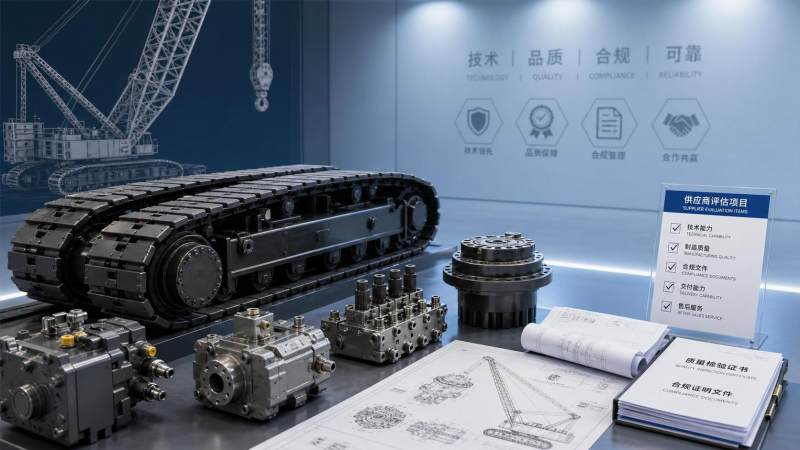
How to Evaluate Heavy Equipment Technical Suppliers: 7 Criteria for Vendor Qualification
Choosing among heavy equipment technical suppliers is no longer just a price comparison. It is a risk-control decision tied to uptime, compliance, lifecycle cost, and delivery performance.
In large infrastructure and industrial projects, the wrong supplier can delay commissioning, weaken safety margins, and raise total cost of ownership long after contract signing.
That is why vendor qualification needs a disciplined framework. The goal is not simply to compare catalogs. It is to verify technical depth, execution reliability, and long-term support capacity.
For sectors such as TBM systems, crawler cranes, mining trucks, excavators, and large road machinery, supplier quality often determines whether equipment performs well under extreme duty cycles.
The seven criteria below offer a practical way to assess heavy equipment technical suppliers and build a shortlist based on operational value, not just commercial promises.
1. Confirm Core Engineering Capability
Start with the supplier’s technical backbone. Many heavy equipment technical suppliers can present polished brochures, but fewer can explain load paths, failure modes, and design margins clearly.
Ask whether the vendor owns core engineering resources or mainly integrates third-party subsystems. This distinction matters when field conditions differ from the original specification.
A qualified supplier should provide evidence in areas such as:
- design calculations for structural, hydraulic, and powertrain components
- finite element analysis or equivalent validation records
- material selection logic for wear, fatigue, and corrosion exposure
- application engineering support for site-specific adaptation
If a supplier cannot discuss technical tradeoffs in practical terms, the risk is obvious. Heavy equipment technical suppliers should be able to connect specifications with real operating conditions.
2. Review Manufacturing Quality and Process Control
Technical competence on paper is not enough. Execution quality inside the factory often separates dependable vendors from those that create hidden downstream costs.
This becomes even more important for welded structures, boom systems, cutterhead components, undercarriage assemblies, and high-pressure hydraulic modules.
Evaluate whether the supplier controls key processes or outsources them without robust supervision. The stronger heavy equipment technical suppliers usually maintain tighter visibility over production consistency.
Look for signs of maturity, including:
- documented welding procedures and welder qualifications
- traceability for steel grades, castings, and critical imported parts
- non-destructive testing records and dimensional inspection reports
- clear nonconformance handling and corrective action workflows
During vendor qualification, factory audit findings often predict field reliability better than generic certificates alone. A clean process map usually matters more than a long slide deck.
3. Check Compliance, Standards, and Documentation Discipline
Compliance is not a back-office detail. For procurement decisions, it directly affects import clearance, project approval, insurance, and site acceptance.
Strong heavy equipment technical suppliers can show how their products align with required standards, regional regulations, and customer-specific documentation protocols.
Review the vendor’s capability to deliver:
- test certificates, inspection dossiers, and quality manuals
- safety and operation documentation in the required language set
- certifications relevant to pressure systems, lifting systems, or emissions rules
- revision control for drawings, spare parts lists, and technical bulletins
In practice, documentation discipline reveals how a supplier manages complexity. If revisions are loose, field teams may install outdated parts or apply obsolete procedures.
For critical projects, this criterion should carry real weight. It is one of the easiest ways to separate responsive heavy equipment technical suppliers from risky ones.
4. Evaluate Application Experience in Comparable Projects
A technically sound product can still fail commercially if the supplier lacks relevant project experience. Similarity matters more than total number of references.
For example, a supplier experienced in standard quarry conditions may struggle in high-altitude mines, soft-ground tunneling, offshore wind lifting, or desert haulage operations.
When comparing heavy equipment technical suppliers, ask for references that match your project on four dimensions:
- equipment class and capacity range
- geology, terrain, or environmental stress
- operating hours, load cycles, and maintenance intensity
- regulatory and logistics complexity
Case studies should include performance data, not just logos. Uptime, parts consumption, major failure history, and response time are far more useful than marketing claims.
Recent shifts in infrastructure and energy projects make this even more important. Heavy equipment technical suppliers now need to support more customized duty profiles than before.
5. Measure Service Network and Parts Support Readiness
A supplier may win the technical review and still create operational pain if after-sales support is weak. In heavy industry, downtime cost can quickly erase any purchase discount.
This is why vendor qualification must include service readiness. The best heavy equipment technical suppliers treat spare parts and field response as part of the technical offer.
Check the supplier’s support model in detail:
- regional spare parts stock and replenishment lead time
- availability of resident technicians or rapid dispatch teams
- remote diagnostics, data access, and troubleshooting protocols
- training support for operators and maintenance crews
Ask for service level commitments in writing. Verbal assurance means little when a failed pump, gearbox, or control unit is holding up a high-value project.
In practical sourcing work, this criterion often changes shortlist rankings. Heavy equipment technical suppliers with strong field support usually deliver lower lifecycle risk.
6. Assess Commercial Stability and Supply Chain Resilience
Technical quality and service capacity still depend on one basic fact: the supplier must remain stable enough to deliver over the full equipment lifecycle.
This has become more critical as freight volatility, sanctions exposure, raw material swings, and component shortages reshape global heavy equipment supply chains.
During supplier evaluation, review several risk signals:
- financial health and ownership transparency
- dependency on single-source components
- backup manufacturing or alternative sourcing arrangements
- historic delivery performance under disruption
A vendor does not need to be the biggest player. However, heavy equipment technical suppliers should show enough resilience to manage shocks without transferring every delay downstream.
This is especially relevant for specialized machines where replacement options are limited and engineering changes cannot be made quickly.
7. Compare Total Value, Not Just Purchase Price
The final qualification step is commercial, but it should not be superficial. Low initial price can hide higher operating cost, shorter service intervals, or weaker asset utilization.
A better approach is to score heavy equipment technical suppliers against total value over the expected lifecycle. This creates a more defensible sourcing decision.
Build a comparison table around factors such as:
The strongest heavy equipment technical suppliers are not always the cheapest. They are the ones that protect output, reduce uncertainty, and support performance through the full operating cycle.
A Practical Qualification Approach
To make these criteria usable, apply them as a weighted scorecard. That keeps vendor discussions structured and reduces bias from price pressure or brand familiarity.
A simple process works well:
- define the operating risk profile of the project
- assign weights to engineering, quality, service, and commercial factors
- request objective evidence from each shortlisted supplier
- validate claims through audits, references, and technical interviews
- compare total value and implementation risk before award
This approach is especially useful when evaluating heavy equipment technical suppliers for strategic assets where downtime, safety incidents, or late delivery carry disproportionate consequences.
In fast-changing sectors tracked by TF-Strategy, the clearer signal is this: technical sourcing now sits at the intersection of engineering, resilience, and long-term project economics.
A disciplined vendor qualification process helps turn that complexity into better decisions. When heavy equipment technical suppliers are assessed through these seven criteria, supplier selection becomes far more reliable and far more valuable.
Related News
 Oct 17, 2026Tunnel Boring Machine Supplier List: Compare TBM Types and Service CoverageExplore our tunnel boring machinery supplier list to compare EPB, slurry and hard rock TBMs, assess service coverage and lifecycle costs, and build a smarter procurement shortlist.
 Oct 16, 2026Heavy-Duty Petrochemical Lifting: Selecting Cranes by Load, Radius, and Site AccessExplore heavy-duty petrochemical lifting solutions. Compare cranes by load, radius, site access, and ground support to reduce project risk and optimize lifting costs.
 Oct 15, 2026Crane Selection for Petrochemical Turnarounds: Capacity, Radius, and Site AccessExplore petrochemical lifting solutions cranes can deliver, with expert guidance on capacity, working radius, and site access to help you plan a safer, more efficient turnaround.
 Oct 14, 2026High-Capacity Heavy Lifting Solutions: Matching Load, Radius, and Ground ConditionsDiscover heavy lifting solutions high capacity projects demand—compare load charts, working radius, and ground conditions to select a feasible, cost-effective system.
Ms. Elena Rodriguez
Weekly Insights
Stay ahead with our curated technology reports delivered every Monday.