
Underground Construction Methods Comparison: TBM, Drill and Blast, or Cut-and-Cover?
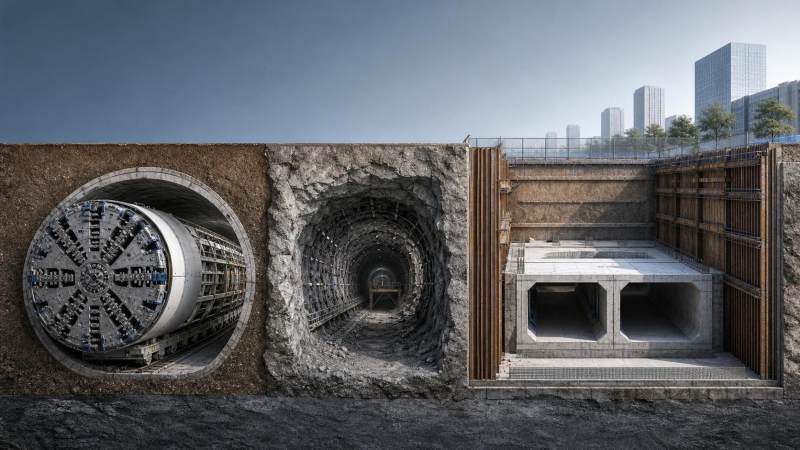
Underground Construction Methods Comparison: TBM, Drill and Blast, or Cut-and-Cover?
Choosing the right tunneling approach can determine a project’s cost, schedule, safety, and long-term performance.
This underground construction methods comparison looks at when TBM, drill and blast, or cut-and-cover creates the strongest project value.
For complex infrastructure, the method decision is rarely only technical.
It also shapes procurement, stakeholder management, logistics, environmental exposure, and commissioning risk.
That is why an effective underground construction methods comparison must connect geology with real delivery conditions.
In practice, the best option is the one that balances ground behavior, access limits, urban sensitivity, and construction productivity over the full project cycle.
Why the method decision matters early
An underground construction methods comparison should begin during concept design, not after procurement starts.
Late method changes often create redesign, claims exposure, utility conflicts, and major schedule resets.
The earlier the decision, the better the alignment between alignment geometry, shaft planning, and construction sequence.
This also improves cost certainty for ventilation, spoil handling, segment supply, and traffic management.
From a delivery standpoint, early clarity reduces interface risk between design teams, contractors, equipment suppliers, and local authorities.
TBM: best for long, repetitive, controlled excavation
A tunnel boring machine works best when the tunnel is long, alignment is stable, and production continuity matters.
In an underground construction methods comparison, TBM usually leads on consistency, surface settlement control, and urban disruption reduction.
That makes it attractive for metro tunnels, water transfer schemes, utility corridors, and deep transport links.
Where TBM creates value
- Long drives with repeatable section profiles
- Dense urban areas with strict settlement limits
- Projects needing predictable excavation rates after launch
- Workflows that benefit from mechanized lining installation
Still, TBM is not automatically the lowest-risk option.
It requires major upfront capital, long manufacturing lead times, and disciplined logistics from launch to breakthrough.
Mixed ground, sudden water ingress, or frequent cross-passage demands can weaken its productivity advantage.
So in any underground construction methods comparison, TBM must be tested against actual geotechnical uncertainty, not only average ground conditions.
Drill and blast: flexible in hard rock and complex geometry
Drill and blast remains a strong option where geology is predominantly hard rock and tunnel geometry is less uniform.
In an underground construction methods comparison, its biggest advantage is adaptability.
Contractors can adjust blast design, support classes, and excavation sequence as ground conditions evolve.
When drill and blast performs well
- Mountain tunnels with competent rock masses
- Projects with variable tunnel shapes or cavern sections
- Sites where access for large TBM assembly is constrained
- Programs needing staged excavation and localized design changes
The tradeoff is that drill and blast introduces vibration, noise, ventilation complexity, and stricter blast management requirements.
Cycle times are also more segmented than TBM operations.
Drilling, charging, blasting, mucking, scaling, and support installation all depend on disciplined handoffs.
This means the underground construction methods comparison should include workforce capability and blast permitting, not geology alone.
Cut-and-cover: practical for shallow urban corridors
Cut-and-cover is often the most direct solution for shallow alignments near the surface.
Within an underground construction methods comparison, it stands out for construction simplicity and easy access to work fronts.
It is commonly used for stations, underpasses, utility passages, and short tunnel sections in urban transport schemes.
Its strongest use cases
- Shallow tunnel depth with manageable groundwater
- Sites where temporary traffic diversion is acceptable
- Projects needing larger box sections or station structures
- Locations with simpler utility relocation paths
However, surface disruption is its defining weakness.
Road closures, business access impacts, utility relocation, and public communication can dominate the risk profile.
For that reason, an underground construction methods comparison must consider community tolerance and stakeholder timelines.
A method that looks cheaper in direct cost can become expensive when traffic, claims, and public disruption are priced correctly.
Key comparison factors for method selection
A useful underground construction methods comparison should score each option across the same decision framework.
That prevents teams from overvaluing one strong feature while missing larger delivery constraints.
In real projects, five factors tend to drive the final decision.
- Ground conditions, including variability, abrasivity, and water pressure
- Depth, alignment length, and required cross section
- Surface constraints, including roads, buildings, and utilities
- Schedule logic, including equipment lead times and access readiness
- Risk ownership across design, contracting, and operations
Common decision mistakes in underground construction methods comparison
One common mistake is selecting a method mainly on unit excavation cost.
That misses secondary costs tied to shafts, spoil routes, dewatering, segment yards, and utility relocation.
Another mistake is relying on incomplete ground investigation.
A shallow borehole program can distort the whole underground construction methods comparison.
There is also a planning bias around equipment availability.
Teams sometimes favor a method because a supplier is known, even when the site conditions argue otherwise.
A stronger approach is to test each method against scenario ranges, not a single base case.
A practical selection framework
A decision-ready underground construction methods comparison should end with a structured shortlist.
The process below works well for early project screening and option refinement.
- Define the tunnel function, depth, alignment, and access points
- Map critical geotechnical risks and confidence gaps
- Quantify urban, environmental, and utility constraints
- Model schedule paths, including long-lead equipment items
- Compare total installed cost, not only excavation cost
- Stress-test the preferred method against worst-case scenarios
This is where strategic industry intelligence becomes especially valuable.
Resources such as TF-Strategy help decision teams connect machine capability, construction method, and project risk in one view.
That broader lens is useful when market lead times, equipment evolution, and regional contractor capacity are shifting quickly.
The more complex the project, the less effective rule-of-thumb selection becomes.
A disciplined underground construction methods comparison gives teams a clearer basis for choosing TBM, drill and blast, or cut-and-cover with fewer downstream surprises.
Related News
 Oct 13, 2026OEM Equipment Suppliers in Europe: Vetting Quality, Lead Times, and SupportCompare OEM equipment Europe suppliers on quality, lead times, and after-sales support. Discover practical vetting steps to reduce downtime and buy heavy equipment with confidence.
 Oct 12, 2026How to Assess a High-Altitude Mining Equipment Manufacturer for Remote ProjectsHigh altitude mining manufacturer assessment guide: compare derating, cold-climate reliability, remote service, parts resilience, and lifecycle risk for smarter project decisions.
 Oct 11, 2026What Drives TBM Cutter Head Material Cost and Life-Cycle Value?Cutter head material cost explained: compare TBM alloys, wear protection, downtime risk, and life-cycle value to choose the most reliable, cost-effective solution.
 Oct 13, 2026Mining Haulage Services Procurement Checklist for Uptime and Cost ControlMining haulage services procurement checklist for stronger uptime, safer fleet selection, transparent pricing, and better cost control across changing mine conditions.

Ms. Elena Rodriguez
Weekly Insights
Stay ahead with our curated technology reports delivered every Monday.