
How to Read Heavy Equipment Specifications in North America for Fleet Selection
How to Read Heavy Equipment Specifications in North America for Fleet Selection
Choosing the right fleet starts with reading the spec sheet correctly. In North America, that means more than scanning horsepower and operating weight.
A heavy equipment specification North America document is a decision tool. It connects machine capability, transport limits, safety rules, site conditions, and long-term ownership cost.
For fleet selection, small specification details often drive big outcomes. A slightly oversized machine can increase permit costs, trailer complexity, fuel burn, and idle time.
On the other hand, a machine that looks efficient on paper may underperform in altitude, heat, steep haul roads, or continuous-duty cycles.
That is why a heavy equipment specification North America review should focus on usable performance, not headline numbers alone.
Start with the Operating Profile, Not the Brochure Highlights
Before reading any heavy equipment specification North America sheet, define the job. The equipment must fit duty cycle, material type, access limits, and production targets.
This sounds obvious, but it is where many selection errors begin. Teams compare machines before agreeing on the real operating envelope.
Build a short operating profile first:
- Expected payload or lift demand
- Shift length and utilization rate
- Material density and abrasiveness
- Ground bearing limits and slope conditions
- Transport route restrictions
- Regional emissions and safety compliance
Once that profile is clear, each line in the heavy equipment specification North America document becomes easier to judge in context.
Read Ratings Carefully: Gross, Net, Nominal, and Maximum Are Not the Same
Specification language in North America can be precise, but easy to misread. Terms that look similar may describe very different operating realities.
Engine power is a common example. Gross horsepower may include values before certain parasitic losses. Net horsepower better reflects usable installed power.
Payload ratings also need caution. A nominal payload may reflect standard conditions. A maximum payload may only apply in limited cycles or short hauls.
For cranes, lift charts are even more sensitive. Rated capacity depends on radius, boom configuration, counterweight, ground condition, and sometimes wind restrictions.
When reviewing a heavy equipment specification North America sheet, ask three practical questions:
- Is this rating continuous or intermittent?
- What test standard or setup produced the number?
- Does the rating include optional attachments or only base configuration?
Those questions usually reveal whether the machine truly fits the fleet strategy or only looks competitive in a sales comparison.
Match Powertrain Data to Real Duty Cycles
A heavy equipment specification North America review should never stop at horsepower. Powertrain selection depends on how torque, transmission behavior, cooling, and altitude response work together.
In open-pit mining or heavy haul roads, torque rise matters because it supports pulling power under changing grade and rolling resistance.
For road machinery, engine power must be read together with hydraulic demand. The engine may be adequate, yet still leave limited reserve under full paving load.
Cooling capacity is another overlooked line item. High ambient temperature, dust, and long idle periods can degrade performance faster than many teams expect.
The better approach is to compare spec sheet values against site reality:
- Haul grade and average speed
- Altitude derating risk
- Engine load factor during peak shifts
- Fuel quality and service interval impact
This is where technical evaluation becomes more valuable than simple model comparison.
Hydraulic Performance: Flow Alone Does Not Tell the Whole Story
For excavators, TBM support units, cranes, and road machinery, hydraulic figures deserve close reading. Many buyers focus only on pump flow and miss the actual system behavior.
A heavy equipment specification North America sheet should be read through four linked values: flow, pressure, cycle time, and controllability.
Higher flow may improve speed, but not necessarily breakout force or lifting stability. Higher pressure may increase force, but can also raise thermal stress.
Auxiliary hydraulic capacity matters too. Attachments, hammers, cutters, compactors, and specialized tools can shift the true requirement well beyond the base machine setup.
In practical fleet selection, review these points together:
If hydraulic data is incomplete, request the test conditions. Without that, comparison across brands can become misleading.
Dimensions, Weight, and Transport Limits Often Decide the Winner
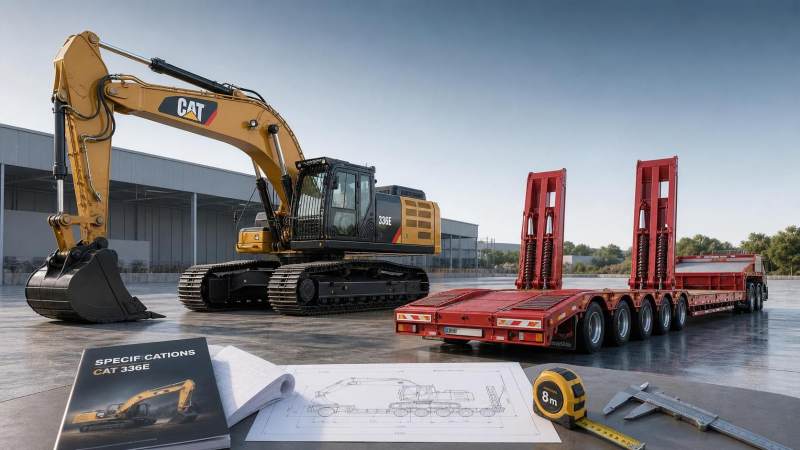
In North America, logistics can be just as important as machine performance. That makes dimensional data a central part of every heavy equipment specification North America review.
Transport width, shipping height, axle loading, and disassembly requirements affect mobilization cost and project readiness.
A machine that needs escort permits, route studies, or special trailers may still be the right choice. But those costs must be visible during selection.
Operating weight also needs context. Standard weight may exclude liners, optional booms, counterweights, blades, or heavy-duty packages.
In soft ground or tunnel support environments, ground pressure is critical. A few specification differences can change matting requirements and site preparation cost.
This is a useful checklist for transport-focused review:
- Shipping configuration versus working configuration
- Trailer compatibility and axle distribution
- Bridge, road, and site access limitations
- Assembly time after delivery
In actual procurement, these details often separate a productive asset from a scheduling problem.
Compliance and Standards Should Be Read as Operational Constraints
A heavy equipment specification North America document usually includes emissions, safety, and certification references. These are not administrative footnotes.
Tier 4 Final compliance, braking systems, rollover protection, lifting standards, and lighting packages can all affect where and how the machine can work.
For mining fleets, site policy may require fire suppression, onboard weighing, fatigue monitoring, or remote diagnostics. Those items should appear in the specification baseline.
For lifting equipment, regional requirements tied to OSHA, ANSI, or project-specific standards may narrow acceptable configurations.
This also means that compliance affects residual value. Machines aligned with current North American standards are easier to redeploy and remarket.
Use Specifications to Estimate Lifecycle Cost, Not Just Purchase Price
The most useful heavy equipment specification North America review connects technical data with total cost of ownership.
Fuel burn, wear life, tire or track consumption, lubrication demand, and planned service intervals should all be translated into fleet economics.
Recent market shifts make this even more important. Higher utilization pressure and tighter project schedules reduce the tolerance for avoidable downtime.
A machine with lower upfront price may create higher cost per productive hour if it needs more transport events, more maintenance labor, or more operator workarounds.
Good evaluators turn specification lines into cost assumptions:
- Estimate fuel and consumables under site load.
- Model service intervals against annual utilization.
- Add mobilization, permitting, and setup time.
- Stress-test resale and redeployment assumptions.
That approach produces a more defensible fleet decision than model-year comparisons alone.
A Practical Review Method for Faster Fleet Selection
A consistent review process helps teams compare equipment faster and with fewer blind spots. It also improves alignment across engineering, operations, and procurement.
Use this sequence when reading any heavy equipment specification North America package:
- Define the site operating profile.
- Separate brochure claims from rated values.
- Verify test standards and configuration assumptions.
- Check dimensions, weight, and transport fit.
- Review compliance against project and regional rules.
- Convert specifications into lifecycle cost inputs.
That method keeps the heavy equipment specification North America review grounded in field reality, not just catalog language.
At TF-Strategy, this is exactly where strategic equipment intelligence creates value. The strongest fleet decisions come from linking machine parameters to method, terrain, compliance, and long-horizon cost.
Read every specification as an operating scenario. When the numbers are placed in real North American conditions, fleet selection becomes faster, safer, and far more reliable.
Related News
 Oct 12, 2026How to Assess a High-Altitude Mining Equipment Manufacturer for Remote ProjectsHigh altitude mining manufacturer assessment guide: compare derating, cold-climate reliability, remote service, parts resilience, and lifecycle risk for smarter project decisions.
 Oct 11, 2026What Drives TBM Cutter Head Material Cost and Life-Cycle Value?Cutter head material cost explained: compare TBM alloys, wear protection, downtime risk, and life-cycle value to choose the most reliable, cost-effective solution.
 Oct 12, 2026How to Read Mining Equipment Performance Reviews Beyond Headline MetricsMining equipment performance reviews explained: learn to assess productivity, availability, maintenance risk, site conditions, and total ownership cost for smarter fleet decisions.
 Oct 11, 2026Payload Management Systems: Preventing Overloads Without Slowing ProductionPayload management helps prevent overloads, protect equipment, and keep production moving. Learn how accurate targets, pass planning, alerts, and calibration improve every load.


Ms. Elena Rodriguez
Weekly Insights
Stay ahead with our curated technology reports delivered every Monday.