
Lifting Equipment Market Analysis: Growth Drivers and Regional Opportunities
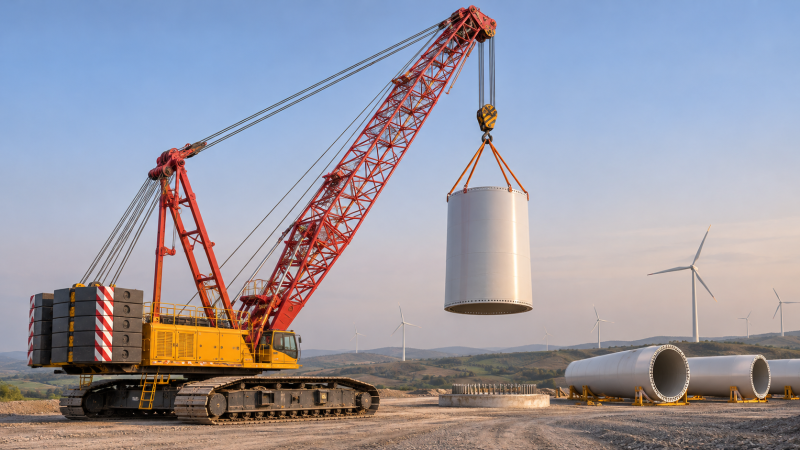
The lifting equipment market is evolving as infrastructure investment, renewable energy projects, and industrial modernization reshape demand for cranes and other heavy lifting solutions. This lifting equipment market analysis examines the commercial drivers and regional opportunities influencing equipment demand, with particular attention to the requirements of large-scale wind, nuclear, and petrochemical projects. For business evaluators, it provides a framework for assessing project pipelines, equipment capabilities, operating costs, and regional market conditions when comparing investment opportunities.
The distinction is between announced construction spending and work that can support a profitable lifting fleet. A project may require a very large crane, but only for a short installation window. Another may use smaller machines for months across several work fronts. Those demand profiles call for different equipment, financing, and commercial arrangements.
Where demand is becoming more specialized
Infrastructure remains a broad source of lifting activity. Bridges, railways, ports, and urban construction need equipment for steel erection, precast placement, and machinery installation. The opportunity is not uniform, however. Dense urban sites may value compact setup and predictable road access more than maximum lifting capacity, while a remote bridge project may place greater weight on transport logistics and ground preparation.
Energy projects can create more concentrated demand for specialized machines. Wind installations require lifts at substantial heights and are sensitive to weather, access roads, and the dimensions of turbine components. As developers consider larger components, a crane that was suitable for an earlier project is not automatically suitable for the next one. The commercial question is whether enough projects in a service area need the same configuration to justify owning it.
Nuclear construction has a different demand pattern. Large modules and components can require carefully engineered lifts, extensive documentation, and coordination with a complex site schedule. A lifting contractor may face a long qualification and planning process before equipment earns revenue. Nuclear opportunity should therefore be assessed alongside the project’s procurement stage, delivery sequence, and applicable site requirements—not simply its headline investment value.
Petrochemical work adds another dimension: congestion. A refinery or processing plant may need heavy equipment for new construction, but maintenance shutdowns can also require lifts inside operating facilities. Restricted access, nearby structures, and short shutdown windows can make setup time and lift planning as commercially significant as the weight being lifted. Delays can be expensive, although the allocation of that risk depends on the contract.
Capacity on paper is not capacity at the job site
A crane’s headline capacity is a starting point, not a commercial specification. Actual capability depends on the manufacturer’s load chart for the selected configuration, including boom length, working radius, counterweight, and other operating conditions. The weight of rigging and lifting attachments must also be accounted for. A machine that appears adequately sized in a preliminary estimate may not be suitable once the lift radius and site constraints are confirmed.
Crawler cranes are attractive for many large projects because they can be configured for demanding lifts and, subject to the manufacturer’s instructions and site conditions, may be able to move with a suspended load. That flexibility comes with assembly, transport, and ground-bearing considerations. All-terrain cranes can offer mobility between sites, but road rules, axle loads, permits, and counterweight transport still shape the real deployment plan.
For an evaluator comparing two fleets, the useful question is not simply which has the larger crane. Ask how often each machine can reach its next job, how much auxiliary equipment it needs, and whether trained crews and support vehicles are available. A less specialized unit with steady work can outperform a larger asset that waits between exceptional lifts.
Regional opportunities depend on project conversion
Regional market analysis works best when it separates long-term construction ambition from near-term procurement. Tender notices, financing progress, contract awards, and equipment mobilization schedules provide different levels of evidence. An announced energy or transport project is a demand signal; it is not yet a crane booking.
North America
Infrastructure renewal, industrial construction, and energy development can support demand across several crane classes. For large lifting assets, distance matters: moving a crane between project clusters can consume time and require significant transport planning. Local permitting, operator availability, and seasonal weather should be included in a regional assessment. A strong pipeline on a map may still be difficult to serve economically if jobs are scattered or schedules overlap.
Europe
Wind energy, industrial maintenance, and transport projects offer varied applications, but operating conditions differ considerably across countries. Road access, lifting requirements, labor arrangements, and environmental restrictions need local verification. In mature rental markets, fleet availability and contractor relationships can matter as much as project volume. For wind work, evaluators should distinguish onshore installation from offshore activity: portside lifting, vessel-based operations, and land transport involve different assets and risks.
Asia-Pacific
The region contains mature equipment markets alongside economies with expanding transport, industrial, and energy needs. That diversity makes a single regional forecast of limited use. Assess local manufacturing and rental capacity, access to parts, financing conditions, and the ability to move equipment across borders. In some markets, competition from established domestic fleets may constrain rates even when construction activity is strong.
Middle East, Africa, and Latin America
Large industrial, energy, mining, and infrastructure projects can create substantial lifting requirements, often alongside long transport routes or remote operating conditions. The commercial case may turn on import procedures, currency exposure, payment terms, and the availability of local maintenance support. Mining-related work should be assessed beyond initial construction: processing facilities and major equipment maintenance may generate follow-on lifts, but their timing and scope need confirmation with the relevant operators and contractors.
Across all regions, check whether equipment demand will be served by local rental companies, international specialists, contractors’ own fleets, or a combination. High project spending does not necessarily translate into an accessible market for a new entrant.
Follow the lift from tender to mobilization
A practical demand model starts with individual project packages. Identify the likely lifting scope, expected construction window, procurement route, and party responsible for supplying cranes. Then compare those needs with equipment already present in the area. A major engineering contractor may bring its own fleet, subcontract heavy lifts, or leave equipment selection to a specialist; each route produces a different sales opportunity.
Project intelligence is particularly useful when physical requirements are connected to construction methods. For example, a tunnel project may involve lifting tunnel boring machine components into a launch shaft, but the crane requirement depends on shaft access, component dimensions, site layout, and assembly sequence. TF-Strategy’s focus on TBMs, heavy lifting, and large-scale earth engineering reflects this connection: the machine specification and the method of work need to be evaluated together.
Watch for schedule concentration as well as total demand. Several projects scheduled for the same season can tighten local crane and crew availability, while a delayed project can leave a specialized fleet underused. Tender dates and planned construction starts should be checked against subsequent awards and mobilization updates rather than treated as fixed commitments.
The cost of ownership extends beyond the purchase price
A sound total cost of ownership assessment includes financing, depreciation, insurance, inspections, maintenance, repairs, storage, and eventual disposal. For large crawler cranes, transport vehicles, auxiliary cranes, assembly crews, and site preparation may materially change the economics of a job. Some costs sit with the crane provider and others with the client; contract terms determine where they fall.
Utilization deserves careful treatment. Calendar days on site are not the same as productive lifting days, and billed days are not necessarily cash collected. Weather, access delays, project resequencing, and payment disputes can all affect returns. Test the investment case with a slower mobilization and gaps between contracts, not just a full order book.
Rental, ownership, and subcontracting each transfer risk differently. Renting can limit upfront capital exposure when demand is uncertain, but availability may be constrained during busy periods. Ownership gives more control over deployment, provided the business can keep the asset working and support it technically. Subcontracting a specialist lift may reduce the need to build an internal capability, although the main contractor still needs to manage interfaces, scheduling, and responsibilities.
Technology helps most when it solves a specific operating problem
Telematics and digital maintenance records can help fleet owners track operating hours, service intervals, and equipment location. Lift-planning software can support configuration checks and communication among engineering teams. Neither replaces a verified load chart, competent personnel, or a site-specific lift plan.
Lower-emission equipment is also entering purchasing discussions, particularly where clients impose site-specific requirements. Its commercial value depends on the duty cycle, available power or fuel infrastructure, service support, and contractual treatment of downtime. Before assuming that a new powertrain will lower costs, compare the full operating profile with the work the machine is actually expected to perform.
Safety and compliance requirements should be checked for the jurisdiction and project rather than generalized across regions. Inspection obligations, operator qualifications, ground assessments, and documentation can affect both the time needed to enter a market and the cost of remaining active in it.
A more useful way to compare opportunities
The strongest opportunity is not necessarily the region with the most announced projects or the fleet with the highest rated capacity. It is the combination of confirmed work, suitable equipment, achievable deployment, and contract terms that leave a reasonable return after idle time and support costs.
Before committing capital, select a shortlist of projects and test each against a realistic crane configuration and mobilization plan. Check who controls the lifting package, whether competing equipment is nearby, and what happens if the schedule moves. Those details are less dramatic than a market forecast, but they are usually closer to the decision that matters.
Have questions about this sector analysis, or seeking best practices specific to your niche? Drop us a line below and let the senior consultants at TF-Strategy assist you.
Related News
 Nov 24, 2026Mining Systems for Extreme Temperatures: Selecting Heat and Cold ProtectionExplore extreme temperature mining solutions systems and learn how to compare heat and cold protection for safer, more reliable operations.
 Nov 23, 2026Lifting Equipment Market Analysis: Growth Drivers and Regional OpportunitiesExplore our lifting equipment market analysis to uncover growth drivers, regional opportunities, and key factors for evaluating crane fleet investments.
 Nov 22, 2026Industrial Equipment Supplier Audit: What Buyers Should Check Before ApprovalIndustrial equipment supplier audit: discover the essential checks for quality, capacity, safety, delivery, and support before approving a vendor.
 Nov 21, 2026Road Construction Equipment in Europe: Choosing Machines for Road ProjectsRoad construction equipment Europe: discover how to choose a balanced fleet, meet site requirements and control costs for successful road projects.
Ms. Elena Rodriguez
Weekly Insights
Stay ahead with our curated technology reports delivered every Monday.