
Tunnel Boring Machine for Metro Projects: Key Selection Factors for Urban Ground Conditions
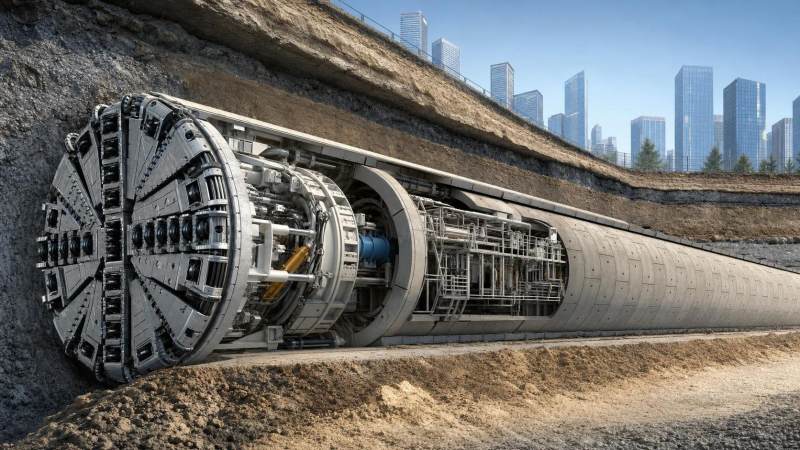
Tunnel Boring Machine for Metro Projects: Key Selection Factors for Urban Ground Conditions
Selecting the right tunnel boring machine for metro construction is never a standard equipment choice.
Ground behavior, alignment geometry, and settlement tolerance shape machine performance from day one.
In dense cities, a tunnel boring machine for metro work must control risk as much as advance rate.
That is why selection should start with geology, hydrogeology, and interface conditions, not headline machine size.
A well-matched tunnel boring machine for metro projects lowers intervention frequency, protects surface assets, and supports predictable delivery.
Why Urban Ground Conditions Drive TBM Selection
Metro tunneling rarely crosses uniform ground.
A single alignment may pass through fill, clay, sand, weathered rock, mixed face zones, and faulted sections.
This makes tunnel boring machine for metro selection a ground response problem, not only a production decision.
Recent market experience shows the biggest cost overruns often come from mismatch between face support method and actual geology.
More importantly, urban projects leave little room for recovery once excessive settlement or water inflow begins.
The Main Ground Variables to Check First
- Soil type distribution and face stability
- Groundwater pressure, inflow pathways, and permeability
- Boulder content, abrasivity, and cutter wear potential
- Transition frequency between soft ground and rock
- Sensitivity of nearby buildings, utilities, and foundations
- Alignment depth, curve radius, and station interface constraints
These variables determine whether an EPB, slurry, mixed shield, or hard rock configuration will actually work on site.
Choosing the Right Tunnel Boring Machine for Metro Ground Types
No single machine suits every urban corridor.
The best tunnel boring machine for metro construction is the one that keeps the face stable under expected and unexpected conditions.
EPB TBM for Cohesive and Conditionable Soils
EPB machines are widely used in metro systems built through clay, silt, and mixed urban fill.
They perform well when excavated material can form a plastic, controlled chamber support medium.
For a tunnel boring machine for metro use, EPB selection depends heavily on soil conditioning response.
If the spoil cannot maintain pressure reliably, settlement control becomes much harder.
Slurry TBM for Water-Bearing and Granular Ground
Slurry shields are often preferred in sand, gravel, and high-permeability ground under strong groundwater pressure.
They offer robust face support, especially below rivers, reclaimed land, or dense downtown districts.
However, a tunnel boring machine for metro projects using slurry support needs more complex surface treatment systems.
That adds logistics, plant footprint, and operational interfaces that must be planned early.
Mixed Ground and Convertible Concepts
Many metro alignments face changing geology rather than one dominant condition.
This is where mixed shield designs, convertible modes, and customized cutterheads become critical.
A tunnel boring machine for metro corridors with frequent transitions should be evaluated for adaptability, not just peak advance speed.
Downtime during mode change or intervention can quickly erase theoretical productivity advantages.
Face Pressure, Settlement Control, and Urban Risk
Surface settlement is often the hardest performance target in metro tunneling.
The selected tunnel boring machine for metro construction must maintain steady face pressure through variable cover and changing ground stiffness.
Pressure instability shows up fast near utilities, old masonry buildings, and shallow foundations.
In practical terms, control systems matter almost as much as mechanical power.
Selection Checks for Settlement-Sensitive Zones
- Review pressure control precision across expected permeability ranges.
- Check screw conveyor or slurry circuit stability under low and high inflow cases.
- Confirm tail void grouting capacity and backup redundancy.
- Assess cutterhead opening ratio against soil loss risk.
- Model likely response during start, stop, and ring build cycles.
These checks help identify whether a tunnel boring machine for metro work can keep settlement within contractual thresholds, not only average design assumptions.
Groundwater, Abrasion, and Intervention Planning
Water and wear are two of the most underestimated selection drivers.
A tunnel boring machine for metro tunnels may look suitable on paper, yet struggle once abrasive sand or unexpected inflow appears.
That is why geotechnical baselines should include more than strength and classification data.
Wear prediction, clogging tendency, and intervention access should all be part of early evaluation.
What to Test Before Final Selection
- Abrasion index and expected cutter consumption
- Groundwater chemistry and sealing material compatibility
- Need for hyperbaric intervention in dense urban stretches
- Availability of safe access points for maintenance windows
- Spoil handling behavior after conditioning or slurry separation
From a cost perspective, interventions and cutter changes often define whether the tunnel boring machine for metro selection remains commercially sound.
Alignment Geometry, Logistics, and Buildability
Urban projects are constrained by more than ground.
Launch shaft size, retrieval method, station box interface, and minimum curve radius can limit machine configuration options.
A tunnel boring machine for metro lines must fit the actual site sequence, not just the tunnel diameter requirement.
This is where buildability reviews become decisive.
In real procurement work, these constraints often eliminate otherwise attractive machine options very quickly.
Lifecycle Cost and Decision Criteria Beyond CAPEX
Price alone is a weak filter for metro TBM selection.
The better question is whether the tunnel boring machine for metro delivery can sustain output without creating hidden operational risk.
Lower upfront cost may lead to higher intervention, conditioning, wear, or delay exposure.
That shifts evaluation toward total cost of ownership and schedule confidence.
A Practical Evaluation Framework
- Map the alignment into geotechnical risk zones.
- Match each zone to required face support performance.
- Score candidate machine concepts against intervention, wear, and settlement risk.
- Add site logistics, utility protection, and shaft constraints.
- Compare lifecycle cost using realistic production and downtime assumptions.
This approach keeps tunnel boring machine for metro decisions grounded in field conditions rather than vendor claims alone.
It also creates a clearer basis for technical clarification during tender review.
Final Selection Guidance for Metro Project Teams
A reliable tunnel boring machine for metro construction is chosen through fit, not reputation alone.
The decisive factors are ground compatibility, pressure control, water management, wear behavior, and workable site logistics.
When those factors are reviewed together, equipment selection becomes a strategic risk decision with direct cost and schedule impact.
For complex urban corridors, the strongest choice is usually the machine that performs steadily across uncertainty.
Start with the ground, test the assumptions, and let the tunnel boring machine for metro evaluation follow the realities of the alignment.
Related News
 Oct 09, 2026Ultra-Large Excavator Bucket Size: Capacity, Width, and Site Fit ExplainedUltra large excavator bucket size explained: compare capacity, width, payload, truck matching, and site conditions to select a reliable, high-productivity bucket.
 Oct 08, 2026How to Evaluate a Heavy Machinery Information Platform for Project Equipment SourcingHeavy machinery information platform guide: compare equipment fit, source reliability, lifecycle costs, supplier capability, and compliance to make smarter sourcing decisions.
 Oct 07, 2026How to Evaluate a Hydraulic System Component Supplier for Heavy Equipment UptimeChoose a hydraulic system component supplier with proven quality, technical fit, and reliable delivery to reduce heavy equipment downtime and lifecycle costs.
 Oct 06, 2026Selecting Petrochemical Overhead Cranes for Hazardous Areas and Heavy Process LoadsPetrochemical overhead cranes for hazardous areas: learn how to match capacity, duty, controls, corrosion protection, and maintenance access for safer, reliable lifts.
Ms. Elena Rodriguez
Weekly Insights
Stay ahead with our curated technology reports delivered every Monday.