
Construction Market Intelligence: Which Data Points Matter for Bidding Decisions?
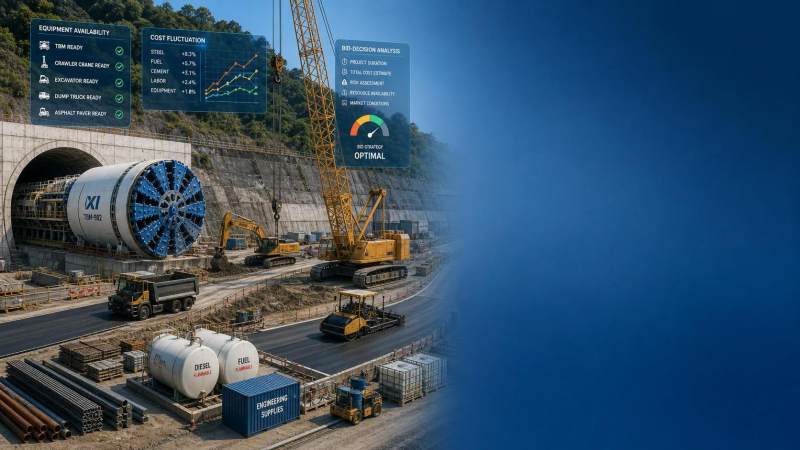
Construction market intelligence is moving from optional context to bid-critical input
Construction bidding has become less forgiving. A strong technical proposal can still fail if the underlying market read is weak.
That is why construction market intelligence now sits much closer to pricing, schedule design, and risk allocation than it did a few years ago.
The change is especially visible in heavy infrastructure, where equipment mobilization, geology, fuel exposure, and policy timing can reshape project economics very quickly.
In tunnel works, open-pit support systems, lifting packages, and road construction, the question is no longer whether data matters. The real issue is which data points actually change a bid decision.
Useful construction market intelligence does not begin with dashboards. It begins with signals that reveal whether demand is durable, costs are stable, and execution capacity is truly available.
The market is sending clearer signals, but they are not all equally valuable
Recent market activity looks busy on the surface. Yet bid viability often turns on a narrower set of signals than headline project counts suggest.
A full tender calendar does not always mean healthy opportunity. Some pipelines are politically accelerated, underfunded, or delayed by land access and grid connection issues.
More useful construction market intelligence focuses on conversion probability. That means asking which announced projects are most likely to move into funded construction windows.
The same applies to cost assumptions. Commodity indexes matter, but local labor availability, diesel logistics, and specialist equipment lead times often move faster than published averages.
This is where sector-specific intelligence becomes more valuable. TF-Strategy’s coverage of TBM deployment, crawler cranes, large road machinery, and mining haulage reflects this reality.
In capital-heavy projects, physical parameters and market timing are tightly linked. If a machine class is constrained, the pricing model must change even before procurement starts.
The data points that deserve a place in every bid screen
Not all inputs belong in first-pass qualification. The most effective construction market intelligence usually concentrates on a short list of market-moving variables.
- Pipeline quality: funded status, permit maturity, land readiness, and realistic award timing.
- Regional cost volatility: steel, cement, explosives, fuel, shipping, and subcontract labor pressure.
- Equipment availability: TBM slots, crane capacity, excavator allocation, truck fleet access, and parts support.
- Contractor density: how many capable rivals are active in the same geography and segment.
- Policy exposure: emissions rules, local content clauses, safety enforcement, and energy transition mandates.
- Ground and site complexity: boring conditions, altitude, haul distance, lifting geometry, and weather seasonality.
These points are practical because they influence markup, contingency, partner selection, and even the choice to bid at all.
Why these signals are becoming more decisive now
Several shifts are making construction market intelligence more operational and less theoretical.
First, infrastructure spending is increasingly tied to strategic themes such as energy security, urban resilience, and industrial relocation. That creates demand bursts, not smooth demand curves.
Second, the heavy equipment base is changing. Electrified fleets, remote-controlled excavation, and upgraded cutter materials alter both performance assumptions and maintenance risk.
Third, financing discipline has tightened. Owners and lenders are scrutinizing delivery certainty much more closely, especially on billion-dollar programs.
That is why commercial intelligence now needs to connect project demand with machine capability, operating conditions, and total cost of ownership.
TF-Strategy’s approach is relevant here because it does not treat heavy industry as a generic market. It links engineering method, machine performance, and strategic timing.
The strongest bids read demand and capacity at the same time
A common mistake is to study market demand without testing delivery capacity. Strong construction market intelligence does both together.
Take tunneling as an example. A region may show robust metro and water transfer plans, but cutter head material supply and TBM refurbishment slots may already be constrained.
In wind, nuclear, or petrochemical construction, the same logic appears through crawler crane availability, heavy lift windows, and transport corridor restrictions.
Road building adds another layer. Asphalt plant economics, paving train utilization, and weather compression can distort seasonal capacity more than annual averages indicate.
Open-pit and mining-adjacent packages show similar patterns, especially where large excavators and dump trucks operate under altitude or extreme temperature stress.
In each case, construction market intelligence becomes more accurate when project opportunity is matched against the real operating envelope of the machines involved.
What deserves closer attention in heavy infrastructure
- Whether demand is concentrated in one quarter or distributed across the year.
- Whether key machine classes are owned, leased, or dependent on cross-border mobilization.
- Whether spare parts, cutters, tires, and hydraulic components have stable replenishment channels.
- Whether decarbonization requirements will force different fleet choices during contract execution.
Impact spreads beyond pricing and into bid posture
Better construction market intelligence does more than sharpen numbers. It changes the posture of the bid itself.
Some opportunities justify aggressive positioning because the pipeline is resilient, competitor activity is fragmented, and equipment access is defendable.
Other projects call for narrower participation, conditional assumptions, or selective partnerships because the uncertainty sits in geology, logistics, or policy timing.
This is increasingly important in cross-border work. A technically attractive package may hide local compliance friction, customs delays, or weak service support for specialized fleets.
Construction market intelligence helps separate visible opportunity from executable opportunity. That distinction often determines whether win rates improve or margins erode after award.
The next useful move is to build a narrower, sharper intelligence routine
Many bid teams already collect market information. The gap is usually not volume. It is relevance, timing, and the ability to connect signals across disciplines.
A workable routine starts with a small set of threshold questions before each major pursuit.
- Has the project pipeline been tested for funding, permitting, and realistic start dates?
- Are local cost movements ahead of published indexes?
- Is the required equipment class available within the actual execution window?
- Have policy changes altered fleet, emissions, or safety assumptions?
- Does site complexity justify a different contingency structure?
From there, construction market intelligence should be refreshed at key milestones, not just at bid launch. Markets move during clarification periods, not only between tenders.
For organizations exposed to heavy equipment and large infrastructure programs, sources that connect tender signals with machinery performance trends are becoming more valuable.
That includes watching shifts in remote operations, cutter technology, electric haulage economics, and road machinery productivity standards, because they increasingly affect bid assumptions.
The market is not short of data. It is short of disciplined interpretation. Better construction market intelligence comes from knowing which signals deserve action, and which only create noise.
The most practical next step is simple: review current bid filters, map them against the highest-impact market signals, and build a recurring check on demand, cost, capacity, and policy movement.
Related News
 Oct 08, 2026How to Evaluate a Heavy Machinery Information Platform for Project Equipment SourcingHeavy machinery information platform guide: compare equipment fit, source reliability, lifecycle costs, supplier capability, and compliance to make smarter sourcing decisions.
 Oct 07, 2026How to Evaluate a Hydraulic System Component Supplier for Heavy Equipment UptimeChoose a hydraulic system component supplier with proven quality, technical fit, and reliable delivery to reduce heavy equipment downtime and lifecycle costs.
 Oct 06, 2026Selecting Petrochemical Overhead Cranes for Hazardous Areas and Heavy Process LoadsPetrochemical overhead cranes for hazardous areas: learn how to match capacity, duty, controls, corrosion protection, and maintenance access for safer, reliable lifts.
 Oct 05, 2026Tunneling Equipment Specification Planning: Key Criteria for Ground and Project RisksEquipment specification planning tunneling: learn how to match TBM systems to ground risks, geometry, safety, logistics, and lifecycle cost for more reliable project delivery.




Ms. Elena Rodriguez
Weekly Insights
Stay ahead with our curated technology reports delivered every Monday.