
Renewable Powered Heavy Equipment: Where It Fits and What It Costs to Run
Renewable Powered Heavy Equipment Is No Longer Experimental
Renewable powered heavy equipment has moved beyond showcase projects and policy headlines.
The better question now is practical: where does it perform reliably, and where does it still strain economics?
That matters across TBM support systems, open-pit haulage, crawler crane deployment, and large road machinery operations.
In heavy industry, decarbonization only survives if uptime, cycle time, and total cost of ownership remain defensible.
TF-Strategy tracks this shift closely because equipment selection now depends on both machine parameters and project energy architecture.
For many fleets, the decision is not a full replacement of diesel.
It is a staged choice between battery-electric, trolley assist, hybrid systems, green hydrogen, and renewable-backed charging.
What counts as renewable powered heavy equipment in real projects?
The term is often used too loosely, which creates bad comparisons.
In practice, renewable powered heavy equipment usually falls into three working models.
- Battery-electric equipment charged from renewable-heavy grids or dedicated solar, wind, or storage systems.
- Hydrogen fuel-cell or hydrogen combustion machines supplied by verified green hydrogen.
- Hybrid fleets using diesel-electric drivetrains, trolley lines, or microgrids that reduce fossil fuel intensity materially.
That distinction matters because emissions, operating cost, and infrastructure complexity differ sharply between them.
A battery mining truck on a coal-heavy grid may lower local emissions yet miss broader carbon targets.
A crane using renewable-backed site charging may deliver a stronger lifecycle case, even with higher upfront equipment cost.
The useful procurement lens is not marketing language.
It is the full chain from energy source to duty cycle, charging pattern, payload impact, and service support.
Where does renewable powered heavy equipment fit best today?
The strongest fit is in repetitive, energy-predictable operations with controlled routes or stable work windows.
This is why mining and fixed-site infrastructure are moving first.
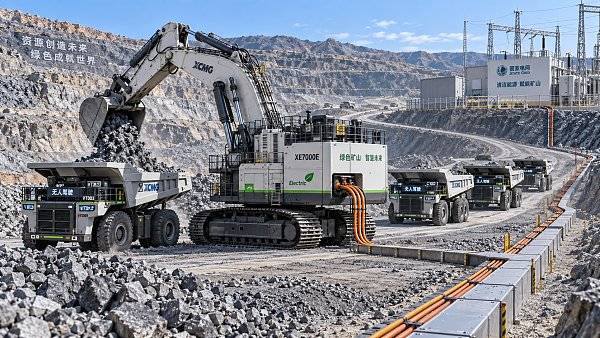
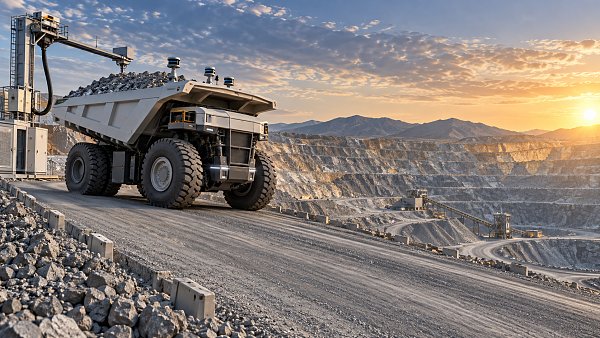
Open-pit mining and haulage
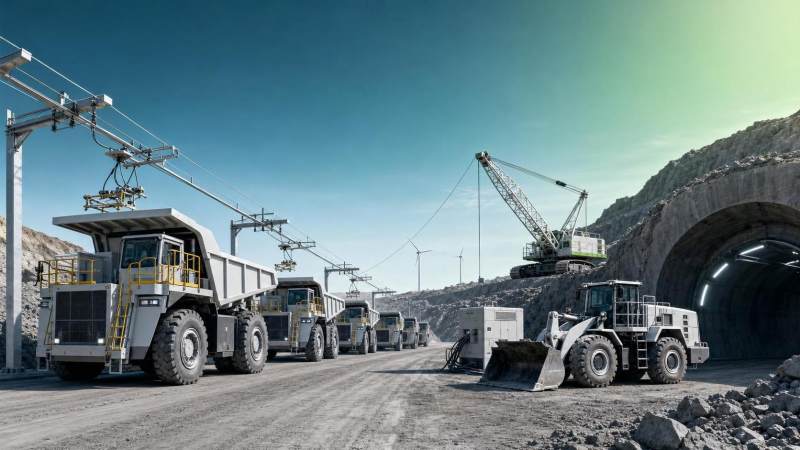
Mining dump trucks are a leading case when routes are repeatable and regeneration can recover downhill energy.
Trolley assist becomes especially compelling on long ramp climbs with high fuel burn.
Here, renewable powered heavy equipment can cut fuel exposure and ventilation burden while improving energy visibility.
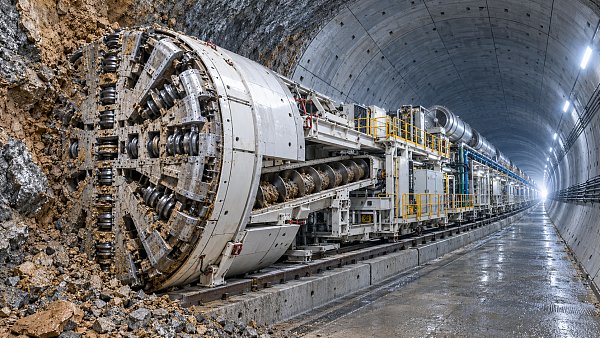
Tunneling and underground support
For TBM ecosystems, electrified loaders, carriers, and auxiliary units can be attractive because ventilation savings have real value.
Underground sites also benefit from lower heat and fewer exhaust constraints.
Still, the equipment mix matters more than the headline technology.
Crawler cranes and heavy lifting
Large lifting projects often have intermittent load profiles rather than constant power draw.
That can favor grid-tied or hybrid configurations on wind, nuclear, and petrochemical sites with planned durations.
The challenge is less propulsion and more temporary power design.
Road machinery
Pavers, rollers, and support machinery can adopt renewable-backed charging when shifts are structured and depots are centralized.
Short urban work windows make quieter machines operationally useful, not just environmentally attractive.
What does it really cost to run?
This is where many decisions become distorted.
Operating cost is not just energy per hour versus diesel per hour.
For renewable powered heavy equipment, a credible run-cost model usually includes six layers.
- Energy price by source, including time-of-use volatility.
- Charging or fueling infrastructure depreciation.
- Battery aging, replacement intervals, or hydrogen supply premiums.
- Maintenance changes, including fewer engine parts but more electrical diagnostics.
- Utilization impact from charging downtime or revised shift patterns.
- System-level savings such as ventilation, noise control, and carbon compliance.
In practical terms, the lowest energy cost does not always produce the lowest operating cost.
A cheaper power tariff can lose its advantage if queueing reduces machine availability.
Likewise, a higher-cost battery loader underground may still win if ventilation demand drops meaningfully.
TF-Strategy often frames this through TCO rather than simple fuel substitution.
That approach better matches how billion-dollar engineering projects absorb energy, maintenance, and schedule risk together.
How should a buyer compare renewable options without getting lost?
A useful comparison starts with duty cycle discipline.
If the machine duty is poorly measured, every later cost estimate becomes fragile.
More reliable evaluations usually ask a few pointed questions.
- Is the load profile steady, peaky, or idle-heavy?
- Can charging happen during natural pauses, shift changes, or downhill recovery?
- Does the site already have grid access, microgrid plans, or renewable generation?
- Will payload, lift capacity, or cycle time change because of energy system weight?
- What happens to productivity during extreme heat, altitude, dust, or cold?
This is why not every zero-tailpipe solution is the same procurement answer.
Battery systems often suit short, repetitive cycles and strong charging control.
Hydrogen may become more attractive where rapid refueling matters and space for charging is constrained.
Hybrid architectures remain relevant where power density is critical and renewable supply is still developing.
Which mistakes make renewable powered heavy equipment look cheaper or easier than it is?
The first mistake is treating machine selection as separate from site energy planning.
In reality, renewable powered heavy equipment succeeds when equipment, charging, grid capacity, and operating schedule are designed together.
Another common error is using average utilization instead of worst-hour demand.
That can understate charger count, cable sizing, and backup power needs.
A third mistake is ignoring residual value uncertainty.
Secondary markets for some renewable heavy equipment categories are still thin and regionally uneven.
There is also a softer risk that matters: service maturity.
Remote mines and complex tunnel sites cannot tolerate long waits for high-voltage components or specialist technicians.
That does not rule out adoption.
It means procurement should examine ecosystem readiness, not only machine specifications.
So when does the switch make sense?
The switch usually makes sense when three conditions align.
The work pattern is predictable, energy access can be engineered with confidence, and non-fuel savings are measurable.
That is why some open-pit truck fleets, underground support units, and depot-based road machinery are advancing faster than other segments.
For crawler cranes and mobile mixed fleets, the answer is often selective deployment rather than full conversion.
A sensible next step is to map one fleet or one project against four checkpoints.
- Measured duty cycles and real hourly power demand.
- Energy infrastructure cost over the project life.
- Productivity impact under actual site conditions.
- Supplier support depth, spare parts access, and retrofit path.
Renewable powered heavy equipment is becoming a serious operating model, not a symbolic one.
The strongest decisions come from matching energy strategy to machine physics, project cadence, and TCO reality.
That is also where informed intelligence platforms such as TF-Strategy add value: connecting technical detail with infrastructure-level judgment.
Related News
 Oct 08, 2026How to Evaluate a Heavy Machinery Information Platform for Project Equipment SourcingHeavy machinery information platform guide: compare equipment fit, source reliability, lifecycle costs, supplier capability, and compliance to make smarter sourcing decisions.
 Oct 07, 2026How to Evaluate a Hydraulic System Component Supplier for Heavy Equipment UptimeChoose a hydraulic system component supplier with proven quality, technical fit, and reliable delivery to reduce heavy equipment downtime and lifecycle costs.
 Oct 06, 2026Selecting Petrochemical Overhead Cranes for Hazardous Areas and Heavy Process LoadsPetrochemical overhead cranes for hazardous areas: learn how to match capacity, duty, controls, corrosion protection, and maintenance access for safer, reliable lifts.
 Oct 05, 2026Tunneling Equipment Specification Planning: Key Criteria for Ground and Project RisksEquipment specification planning tunneling: learn how to match TBM systems to ground risks, geometry, safety, logistics, and lifecycle cost for more reliable project delivery.
Prof. Marcus Chen
Weekly Insights
Stay ahead with our curated technology reports delivered every Monday.