
Tunneling Equipment Innovations: How Remote Monitoring Cuts Downtime Underground
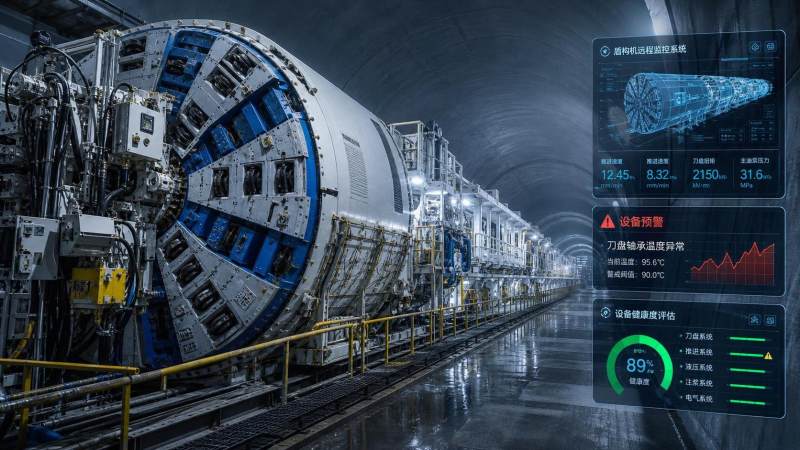
When Downtime Underground Becomes a Strategic Problem
In tunneling, a stopped machine rarely remains a local technical issue.
It quickly affects crew sequencing, muck handling, segment supply, ventilation planning, and surface logistics.
That is why tunneling equipment innovations now focus less on isolated machine upgrades and more on connected operating intelligence.
Among those changes, remote monitoring has become one of the most practical tools for cutting downtime underground.
The value is not only faster alarms.
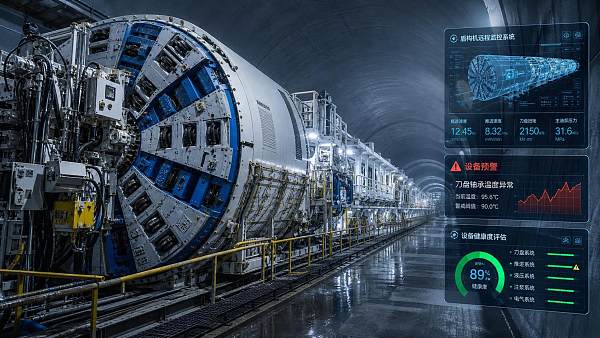
It is the ability to read cutterhead wear, hydraulic drift, bearing temperature, lubrication irregularities, and control system faults before they stop advance.
For a platform such as TF-Strategy, this matters because machine data only becomes useful when tied to geology, construction method, maintenance timing, and project economics.
That same logic already shapes decisions across excavators, crawler cranes, road machinery, and mining trucks.
TBM work simply makes the consequences more concentrated, less visible, and more expensive per hour.
Actual Site Conditions Change What Remote Monitoring Must Do
Not every tunnel demands the same monitoring depth.
An urban metro drive behaves differently from a long mountain tunnel or a mixed-ground utility crossing.
The same dashboard can look complete on paper and still miss the real failure pattern underground.
In practical use, the first judgment is not which software package looks advanced.
It is which variables are decisive in that specific operating environment.
- Soft ground urban tunneling usually demands close tracking of face pressure stability, slurry or spoil balance, and short-interval alarm response.
- Hard rock drives often care more about cutter consumption, vibration, thrust consistency, and heat buildup in hydraulic systems.
- Mixed-ground sections require stronger correlation between geology transitions and sudden parameter deviation.
- Remote or high-altitude projects depend more heavily on remote monitoring because specialist access is slower and intervention windows are narrower.
This is where tunneling equipment innovations remote monitoring becomes more than a maintenance accessory.
It becomes part of construction strategy, especially when schedule risk is larger than component replacement cost.
Urban Metro Drives Need Early Warnings, Not Just Fault Logs
In dense metro projects, downtime carries unusual pressure.
Access shafts are limited, community restrictions are tighter, and recovery work can disrupt several linked activities at once.
Here, remote monitoring is most effective when it detects small performance drift before operators feel a serious loss of efficiency.
Hydraulic pressure fluctuation, seal leakage trends, screw conveyor load instability, and lubrication anomalies are often more valuable than dramatic red alarms.
A common mistake is to treat urban monitoring as a reporting tool for the control room.
What matters more is whether after-sales service teams can compare live data against recent operating history and issue maintenance advice during planned stoppages.
That reduces emergency entries underground and improves maintenance safety, especially in confined sections with strict access control.
Long Mountain Tunnels Usually Expose a Different Weakness
Mountain tunneling often stretches logistics more than urban jobs do.
Long haul distances, slower parts delivery, and harsher geology make downtime recovery heavier and more expensive.
In this setting, tunneling equipment innovations remote monitoring should emphasize component life prediction, not only active fault notification.
Cutterhead torque patterns, penetration change, disc cutter replacement intervals, and bearing temperature trends become leading indicators.
The useful question is not simply whether a part is healthy today.
The better question is whether it will remain serviceable until the next planned intervention window.
This planning logic is familiar across heavy equipment sectors.
Mining trucks monitor thermal stress and payload behavior for similar reasons, while crawler cranes depend on condition visibility to avoid nonproductive waiting on major lifts.
The tunneling version is simply more constrained because access is linear, underground, and operationally unforgiving.
Mixed Geology Requires Correlation, Not Standalone Data Points
Mixed-ground tunneling is where many monitoring systems underperform.
The issue is rarely lack of sensors.
The issue is weak interpretation.
When soil, weathered rock, groundwater, and abrasive inclusions shift within short intervals, single-parameter alarms become noisy and easy to ignore.
Better remote monitoring links machine behavior to geological mapping, ring location, and recent intervention records.
Without that context, teams can misread normal transition stress as a defect, or dismiss early damage as temporary fluctuation.
This is exactly the kind of intelligence stitching TF-Strategy’s heavy industry perspective highlights.
Physical parameters make sense only when paired with method and mission.
What Different Jobs Actually Need From Tunneling Equipment Innovations Remote Monitoring
The differences are not academic.
They shape sensor selection, alarm logic, data transmission design, and maintenance workflow.
A practical review usually includes four checks.
- Confirm which failures create the highest schedule disruption, not merely the highest replacement cost.
- Separate variables that support diagnosis from variables that trigger action.
- Check whether communication reliability underground matches the required response speed.
- Define who interprets exceptions when data sits between mechanical wear and geological change.
That last point is often overlooked.
Remote monitoring only cuts downtime when someone can turn information into an intervention decision quickly enough.
Where Misjudgment Usually Happens Before Deployment
Several weak assumptions appear repeatedly in tunnel projects.
One is assuming all modern TBMs need the same data model.
Another is focusing on procurement features while ignoring how service teams will actually use alerts underground.
There is also a tendency to value dashboard visibility over data quality.
If hydraulic sensors drift, or wear data is not calibrated to cutter replacement records, the system can encourage false confidence.
More broadly, tunneling equipment innovations remote monitoring should not be judged by installation alone.
It should be judged by whether it reduces avoidable stoppages, emergency maintenance exposure, and unplanned spare consumption over time.
A Grounded Way to Match the System to the Project
A sensible rollout starts with the tunnel’s operating pressure points.
Map the likely failure chain from component stress to project disruption.
Then decide which remote monitoring functions must be real-time, which can be reviewed by shift, and which belong in periodic health analysis.
In many cases, the strongest result comes from a layered model.
Use immediate alarms for safety and stoppage threats.
Use trend analytics for wear planning.
Use project intelligence to interpret whether a deviation reflects equipment condition, ground change, or operational adjustment.
That approach fits the wider heavy industry shift toward digitally informed machinery decisions.
It also explains why remote monitoring is no longer a niche add-on in tunneling equipment innovations.
It is becoming part of how underground availability is protected.
What to Clarify Before the Next Upgrade Decision
The next step is rarely buying more sensors.
It is clarifying the operating scenario, the intervention window, the data needed for action, and the cost of a wrong call.
Projects that do this well tend to compare tunnel conditions, maintenance access limits, spare lead times, and alarm response ownership before expanding any system.
From there, tunneling equipment innovations remote monitoring can be assessed on real project fit rather than abstract digital promise.
That is the more reliable path to lower downtime underground, better maintenance timing, and stronger infrastructure delivery discipline.
Related News
 Oct 08, 2026How to Evaluate a Heavy Machinery Information Platform for Project Equipment SourcingHeavy machinery information platform guide: compare equipment fit, source reliability, lifecycle costs, supplier capability, and compliance to make smarter sourcing decisions.
 Oct 07, 2026How to Evaluate a Hydraulic System Component Supplier for Heavy Equipment UptimeChoose a hydraulic system component supplier with proven quality, technical fit, and reliable delivery to reduce heavy equipment downtime and lifecycle costs.
 Oct 06, 2026Selecting Petrochemical Overhead Cranes for Hazardous Areas and Heavy Process LoadsPetrochemical overhead cranes for hazardous areas: learn how to match capacity, duty, controls, corrosion protection, and maintenance access for safer, reliable lifts.
 Oct 05, 2026Tunneling Equipment Specification Planning: Key Criteria for Ground and Project RisksEquipment specification planning tunneling: learn how to match TBM systems to ground risks, geometry, safety, logistics, and lifecycle cost for more reliable project delivery.

Dr. Alistair Vaughn
Weekly Insights
Stay ahead with our curated technology reports delivered every Monday.