
Equipment Category Guide for Suppliers: How to Organize Product Lines for Buyer Search
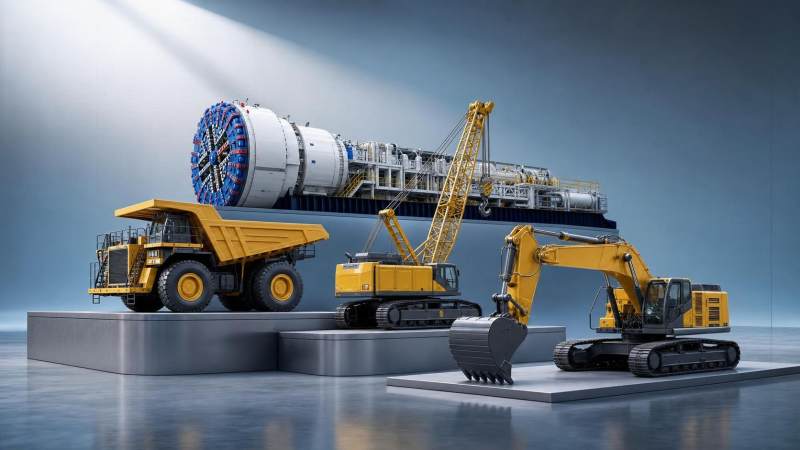
Equipment Category Guide for Suppliers: How to Organize Product Lines for Buyer Search
For distributors, agents, and supply-side partners, a clear equipment category guide supplier strategy can directly improve buyer search visibility and product discovery.
In heavy industry, product portfolios are rarely simple. One supplier may cover TBMs, mining dump trucks, crawler cranes, excavators, and road machinery.
That creates a real search problem. Buyers do not search the way internal sales teams name products.
They search by jobsite need, budget pressure, tonnage, application, power source, delivery timeline, and operating conditions.
A strong equipment category guide supplier framework bridges that gap. It turns a mixed catalog into a procurement-ready structure.
For TF-Strategy, this matters even more. Heavy equipment decisions sit at the intersection of engineering data, project sequencing, and total cost control.
When categories reflect real buying behavior, product lines become easier to compare, easier to shortlist, and easier to convert into serious inquiries.
Why Category Structure Shapes Buyer Search
Many suppliers still organize listings around internal factory logic. That may work for inventory control, but it often weakens external search performance.
A buyer sourcing a crawler crane for wind projects will not begin with factory division names. The search usually starts with lifting capacity and use case.
The same pattern applies across open-pit mining and tunneling. Buyers want fast access to machine classes that match project scope.
This is where an equipment category guide supplier model becomes practical. It helps search engines and human buyers understand your catalog at the same time.
From a procurement angle, clear categorization also lowers friction. Shorter search paths reduce bounce, improve product comparison, and strengthen quote quality.
More importantly, better structure helps suppliers surface higher-value models instead of losing attention inside broad, poorly labeled product groups.
Build Categories Around Buyer Intent First
The most useful equipment category guide supplier systems start with buyer intent, not with internal naming habits.
In actual sourcing, intent usually falls into several predictable paths:
- Application search, such as tunnel excavation, open-pit loading, pavement construction, or heavy haulage.
- Specification search, such as lifting capacity, payload, bucket volume, bore diameter, or paving width.
- Operating environment search, such as high altitude, hard rock, urban tunneling, or extreme temperature sites.
- Procurement model search, such as new equipment, remanufactured units, fleet expansion, or project-based rental alternatives.
- Cost-focused search, such as low fuel consumption, reduced maintenance intervals, or lower total cost of ownership.
That means your top-level categories should mirror these patterns. Product families must answer the buyer’s first question within seconds.
An equipment category guide supplier page should feel like a navigation tool for procurement, not just a warehouse list moved online.
A Practical Category Model for Heavy Equipment Suppliers
For complex portfolios, a layered structure works best. It keeps the catalog searchable without forcing buyers through too many clicks.
A solid equipment category guide supplier model often follows four levels.
- Equipment family: TBM, crawler crane, mining dump truck, large excavator, road machinery.
- Primary function: excavation, lifting, hauling, paving, material handling.
- Key specification band: payload range, tonnage class, cutterhead diameter, engine power, or working width.
- Application segment: metro tunneling, copper mine operations, wind power erection, expressway paving, quarry transport.
This structure keeps broad search and precise filtering connected. Buyers can enter from either direction and still find the right shortlist.
For example, a mining dump truck category should not stop at brand and model. It should quickly branch into payload, terrain, and powertrain type.
The same applies to TBM pages. Diameter, geology, drive system, and urban versus mountain use should be visible at category level.
What Data Must Appear Inside Each Category
A useful equipment category guide supplier strategy is not only about labels. It also depends on the right data appearing early in the browsing process.
Buyers in heavy industry compare technical fit before they contact sales. If key fields are hidden, search performance may improve, but conversion will stall.
At category and subcategory level, include:
- Capacity bands and model ranges.
- Main applications and project types.
- Working condition suitability.
- Power system or energy type.
- Maintenance or service interval highlights.
- Lead time and delivery scope.
- Compliance, safety, or emission references.
This approach supports both search ranking and procurement confidence. It also reduces low-quality inquiries driven by unclear product positioning.
For TF-Strategy audiences, this is especially relevant because machine selection often depends on matching physical parameters with project risk and output targets.
How to Handle Cost and Comparison Queries
Cost-driven searches are becoming more specific. Buyers rarely ask only for price. They increasingly ask what the machine will cost over time.
That changes how an equipment category guide supplier page should be built. Categories must support comparison, not just discovery.
Useful comparison signals include fuel efficiency, cutter wear life, tire consumption, service access, rebuild cycle, and utilization rate assumptions.
When buyers compare a 220-ton mining truck with a 290-ton model, they are judging route design, loading match, and operating cost per ton.
When they compare crawler cranes, they care about transport complexity, assembly time, site footprint, and lifting radius efficiency.
So the equipment category guide supplier framework should include category-level comparison tables or concise cost drivers that help buyers narrow options faster.
Common Category Mistakes That Hurt Conversion
Several issues appear again and again in supplier catalogs.
- Putting unrelated models into one oversized category.
- Using technical labels that buyers do not search.
- Skipping application-based subcategories.
- Hiding critical specifications until the product detail page.
- Failing to separate new energy models from diesel fleets.
- Ignoring regional compliance and operating condition differences.
These mistakes weaken both SEO and commercial quality. They attract traffic that does not convert and bury the machines that should lead the portfolio.
A disciplined equipment category guide supplier structure avoids that by making every category carry a clear search purpose and a clear buying signal.
A Simple Process to Rebuild Your Product Line Structure
If your current catalog feels hard to navigate, rebuild it in stages.
- List every model and assign one primary application.
- Group models into equipment families buyers already recognize.
- Create subcategories using major specification bands.
- Add filters for environment, energy type, and project segment.
- Write category text around procurement questions and comparison needs.
- Review inquiry quality and adjust weak category paths.
From recent market shifts, the stronger signal is clear. Buyers want faster prequalification before they contact a supplier team.
That means a better equipment category guide supplier system is no longer a content exercise. It is part of sales efficiency and margin protection.
For TF-Strategy, the logic is consistent with the broader mission. Physical parameters, operating methods, and strategic project needs must be connected clearly.
When suppliers organize product lines around real buyer search behavior, the catalog becomes more than a list. It becomes a decision tool.
Start with category clarity, then refine comparison depth. That sequence usually delivers the fastest gains in search visibility, inquiry quality, and procurement conversion.
Related News
 Sep 29, 2026Infrastructure Construction Standards: A Project Manager’s Guide to ComplianceInfrastructure construction standards guide for project managers: turn requirements into field controls, hold points, traceability, and compliant delivery.
 Sep 28, 2026How to Specify Custom Mining Equipment for Abrasive Ground and High-Load HaulageCustom mining equipment for abrasive ground and high-load haulage: learn how to optimize payload, wear protection, powertrains, uptime, and lifecycle cost for safer, reliable production.
 Sep 29, 2026What belongs in a construction equipment package sourcing plan?Construction equipment package planning sourcing guide: learn how to match machines, attachments, site conditions, supplier support, costs, and acceptance gates for reliable project delivery.
 Sep 29, 2026How to verify equipment durability before approving suppliers at scaleHow can heavy equipment manufacturers verify durability and manage supplier risk at scale? Explore practical testing, traceability, audits, and control strategies.


Ms. Elena Rodriguez
Weekly Insights
Stay ahead with our curated technology reports delivered every Monday.