
What Are the Most Effective Slurry TBM Construction Methods for Soft Ground Tunneling?
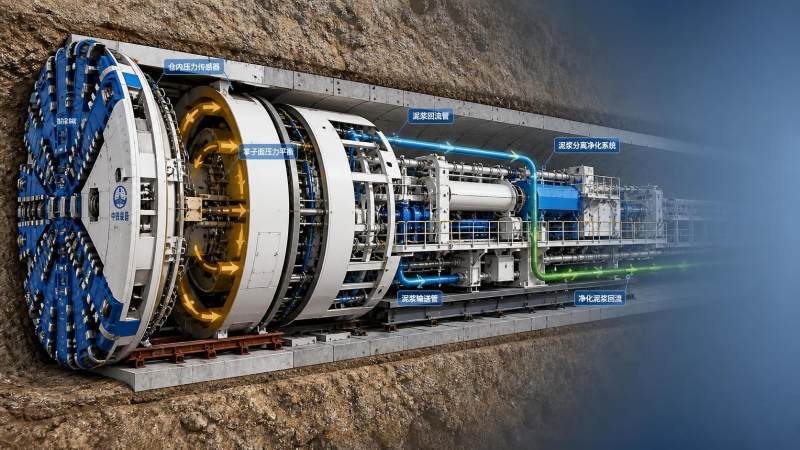
On soft ground tunnel jobs, trouble often starts before anyone calls it trouble. The face may still look stable, the machine may still be advancing, and the daily reports may not show anything dramatic. But the first signs are usually practical ones: slurry density drifting out of the expected range, separation efficiency dropping, segment erection falling behind the excavation rhythm, or operators spending too much time correcting pressure instead of maintaining a smooth cycle. Many teams meet this situation when ground conditions are mixed, groundwater is active, or the tunnel alignment passes through sensitive urban zones where settlement tolerance is tight.
If you are responsible for planning or supervising such work, the question is rarely whether a slurry shield can tunnel in soft ground. The real question is which slurry TBM construction methods are most effective under the actual constraints of the project. A method that works in uniform fine sand may struggle in clayey silt with cobbles. A pressure strategy that protects the face may still create downstream problems if spoil separation cannot keep up. In practice, the best approach is usually not one single technique, but a coordinated set of decisions covering pressure control, slurry conditioning, circulation, separation, and lining logistics.
Where soft ground jobs usually begin to go off track
A common mistake is to treat slurry operation as a support system rather than the center of face control. In soft ground, the slurry circuit is not just handling spoil; it is part of the excavation method itself. When support pressure is poorly matched to the ground and groundwater conditions, the face may become unstable or overpressurized. That can lead to settlement, heave, excessive slurry losses, or repeated stoppages for investigation.
Another recurring issue is that teams focus heavily on the cutterhead and thrust system, but not enough on the relationship between excavation rate and the processing capacity at the surface. If the separation plant cannot maintain effective removal of excavated fines, the slurry properties change, the chamber becomes harder to control, and the machine starts reacting late rather than early. The operator is then managing symptoms instead of running a stable tunneling process.
In many projects, lining operations also become a hidden bottleneck. Segment erection may appear secondary compared with face stability, but a slow or inconsistent lining cycle disrupts advance rhythm. Once that rhythm breaks, slurry balance becomes harder to keep steady because the machine alternates between waiting, correcting, and pushing forward in uneven intervals.
The most effective method is controlled pressure, not maximum pressure
When people first think about soft ground tunneling, they often assume the safest method is simply to keep chamber pressure high. That sounds reasonable, but it is usually too crude. The effective method is controlled pressure management based on expected earth and water loads, observed response at the face, and continuous correlation with advance behavior, slurry inflow, and surface indicators.
In practical terms, this means defining a pressure operating window rather than a fixed number. The lower side of that window needs to preserve face stability and groundwater control. The upper side needs to avoid hydraulic fracturing, excessive slurry loss into permeable layers, or uplift effects in sensitive ground. Operators need to work inside that band while accounting for transients during excavation, ring build, tool inspection, and restart.
This is one of the reasons the better slurry TBM construction methods rely on disciplined monitoring and adjustment, not on aggressive correction after a problem appears. Stable face support comes from reducing fluctuation. Sudden pressure swings during stoppage and restart are often more damaging than a small deviation that is corrected gradually.
What makes pressure control work better in the field
The method is stronger when pressure decisions are linked to more than one signal. Chamber pressure alone is not enough. It helps to read it alongside slurry feed and discharge flow, density, viscosity, penetration rate, cutterhead torque, and the quantity and character of separated spoil. If one value shifts but the others remain stable, that may indicate instrumentation noise or a short-term disturbance. If several variables move together, the machine is telling you that the ground response is changing.
That habit of reading the full process is often what separates smooth drives from reactive drives.
Slurry conditioning matters more than many teams expect
Soft ground is not a single material. Fine sand, silty sand, soft clay, weathered mixed ground, and water-bearing granular zones all respond differently to slurry. One of the most effective methods is to adjust slurry properties to suit the ground behavior rather than operating with one standard mix throughout a drive.
For permeable granular soils, the aim is usually to create a stable filter cake quickly at the excavation face. For more cohesive soils, the focus may shift toward maintaining transportability and preventing clogging or unstable chamber behavior. In mixed ground, the challenge is that the requirements can change over short distances, which is why the slurry plant and tunneling crew need close communication instead of working as separate units.
A practical way to think about this is simple: if the slurry cannot support the face, carry spoil reliably, and remain processable at the surface, it is not the right slurry for that stretch of tunnel. The most effective method is not the thickest slurry or the most expensive additive package. It is the one that creates a workable balance between support and circulation.
Closed-loop circulation has to be treated as a production system
On paper, the slurry circuit is straightforward: feed slurry to the chamber, transport excavated material out, separate solids, and return conditioned slurry. On site, however, this loop determines whether the TBM can advance steadily. A well-run soft ground drive depends on keeping this loop predictable.
That means paying attention to pipe wear, pump behavior, valve response, and the position where material starts to accumulate or degrade flow. Slurry lines that are technically functional can still be operationally weak if they create pressure lag, encourage sedimentation, or make density readings unreliable. Teams sometimes discover these weaknesses only after several difficult rings, when the problem has already spread through the cycle.
One effective approach is to match circulation management to expected excavation variability. In uniform ground, steady settings may work for longer periods. In mixed or changing ground, shorter review intervals and faster process feedback are usually more reliable. This is not overmanagement. It is simply recognizing that soft ground tunneling becomes unstable when the slurry loop reacts too slowly.
Separation efficiency is not a surface issue only
When the separation plant underperforms, the effect is felt at the face. That is why one of the strongest slurry TBM construction methods is to design excavation rate around realistic spoil treatment capacity, not ideal capacity. Fine particles are especially important in soft ground because they influence slurry density, viscosity, and recirculation quality.
If separation is incomplete, solids can build up in the system and alter chamber behavior. The machine may then show rising torque, difficult spoil transport, or pressure control that feels inconsistent even though the operator is following the usual settings. In those moments, the root cause may not be at the cutterhead at all.
Good practice is to watch for the operational signs of reduced separation performance: unstable return slurry character, frequent corrections to maintain face pressure, more difficult pipeline flushing, or changes in spoil appearance that do not match the anticipated geology. These are often earlier warnings than a formal plant alarm.
Segmental lining coordination is part of excavation control
Some tunneling teams treat ring building as a downstream activity that only affects schedule. In soft ground, that view causes problems. Segment erection and tail void treatment are part of ground control. If the machine excavates efficiently but ring closure is delayed, the entire cycle becomes uneven. During those interruptions, pressure management gets harder and exposure time in sensitive ground increases.
The effective method is to synchronize excavation, segment supply, erection, and annular gap treatment so that the machine keeps a stable rhythm. Grouting should not be seen as a final touch after the real work is done. In soft ground, immediate and consistent tail void filling helps limit ground movement and supports the lining as the shield advances away.
Where conditions are variable, the tunneling plan should also allow for adjustments in advance length, ring build timing, and intervention readiness. The more tightly these functions are coordinated, the less likely the machine is to alternate between overdriving and waiting.
Mixed ground and obstructions require a different mindset
Many of the toughest soft ground drives are not purely soft. They include lenses of denser material, occasional cobbles, man-made obstructions, or transitions between cohesive and granular strata. In those stretches, the most effective method is not to force the machine to maintain the same operating pattern as before. It is usually better to narrow the pressure control window, reduce sudden changes in penetration, and observe spoil characteristics more carefully.
Operators may be tempted to chase production when the machine seems capable of more. But in mixed ground, spikes in penetration or aggressive cutterhead behavior can create uneven face conditions that are hard to recover from. A controlled, observant approach often prevents larger interruptions later.
This is also where engineering intelligence becomes useful. Not promotional material, but practical interpretation of geology, machine response, and construction methodology together. For teams reviewing equipment behavior, ground transition risks, or methodology choices across international projects, industry intelligence sources focused on TBM practice can help frame better decisions before a problem becomes operational.
When methods should be adjusted instead of defended
There is a pattern seen on difficult drives: once a method has been approved, teams sometimes keep defending it even when field behavior suggests it is no longer the best fit. Soft ground tunneling does not reward rigidity. A method can be technically sound at launch and still need adjustment when actual groundwater connectivity, fines content, or chamber behavior differs from the expected model.
The better response is to treat the method statement as a controlled baseline, not a fixed script. If slurry losses increase, if filter cake formation is inconsistent, if circulation becomes unstable, or if segment operations repeatedly fall behind, those are signals to re-examine the method. That might mean changing slurry properties, refining pressure bands, modifying advance pace, or rebalancing separation throughput against excavation rate.
None of this means the original plan was poor. It means the job has moved from design assumption to live ground response, and the method needs to follow.
Questions that usually come up during planning and early drive stages
Is a slurry shield always the best choice for soft ground?
Not always. It is especially effective where groundwater pressure is significant and face support needs to be tightly maintained. But the best choice depends on permeability, fines content, settlement sensitivity, spoil treatment logistics, and operational capability. The method works well when the slurry circuit can be managed as carefully as the excavation itself.
Which operating problem should be investigated first when face control feels unstable?
Start by checking whether the instability is really a face issue or a circulation issue. Chamber pressure, feed and discharge flow, slurry properties, and separation performance should be read together. Many apparent face-control problems are linked to changing slurry behavior elsewhere in the loop.
Can the same slurry properties be used across a full tunnel drive?
Sometimes, but it is risky to assume so at the outset. Ground can vary over relatively short distances, especially in urban or alluvial conditions. It is usually more effective to define acceptable property ranges and adjust within them as geology and spoil response change.
Why do some projects struggle even when the machine itself is performing well?
Because machine performance is only one part of the process. Surface separation, slurry recirculation, segment logistics, tail void treatment, and restart control can all limit the overall method. A TBM can be mechanically sound while the tunneling system around it is unstable.
In the end, the most effective slurry TBM construction methods for soft ground tunneling are the ones that keep the entire excavation system in balance. That usually means disciplined pressure control, slurry properties matched to the actual ground, circulation that reacts quickly, separation sized to real spoil conditions, and lining operations that protect advance rhythm rather than interrupt it. If you are trying to decide which method deserves the most attention, start with the one that reduces fluctuation across the whole cycle. In soft ground, stable progress is usually the clearest sign that the method is working.
Related News
 Sep 27, 2026Heavy Equipment Selection Factors for Matching Machine Capacity to Jobsite ConditionsHeavy equipment selection factors for matching capacity to jobsite conditions, improving productivity, safety, fleet efficiency, and total project cost control.
 Sep 26, 2026How to Select Wind Rotor Lifting Equipment for Safe Blade and Hub InstallationWind rotor lifting equipment selection guide: ensure safe blade and hub installation with the right lift method, load control, crane compatibility, wind limits, and compliance.
 Sep 25, 2026What Drives Heavy Haulage Cost on Oversized Construction Equipment Moves?Heavy haulage cost explained: discover how load dimensions, route surveys, permits, escorts, lifting plans, and scheduling shape reliable oversized equipment transport budgets.
 Sep 24, 2026Supplier Management Frameworks That Reduce Delays on Large Construction ProjectsLarge-scale construction projects supplier management frameworks help prevent costly delays with risk-based controls, milestone tracking, quality oversight, and escalation plans for critical packages.




Geological Boring Fellow
Weekly Insights
Stay ahead with our curated technology reports delivered every Monday.