
How to Evaluate an Industrial Equipment Sourcing Marketplace for Supplier Quality and Risk
How to Evaluate an Industrial Equipment Sourcing Marketplace for Supplier Quality and Risk
Choosing an industrial equipment sourcing marketplace used to be a fairly direct exercise: compare prices, review lead times, negotiate terms, and move on. That still matters, but it is no longer enough—especially in heavy industry, where a poor sourcing decision can ripple into project delays, field failures, unplanned maintenance, and contractual exposure. When the equipment involved includes tunnel boring machine components, mining machinery, crawler crane systems, or large road equipment, the cost of being wrong is rarely limited to the purchase order value.
A serious evaluation framework needs to answer a harder question: does the marketplace help you identify reliable suppliers and reduce risk, or does it simply aggregate listings? Those are very different things. Procurement teams working on capital-intensive projects usually need more than supplier visibility. They need traceability, technical clarity, and confidence that delivery promises match operational reality.
That is why marketplace selection has become part of risk management. In sectors followed closely by TF-Strategy—TBM systems, open-pit mining equipment, ultra-large lifting machinery, road machinery, and heavy haulage—the link between equipment specification and project outcome is too tight to ignore. A platform that understands the difference between a brochure claim and a usable procurement signal is immediately more valuable than one that only offers broad supplier access.
Start with the marketplace itself, not the supplier list
Many buyers jump straight to supplier comparison. It is more useful to assess the marketplace architecture first. A marketplace can only be as reliable as its onboarding standards, verification process, data discipline, and dispute visibility. If the platform does not clearly explain how suppliers are reviewed, what information is verified, or how often records are updated, you are already working in a low-transparency environment.
A credible industrial equipment sourcing marketplace should make it possible to examine the supplier beyond a sales profile. That includes legal business identity, manufacturing or trading role, export experience, product scope, documentation practices, and at least some evidence of operational consistency. If all suppliers look equally polished on the surface, that is often a warning sign. Real industrial vendors differ in depth, specialization, and execution capability, and a useful marketplace should help buyers see those differences.
Another practical test: does the platform support technical procurement, or only commercial procurement? Heavy equipment sourcing rarely succeeds on price sheets alone. Buyers may need to compare wear material grades, hydraulic interface compatibility, emissions configurations, transport dimensions, crane chart implications, or cutterhead-related consumable standards. If a marketplace cannot structure that kind of information, procurement ends up moving off-platform anyway.
Supplier quality is more than certification paperwork
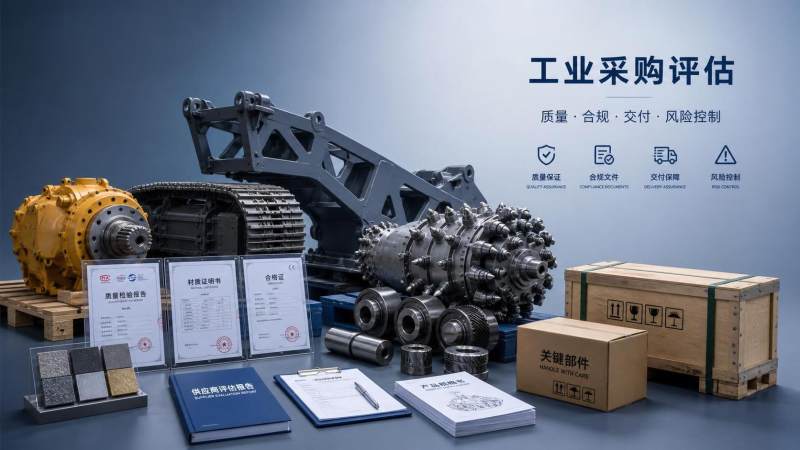
One common mistake is to treat supplier quality as a document check. Certifications matter, but in industrial sourcing they are only part of the picture, and in some categories they tell you less than buyers assume. A supplier may present management system certificates and still perform poorly in engineering communication, process control, packaging discipline, or delivery reliability.
The better question is whether the marketplace helps you evaluate production maturity. Can you see whether the supplier is an OEM, a qualified fabricator, a component specialist, or a trading intermediary? Can you review product drawings, material traceability, inspection workflows, or quality records appropriate to the equipment category? For replacement parts and fabricated assemblies, the ability to link specification control with manufacturing consistency is often more useful than a generic company introduction.
In heavy equipment categories, supplier quality also has a field-performance dimension. A vendor supplying a structural component for a crawler crane or a wear-critical part for mining operations should be evaluated differently from a supplier of standard MRO consumables. The marketplace does not need to make the decision for you, but it should help surface the right evidence: project references if available, export destinations, technical response quality, after-sales capability, and whether the supplier understands the installation and operating context.
Look for risk signals hidden behind attractive pricing
Low price is not always a red flag. But unexplained low price usually is. In an industrial equipment sourcing marketplace, pricing gaps often reflect one of several realities: different scope assumptions, lower-grade materials, omitted testing, longer actual lead times, weak packaging standards, or limited warranty support. Sometimes the supplier is simply using aggressive quoting to enter a new market. The difficulty is that the cost consequence appears later, not at quote stage.
This is where procurement teams should compare total acquisition exposure rather than unit price. Ask what is included in the offer: drawings, inspection plans, spare parts recommendations, commissioning support, logistics handling, export packing, language of technical documents, and response responsibilities if the equipment fails acceptance checks. A marketplace that encourages line-item clarity and version-controlled quotation records reduces ambiguity before it becomes a claims issue.
It is also worth checking whether the platform makes historical edits visible. If technical details, lead times, or commercial terms can be changed without trace, buyers lose an important control point. For complex equipment, procurement risk often enters through undocumented assumption changes rather than obvious fraud.
Delivery risk should be evaluated like a technical parameter
In project procurement, delivery reliability is not an administrative issue. It is a performance variable. A delayed gearbox, boom section, cutterhead tool set, or mining truck subsystem can stall downstream work that is far more expensive than the item itself. Yet many marketplaces still treat lead time as a simple number entered by the supplier.
A better marketplace helps buyers test lead-time credibility. That may include visibility into production status, inventory position, manufacturing location, dependence on sub-suppliers, or shipping route constraints. For oversized or heavy-lift components, transport feasibility can be as important as factory completion. Delivery risk should be reviewed against actual logistics conditions, port handling limitations, destination import procedures, and site readiness.
TF-Strategy’s intelligence-led approach is relevant here because in heavy industry, equipment delivery cannot be separated from construction methodology and project sequence. A TBM-related procurement package, for example, is shaped by tunneling schedule, geology-related wear expectations, and maintenance windows. Mining and lifting equipment have similar dependencies. A marketplace that ignores operating context may still be useful for simple sourcing, but it is less reliable for high-consequence procurement.
Compliance, standards, and documentation are where many deals quietly fail
Not every procurement problem is a manufacturing problem. A surprising number of failures come from documentation mismatch: wrong technical file set, incomplete inspection records, incorrect country-of-origin paperwork, missing packing declarations, or standards that do not match the destination market. None of this is glamorous, but it directly affects cost and schedule.
When evaluating a marketplace, pay attention to how it handles compliance information. Does it allow suppliers to map products to applicable standards, or does it leave all technical conformity claims in free text? Can buyers request mandatory documents before award, not after shipment? Is there room to specify acceptance criteria tied to contract documents and local requirements? These details matter more in cross-border procurement than in domestic spot buying.
The same goes for spare parts and service documentation. For complex machinery, incomplete manuals or poor parts traceability can turn a low-cost purchase into a long-term maintenance burden. Procurement teams focused on cost control should not ignore post-delivery information quality, because that is often where total cost of ownership starts to drift.
Questions worth asking before you trust the platform
Where procurement teams often misjudge marketplace value
One misjudgment is assuming scale equals quality. A marketplace with a very large supplier base may still be weak in verification depth. Another is overvaluing response speed. Fast quoting feels efficient, but if the supplier has not understood the load case, site condition, duty cycle, or interface requirements, the quote may only create false progress.
There is also a tendency to treat all industrial categories the same. That rarely works. Sourcing a standard motor is different from sourcing a fabricated lifting component, a specialized tunneling consumable, or a subsystem intended for extreme-altitude mining conditions. Category intelligence matters. This is one area where a specialist perspective becomes useful: not because it replaces procurement discipline, but because it helps frame the right technical and commercial questions early.
Platforms informed by sector intelligence, such as the kind of heavy-industry monitoring associated with TF-Strategy, are often better positioned to connect supplier data with operational realities—raw material shifts, evolving equipment configurations, remote-control trends, and the commercial pressures behind electrification or safety upgrades. That kind of context does not close a deal by itself, but it helps buyers avoid sourcing decisions that look efficient on paper and become expensive in the field.
A practical way to compare marketplaces
If you are comparing more than one platform, run a live procurement test rather than relying on demos. Use a real but controlled RFQ package. Include technical specifications, documentation requirements, delivery constraints, and at least one compliance condition. Then compare not just the quotes you receive, but the quality of the process: how suppliers ask clarifying questions, how the marketplace records revisions, how easy it is to compare scope differences, and whether risk becomes more visible or more hidden as the RFQ progresses.
That test usually reveals the platform’s true operating value. A strong marketplace will not simply generate more responses. It will help filter noise, expose weak assumptions, and improve procurement confidence before commitment.
For high-value equipment and critical components, the right industrial equipment sourcing marketplace should function as a decision support environment, not just a digital trading board. If it cannot help you assess supplier quality, documentation readiness, and delivery risk in a structured way, any upfront price advantage may prove temporary. Before issuing the next major RFQ, it is worth checking whether the platform you use can stand up to the same scrutiny you apply to the supplier itself.
Related News
 Sep 27, 2026Heavy Equipment Selection Factors for Matching Machine Capacity to Jobsite ConditionsHeavy equipment selection factors for matching capacity to jobsite conditions, improving productivity, safety, fleet efficiency, and total project cost control.
 Sep 26, 2026How to Select Wind Rotor Lifting Equipment for Safe Blade and Hub InstallationWind rotor lifting equipment selection guide: ensure safe blade and hub installation with the right lift method, load control, crane compatibility, wind limits, and compliance.
 Sep 25, 2026What Drives Heavy Haulage Cost on Oversized Construction Equipment Moves?Heavy haulage cost explained: discover how load dimensions, route surveys, permits, escorts, lifting plans, and scheduling shape reliable oversized equipment transport budgets.
 Sep 24, 2026Supplier Management Frameworks That Reduce Delays on Large Construction ProjectsLarge-scale construction projects supplier management frameworks help prevent costly delays with risk-based controls, milestone tracking, quality oversight, and escalation plans for critical packages.



Ms. Elena Rodriguez
Weekly Insights
Stay ahead with our curated technology reports delivered every Monday.