
How to Estimate Construction Equipment Planning Cost for Large Projects?
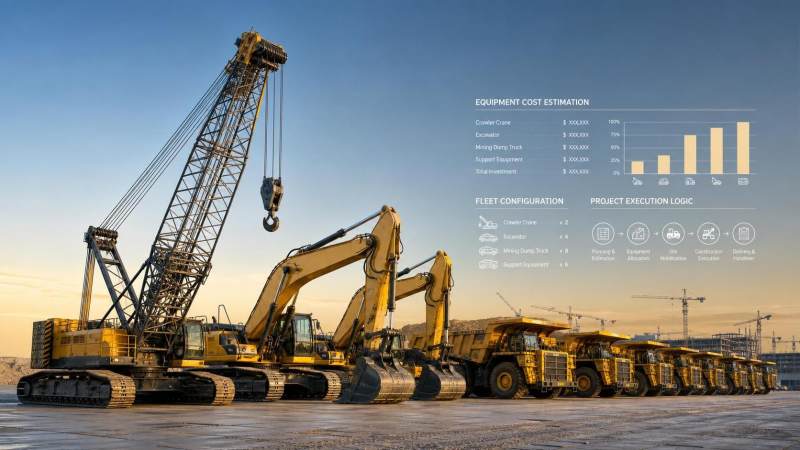
How to Estimate Construction Equipment Planning Cost for Large Projects?
Estimating construction equipment planning cost for large projects is not just an early budgeting task. It shapes bid competitiveness, site productivity, schedule resilience, and ultimately margin protection. On a tunnel, mine expansion, industrial plant, offshore yard, highway package, or heavy lifting campaign, the wrong equipment plan usually shows up twice: once in the budget, and again in delays, standby time, or emergency rentals.
That is why experienced project teams do not treat equipment planning as a line item copied from a previous job. They build it from the work method outward. The cost of a crawler crane, excavator fleet, TBM support spread, road machinery train, or dump truck system depends on how the project will actually be executed, under what constraints, and with what tolerance for disruption.
In practice, the most useful estimate is not the cheapest number. It is the one that explains where cost comes from, what assumptions support it, and which variables are likely to move.
Start with the construction method, not the machine list
Large projects often go wrong at the estimating stage because teams jump too quickly to equipment categories: four excavators, two cranes, twenty dump trucks, one batching plant, and so on. But equipment cost only makes sense when attached to production logic. A lifting-heavy petrochemical job, a drill-and-blast tunnel, a slurry TBM drive, and a large open-pit stripping program may all require high-capex equipment, yet their cost structure is completely different.
Before pricing anything, define the work packages that actually drive output: excavation, hauling, lifting, lining, paving, material handling, dewatering, spoil disposal, or segment transport. Then identify the production target for each package. If the schedule requires a certain daily advance rate, lifting cycle, haulage volume, or paving width, the equipment fleet has to support that target with a realistic buffer.
This is one reason infrastructure planners increasingly rely on sector intelligence rather than generic cost libraries. Platforms such as TF-Strategy, which track TBM systems, ultra-large excavators, crawler cranes, road machinery, and mining dump trucks as connected parts of global heavy engineering, are useful not because they provide one magic price, but because they help link machine parameters to construction methodology and delivery risk. That connection is where a serious estimate begins.
What should be included in construction equipment planning cost?
Many budgets understate equipment cost because they focus on ownership or rental rate alone. For large projects, equipment planning cost is broader. It usually includes acquisition or hire cost, mobilization and demobilization, assembly and commissioning, fuel or power consumption, operator and technician cost, maintenance support, wear parts, insurance, permits, transport restrictions, standby exposure, and eventual replacement if utilization is high or site conditions are harsh.
A simple way to avoid blind spots is to separate the estimate into five layers:
- Core machine cost: purchase, lease, or rental
- Deployment cost: shipping, customs, route survey, assembly, craneage, site setup
- Operating cost: fuel, electricity, lubricants, operators, daily inspections
- Support cost: maintenance teams, critical spares, tire management, cutter tools, undercarriage wear, telemetry systems
- Risk cost: weather delay, ground uncertainty, idle time, low utilization, backup fleet, subcontractor interface failure
On heavy civil and mining jobs, the support and risk layers are often where the estimate drifts furthest from reality. A machine that looks economical on paper can become expensive if parts lead times are long, if specialist technicians are scarce, or if the project location makes every breakdown a logistics event.
The key variables that move the estimate
No two large projects carry the same equipment profile, even when the machine types look familiar. Several variables usually have the biggest impact on planning cost.
Fleet size and utilization
A common estimating mistake is to size the fleet using theoretical capacity. Real-world utilization is lower because of queuing, traffic pattern conflicts, blasting windows, shift changes, weather, maintenance stops, and handover between trades. The question is not how much one machine can do in ideal conditions, but how much the system can deliver across the actual work cycle.
This matters especially in haulage and lifting. A dump truck fleet is only as efficient as the loading arrangement, road condition, gradient, turning radius, and dumping sequence. A crawler crane plan only works if component laydown, crane walking path, ground bearing pressure, and tandem lift constraints have been priced into the method.
Ground, climate, and altitude
Site conditions change both machine selection and operating cost. Abrasive rock increases wear. Soft ground may require different undercarriage choices or matting support. High altitude can affect engine performance. Extreme temperature affects tires, hydraulic systems, batteries, and maintenance intervals. In tunneling, geology influences everything from cutter consumption to slurry treatment requirements.
These are not secondary details. They can shift total equipment cost materially, particularly on remote mining and mountain infrastructure projects.
Project duration and scheduling logic
Short-duration peak works may justify rental premiums if they avoid long ownership exposure. Multi-year programs may favor purchase, long-term lease, or hybrid fleet strategies. The estimate also has to reflect schedule shape. If work is front-loaded, equipment demand may spike early and taper later. If interfaces are uncertain, the budget should not assume continuous high utilization from day one.
Compliance and local market conditions
Import rules, emission requirements, transport permits, road restrictions, operator licensing, and local content rules can all affect equipment planning cost. These items vary by jurisdiction and usually need confirmation against project documents and local regulations. On cross-border projects, the commercial difference between importing a specialized machine and sourcing regionally can be substantial, even before maintenance support is considered.
A practical framework for estimating the cost
A useful estimate usually moves through a sequence like this.
At this stage, many teams also build a base case, a constrained case, and a stress case. The base case assumes normal utilization. The constrained case reflects likely interruptions such as traffic conflicts, weather exposure, or slower learning curves. The stress case tests what happens if critical equipment is delayed or if production assumptions prove optimistic. This approach is more credible than pretending one neat number can absorb every uncertainty.
Rental, ownership, or mixed fleet?
There is no universal answer, but there is a practical way to judge it. If the equipment is standard, available locally, and needed for a short defined window, rental may be efficient even at a higher nominal day rate. If the machine is specialized, central to the critical path, or likely to be reused across projects, ownership or long-term lease may offer better control.
Mixed fleet strategies are common on large projects for a reason. Contractors may own the core machines they trust for productivity and rent the peak-demand units that cover temporary surges. In tunneling and heavy lifting, this is often the most realistic balance between capital discipline and operational flexibility.
The trap is comparing options only on invoice rate. Total cost of ownership, support network strength, operator familiarity, resale outlook, and spare parts availability matter more than a headline rental number when the project runs into complexity.
Where estimates are often too optimistic
Large-project equipment budgets tend to be light in predictable places. Mobilization is often underestimated for oversized equipment. Support plant is omitted because it is not seen as “main equipment.” Maintenance is budgeted as routine even when the site is abrasive, remote, or running double shifts. Fuel burn is lifted from brochure figures instead of site cycle conditions. Standby is ignored, even though interfaces with civils, utilities, blasting, marine access, or component delivery may create unavoidable idle periods.
Digital systems are another area that deserves better treatment. Remote diagnostics, fleet management software, payload monitoring, machine guidance, and predictive maintenance tools do add cost. But on complex sites, they can also reduce unplanned downtime and improve utilization visibility. TF-Strategy’s coverage of 5G remote-controlled excavation, evolving TBM cutter head materials, and the commercial logic behind electric mining trucks reflects a broader point: technology choices are no longer separate from equipment planning cost. They are becoming part of it.
Use market intelligence, but keep it tied to the job
Benchmarking matters, especially when pricing unfamiliar geographies or specialized heavy equipment. Market intelligence on tenders, fleet trends, raw material supply, OEM developments, and regional demand can help estimators avoid outdated assumptions. That is particularly relevant in sectors where supply tightness, energy transition policy, or infrastructure cycles are changing equipment availability and support economics.
Still, external intelligence only becomes useful when translated into project-specific assumptions. A contractor does not need abstract market commentary. It needs to know whether a 600-ton crawler crane can be sourced on time, whether cutter consumption is likely to rise under specific geology, whether pure electric haulage is operationally viable for the climate and shift model, and how those decisions affect total project exposure.
A better estimate is one you can defend
When evaluating construction equipment planning cost, the real test is not whether the estimate looks lean. It is whether the team can explain every major assumption behind it. What production rate was used? What utilization was assumed? What support equipment is included? Which maintenance intervals were priced? What happens if delivery slips by four weeks? Which items are fixed, and which remain exposed to fuel, transport, or spare parts volatility?
For large projects, those questions matter more than the spreadsheet format. Equipment planning is where engineering method, commercial discipline, and operational realism meet. If one of those is missing, the budget usually becomes fragile.
A solid next step is to review the estimate package against actual site parameters: work fronts, ground conditions, logistics routes, power availability, duty cycle, local compliance, and support capability. That review often reveals whether the number reflects a workable execution plan or just a hopeful one.
Related News
 Sep 27, 2026Heavy Equipment Selection Factors for Matching Machine Capacity to Jobsite ConditionsHeavy equipment selection factors for matching capacity to jobsite conditions, improving productivity, safety, fleet efficiency, and total project cost control.
 Sep 26, 2026How to Select Wind Rotor Lifting Equipment for Safe Blade and Hub InstallationWind rotor lifting equipment selection guide: ensure safe blade and hub installation with the right lift method, load control, crane compatibility, wind limits, and compliance.
 Sep 25, 2026What Drives Heavy Haulage Cost on Oversized Construction Equipment Moves?Heavy haulage cost explained: discover how load dimensions, route surveys, permits, escorts, lifting plans, and scheduling shape reliable oversized equipment transport budgets.
 Sep 24, 2026Supplier Management Frameworks That Reduce Delays on Large Construction ProjectsLarge-scale construction projects supplier management frameworks help prevent costly delays with risk-based controls, milestone tracking, quality oversight, and escalation plans for critical packages.
Ms. Elena Rodriguez
Weekly Insights
Stay ahead with our curated technology reports delivered every Monday.