
Heavy Equipment Selection Factors for Matching Machine Capacity to Jobsite Conditions
Heavy Equipment Selection Factors for Matching Machine Capacity to Jobsite Conditions
Introduction: Choosing the right machine is a strategic decision that directly affects productivity, safety, cost control, and project delivery across complex infrastructure and industrial projects.
For project managers, the central question is not simply which machine has the highest rated capacity. It is whether that capacity remains productive, safe, and economical under actual jobsite conditions.
The most important heavy equipment selection factors connect machine specifications with ground behavior, material density, site geometry, operating hours, logistics, workforce capability, and planned production targets.
A well-matched machine reduces idle time, avoids premature wear, protects schedules, and improves total cost of ownership. A poorly matched machine can create bottlenecks even when its specifications appear impressive.
Start With the Required Production Outcome
Equipment selection should begin with the output the project must achieve each day, shift, week, or construction phase. Capacity only has value when it supports measurable production requirements.
Define the target using practical units such as tonnes moved, cubic meters excavated, meters paved, lifts completed, or tunnel meters advanced under expected operating conditions.
Rated manufacturer capacity is a reference point, not a guaranteed project outcome. Real production depends on cycle times, material conditions, machine availability, operator performance, and site coordination.
Project managers should calculate the required effective hourly output before comparing models. This creates a realistic basis for deciding whether a machine is undersized, properly matched, or excessive.
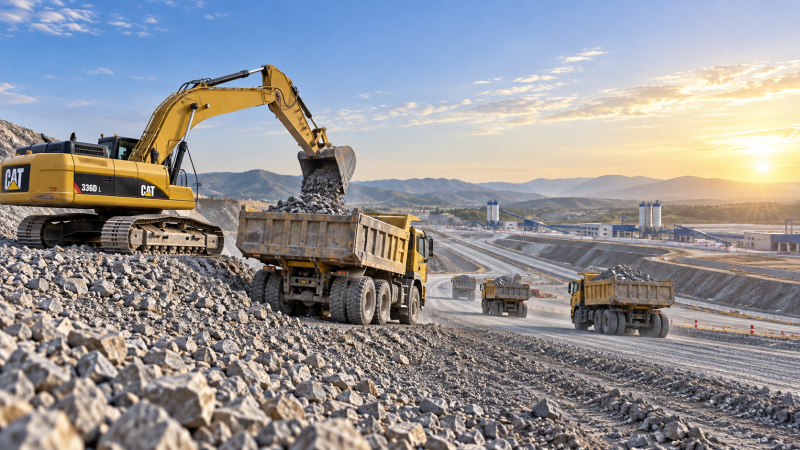
For example, an excavator with a larger bucket may not increase production when trucks cannot be positioned efficiently or when fragmented rock requires repeated bucket penetration attempts.
Similarly, a crawler crane with exceptional lifting capacity may create little schedule benefit if transportation, assembly space, ground preparation, or lifting windows remain limiting factors.
The strongest equipment decision identifies the project bottleneck first. The selected machine should remove that bottleneck without introducing new constraints elsewhere in the operating system.
Match Machine Capacity to Duty Cycle, Not Peak Demand
Many equipment decisions fail because they are based on occasional peak loads instead of the normal workload. Machines should be evaluated against sustained duty cycles.
Duty cycle describes how intensively equipment works during a shift, including loading, traveling, lifting, waiting, refueling, maintenance, repositioning, and unavoidable operational interruptions.
A machine operating near maximum capacity continuously may experience accelerated component wear, higher fuel consumption, overheating risk, and lower availability during critical project periods.
Conversely, oversized equipment can carry unnecessary acquisition, transport, fuel, maintenance, and mobilization costs while delivering little additional usable output.
Project managers should distinguish between nominal capacity, practical operating capacity, and peak capacity. These three figures are often materially different on demanding jobsites.
A practical selection usually leaves enough operating margin for changing material conditions, weather disruption, operator variation, equipment aging, and short-term increases in production demand.
For heavy-duty mining, tunneling, and lifting work, capacity margin supports reliability. It should be planned deliberately rather than treated as an informal buffer during procurement.
Assess Ground Conditions Before Selecting Machine Size
Ground conditions are among the most decisive heavy equipment selection factors because they affect traction, stability, bearing pressure, excavation resistance, access, and machine operating speed.
Soft soils, saturated ground, steep grades, fractured rock, compacted fill, frozen surfaces, and unstable benches each create different requirements for tracks, tires, undercarriages, and attachments.
For excavators, ground conditions influence whether a larger machine can safely reach the workface without excessive sinking, sliding, instability, or costly temporary ground improvement.
For crawler cranes, soil bearing capacity must be assessed alongside crane load charts. A crane’s rated load is irrelevant if the supporting ground cannot safely distribute imposed loads.
Mining dump trucks require traction and braking performance that match haul-road gradients, rolling resistance, turning geometry, and surface maintenance quality throughout the operating cycle.
Tunnel boring machine selection requires even deeper geological analysis. Rock strength, abrasivity, groundwater pressure, fault zones, mixed-face conditions, and settlement tolerance shape viable machine configurations.
Equipment specifications should therefore be reviewed together with geotechnical data, not afterward. Late discovery of unsuitable conditions usually leads to expensive redesign, standby time, or replacement equipment.
Understand Material Characteristics and Load Variability
Machine capacity must match the material being moved, processed, lifted, or compacted. Volume alone is insufficient because material density, moisture, fragmentation, and abrasiveness change operating demands.
Loose dry soil, wet clay, blasted rock, overburden, recycled aggregate, asphalt mix, and mineral ore can occupy similar volumes while placing very different loads on equipment.
Excavator bucket selection requires careful attention to fill factor. A large bucket may remain partly empty in sticky material or become overloaded when handling dense rock.
Dump truck payload planning must account for material density variation. Repeated overloading damages tires, suspension systems, frames, and haul roads while increasing safety exposure.
For lifting operations, the actual load includes rigging, hooks, lifting beams, spreaders, wind effects, dynamic movement, and possible changes in center of gravity.
Road construction equipment must also reflect material behavior. Compaction machinery, pavers, and milling machines need configurations compatible with layer thickness, aggregate composition, temperature, and specified tolerances.
Projects should use verified field samples and production data whenever possible. Assumptions based only on design quantities can create misleading capacity calculations and poor equipment utilization.
Evaluate Access, Working Envelope, and Site Geometry
A machine can be technically capable yet operationally unsuitable when site access, turning space, overhead clearance, working radius, or transport restrictions limit its deployment.
Project managers should assess equipment dimensions before procurement, including width, height, tail swing, transport weight, boom clearance, turning radius, and assembly requirements.
Urban construction sites often require compact but highly capable machines because utility conflicts, adjacent structures, traffic management, and restricted staging areas limit larger equipment.
Open-pit mining sites may accommodate massive fleets, but haul-road widths, ramp grades, loading-zone design, and dumping geometry still determine whether production can flow efficiently.
For cranes, lifting capacity declines as radius increases. The required lift must be checked against actual boom configuration, ground elevation, obstructions, and lift-path geometry.
TBM projects need comparable discipline underground. Launch chambers, rescue shafts, segment logistics, conveyor routes, slurry treatment systems, and backup gantry length affect machine selection.
These constraints should be modeled early using site drawings, surveys, and construction sequencing. Physical compatibility is a prerequisite for realizing theoretical machine performance.
Balance Fleet Capacity Instead of Optimizing One Machine
Equipment should be selected as part of an integrated production system. A highly productive primary machine cannot compensate for weak support equipment or poor material flow.
An excavator must be matched with enough trucks, appropriate truck payloads, reliable loading positions, and suitable haul-road conditions to avoid waiting on either side.
Similarly, a high-capacity crusher requires feeding equipment, conveyors, stockpile space, maintenance access, and downstream processing capacity that can absorb its output.
In tunneling, TBM advance rates depend on segment supply, cutter replacement planning, spoil removal, grout systems, ventilation, survey control, and maintenance response capability.
Crane operations depend on transporters, rigging crews, lifting supervisors, access preparation, component delivery timing, and weather monitoring, not only crane tonnage.
Fleet balance should be tested using cycle-time analysis. Compare the loading cycle, travel cycle, unloading cycle, return cycle, and expected delays across all connected assets.
The preferred fleet minimizes total system waiting time. This often produces better economics than purchasing the largest available machine for a single activity.
Include Availability, Service Support, and Operator Capability
Machine capacity has limited value when availability is low. Selection decisions should include expected uptime, scheduled maintenance requirements, parts supply, field service coverage, and diagnostic support.
Remote projects, high-altitude mines, offshore-adjacent sites, and underground works require particular attention to local dealer capability and critical spare-parts lead times.
Project managers should review maintenance intervals alongside expected operating hours. A machine requiring frequent service interruptions may not support continuous production targets without standby capacity.
Operator capability is equally important. Advanced equipment can underperform when operators lack training in machine control, payload management, grade control, automation, or condition monitoring.
Digital systems can improve performance when they are integrated into actual workflows. Telematics, payload monitoring, fatigue systems, and remote diagnostics require accountable teams and response procedures.
Equipment selection should also consider maintainability. Access to filters, lubrication points, wear components, electrical systems, and hydraulic assemblies affects service time and repair quality.
When comparing suppliers, evaluate the complete operating support model. Purchase price may be less important than dependable availability during a schedule-critical construction phase.
Compare Total Cost of Ownership, Not Purchase Price
The lowest purchase price does not always create the lowest project cost. Total cost of ownership provides a more accurate view of equipment value over its planned use.
Relevant costs include acquisition or rental expense, financing, mobilization, fuel or electricity, consumables, maintenance, tires or tracks, operators, insurance, downtime, and resale value.
For short-duration work, rental or specialist subcontracting may reduce capital exposure. For long-term, high-utilization projects, ownership can offer stronger control and lower unit costs.
Fuel consumption should be evaluated per productive tonne, cubic meter, lift, or kilometer moved rather than per operating hour alone. Production efficiency is the meaningful comparison.
Electric and hybrid equipment may offer lower operating emissions and energy costs, but charging infrastructure, power reliability, battery performance, and service support must be assessed realistically.
Equipment with higher initial cost can be justified when it reduces rework, improves safety, shortens schedules, lowers maintenance demand, or increases usable uptime.
A credible business case compares alternatives through unit production cost, expected availability, residual value, risk exposure, and schedule impact rather than headline machine price.
Plan for Safety, Environmental Limits, and Regulatory Compliance
Safety requirements should shape equipment selection from the start. A productive machine that creates unacceptable operational risk is not an effective project asset.
Consider rollover protection, visibility, collision avoidance, emergency access, lifting controls, braking performance, fire suppression, fatigue monitoring, and safe maintenance access.
Environmental conditions also influence capacity choices. High temperatures, freezing conditions, altitude, dust, humidity, vibration, and corrosive environments can reduce effective machine performance.
Noise limits, emissions rules, working-hour restrictions, road permits, and local safety regulations may prevent the use of certain equipment configurations despite otherwise attractive specifications.
Urban projects may prioritize low-noise, low-emission, compact equipment. Remote mining projects may prioritize durability, fuel autonomy, fire protection, and long-distance service support.
For large lifts, wind limits must be incorporated into the work plan. Selecting a crane without considering weather downtime can lead to unrealistic installation schedules.
Compliance should be verified before contract commitment. Late regulatory changes can affect transport, operator licensing, environmental approvals, and the ability to operate equipment as planned.
Use a Structured Selection Process Before Committing
A disciplined selection process turns complex equipment choices into defensible project decisions. It also creates a documented basis for procurement, risk review, and stakeholder approval.
First, define the production target, project duration, operating hours, material properties, ground conditions, access limits, safety requirements, and expected weather exposure.
Next, create a shortlist of machines that meet the minimum practical requirements. Exclude options that fail critical constraints even if their rated capacity appears attractive.
Then compare alternatives using consistent criteria, including output, fuel efficiency, availability, service support, transport requirements, operator needs, safety systems, and total cost of ownership.
Where project value or risk is high, request site-specific production simulations, lift studies, geotechnical reviews, manufacturer input, and reference data from comparable projects.
Trial operations can reveal issues that specifications cannot show. Field testing helps validate cycle times, payload balance, machine stability, operator ergonomics, and maintenance accessibility.
Finally, revisit the equipment plan as conditions change. Heavy equipment selection factors should be reviewed during design development, mobilization, production ramp-up, and major scope changes.
Conclusion: Select Capacity That Works in Real Conditions
The best equipment choice is not necessarily the biggest, newest, or cheapest option. It is the machine whose usable capacity aligns with the project’s real operating environment.
Project managers should assess production targets, duty cycles, ground conditions, material behavior, site geometry, fleet balance, service support, safety requirements, and lifecycle economics together.
This approach helps prevent costly over-specification and under-capacity. It also improves schedule confidence by identifying the operational constraints that determine actual productivity.
For mining, tunneling, lifting, and road construction projects, informed equipment selection converts technical specifications into stronger delivery performance, lower risk, and more durable project value.
Related News
 Sep 27, 2026Heavy Equipment Selection Factors for Matching Machine Capacity to Jobsite ConditionsHeavy equipment selection factors for matching capacity to jobsite conditions, improving productivity, safety, fleet efficiency, and total project cost control.
 Sep 26, 2026How to Select Wind Rotor Lifting Equipment for Safe Blade and Hub InstallationWind rotor lifting equipment selection guide: ensure safe blade and hub installation with the right lift method, load control, crane compatibility, wind limits, and compliance.
 Sep 25, 2026What Drives Heavy Haulage Cost on Oversized Construction Equipment Moves?Heavy haulage cost explained: discover how load dimensions, route surveys, permits, escorts, lifting plans, and scheduling shape reliable oversized equipment transport budgets.
 Sep 24, 2026Supplier Management Frameworks That Reduce Delays on Large Construction ProjectsLarge-scale construction projects supplier management frameworks help prevent costly delays with risk-based controls, milestone tracking, quality oversight, and escalation plans for critical packages.
Ms. Elena Rodriguez
Weekly Insights
Stay ahead with our curated technology reports delivered every Monday.