
Remote Controlled Excavation Price: What Drives Cost in Hazardous and Confined Sites?
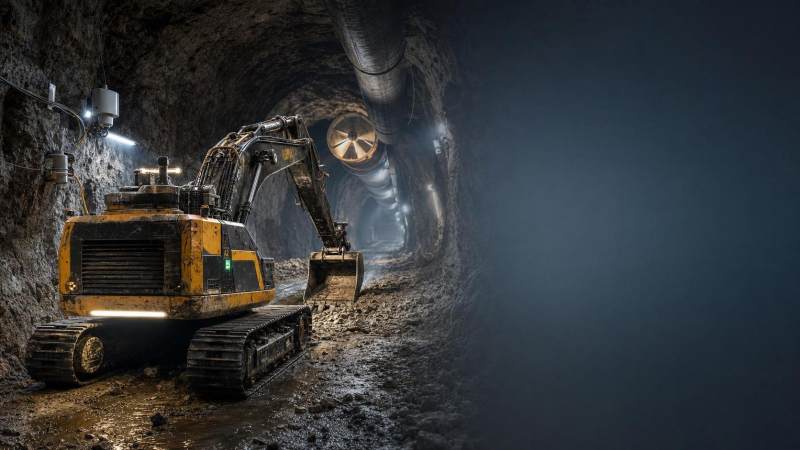
Remote Controlled Excavation Price: Why the Number Changes So Much
Remote controlled excavation price becomes a serious decision point when digging must continue inside unstable, toxic, or narrow work zones.
In those settings, the machine is only one part of the budget.
Control architecture, video latency, shielding, ventilation rules, communication stability, and rescue planning all influence the final cost.
That is why two excavators with similar operating weight can show very different remote controlled excavation price levels.
Across mining, tunneling, demolition, and heavy civil works, the smarter comparison is total operating fit, not headline purchase price alone.
This is also the lens often used by TF-Strategy when reading heavy equipment trends: physical performance must match construction reality and long-term project economics.
What does remote controlled excavation price usually include?
A common mistake is assuming the quote covers only the base excavator plus a remote console.
In practice, remote controlled excavation price may include several technical layers, depending on the site and operating method.
- Base machine, undercarriage, boom configuration, and attachment compatibility.
- Remote control package, including transmitters, receivers, fail-safe logic, and emergency stop systems.
- Camera arrays, night vision, dust-resistant housings, and extra lighting.
- Data link infrastructure, such as radio repeaters, fiber links, or private 5G integration.
- Operator station, simulator-based familiarization, and commissioning support.
- Maintenance spares, software support, and cybersecurity controls.
The wider the operating distance and the higher the hazard level, the more these add-ons matter.
A confined tunnel heading, for example, often needs more communication redundancy than an open bench in a mine.
So when reviewing remote controlled excavation price, ask for a scope split between machine cost, remote kit, site infrastructure, and support.
Which site conditions push the cost higher?
Hazardous and confined sites rarely accept a standard configuration.
The site itself often dictates the premium.
Remote controlled excavation price usually rises when visibility is poor, signals are obstructed, or evacuation time is critical.
Typical cost drivers include gas exposure, rockfall risk, demolition debris, underwater seepage, heat, and heavy dust loading.
Another factor is cycle continuity.
If the machine must run for long shifts with little downtime, buyers may need upgraded cooling, protected harnesses, and higher-spec sensors.
More advanced teleoperation also adds cost when precision work is required near walls, utilities, support frames, or unstable faces.
In real projects, the highest price is not always tied to the largest machine.
It is often tied to the most demanding risk control environment.
A quick comparison of common pricing pressure points
The table below helps separate visible equipment cost from hidden implementation cost.
Is buying always better than renting or retrofitting?
Not necessarily.
Remote controlled excavation price should be judged against project duration, utilization rate, attachment changes, and redeployment potential.
For short campaigns, rental or a specialist subcontract package can be more rational.
That is especially true when the hazardous phase lasts only weeks, not years.
Retrofitting an existing excavator can also work, but only when the hydraulic and electronic platform is suitable.
Older machines may look cheaper upfront, yet generate integration delays, unstable controls, and weak parts support.
A factory-integrated machine usually costs more at first, but it often reduces troubleshooting and commissioning risk.
A practical way to compare options is to model three numbers: acquisition cost, monthly uptime value, and exit value after the project ends.
If redeployment into mining, tunneling, or infrastructure maintenance is realistic, ownership becomes easier to justify.
Where do buyers misread remote controlled excavation price?
The biggest misunderstanding is treating remote controlled excavation price as a one-line capital cost.
The more useful question is what the system costs per safe, productive operating hour.
Several blind spots appear repeatedly.
- Underestimating communication infrastructure in tunnels, plants, or deep cuts.
- Ignoring training time for operators who are skilled in excavation but new to teleoperation.
- Missing software update terms, license renewals, and remote diagnostics fees.
- Failing to budget for replacement cameras, antennas, or protected connectors.
- Comparing a basic remote kit against a fully redundant safety architecture.
In sectors watched closely by TF-Strategy, digital equipment economics increasingly depend on supportability, not just horsepower.
That is very clear in 5G-enabled remote excavation and other connected heavy equipment systems.
A lower quote can become the more expensive option if field repairs are slow or the site cannot tolerate communication downtime.
How should remote controlled excavation price be evaluated before a final decision?
A strong evaluation process does not start with brand preference.
It starts with operating conditions, production targets, and the cost of human exposure.
More common and more reliable is a checklist approach tied to measurable job demands.
Key questions worth settling early
- How far must the operator be from the face during normal and emergency conditions?
- What latency can the task tolerate during bucket positioning or breaker work?
- Will the machine operate with one attachment or several specialized tools?
- How many hours per month justify ownership instead of contracted service?
- Which spare parts must be stocked on site to protect uptime?
- Can the remote system integrate with site connectivity plans already in use?
It also helps to request a scenario-based quotation, not a generic brochure price.
Ask suppliers to price the system under your actual excavation depth, signal environment, shift pattern, and hazard controls.
That makes remote controlled excavation price comparisons much cleaner.
So what is the most useful way to think about cost?
The best reading of remote controlled excavation price is not cheapest versus most expensive.
It is fit versus exposure, uptime, and adaptability.
When the work zone is dangerous or constrained, cost discipline means understanding the full operating system behind the machine.
That includes communication reliability, visual control, maintenance strategy, and whether the asset can move into the next project without heavy modification.
A useful next step is to build a comparison sheet covering base machine scope, remote package depth, site infrastructure, operator training, and annual support.
With that structure in place, remote controlled excavation price becomes a measurable decision instead of a vague premium.
For heavy industry teams tracking tunnel work, open-pit operations, and connected machinery trends, that is where better decisions usually begin.
Related News
 Sep 27, 2026Heavy Equipment Selection Factors for Matching Machine Capacity to Jobsite ConditionsHeavy equipment selection factors for matching capacity to jobsite conditions, improving productivity, safety, fleet efficiency, and total project cost control.
 Sep 26, 2026How to Select Wind Rotor Lifting Equipment for Safe Blade and Hub InstallationWind rotor lifting equipment selection guide: ensure safe blade and hub installation with the right lift method, load control, crane compatibility, wind limits, and compliance.
 Sep 25, 2026What Drives Heavy Haulage Cost on Oversized Construction Equipment Moves?Heavy haulage cost explained: discover how load dimensions, route surveys, permits, escorts, lifting plans, and scheduling shape reliable oversized equipment transport budgets.
 Sep 24, 2026Supplier Management Frameworks That Reduce Delays on Large Construction ProjectsLarge-scale construction projects supplier management frameworks help prevent costly delays with risk-based controls, milestone tracking, quality oversight, and escalation plans for critical packages.


Ms. Elena Rodriguez
Weekly Insights
Stay ahead with our curated technology reports delivered every Monday.