
Construction Machinery Price Trends: What Drives Equipment Costs and How to Time Purchases
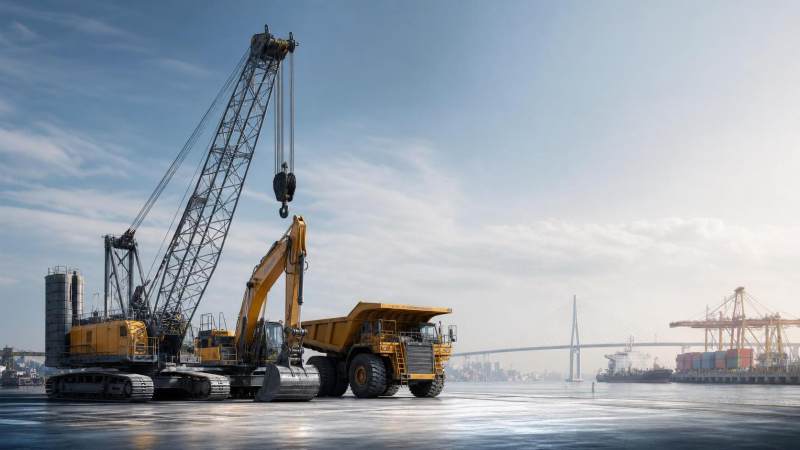
Construction machinery price trends are no longer moving in one direction
Construction machinery price trends now reflect a layered market, not a simple annual increase or decline.
List prices still matter, but they no longer tell the full story.
Steel costs, diesel swings, freight rates, emissions compliance, interest expense, and project timing all feed into final equipment cost.
That is especially visible in heavy segments tied to energy, mining, tunneling, and transport infrastructure.
A crawler crane for wind installation, a TBM system, or a large mining truck carries pricing pressure very differently from compact equipment.
From recent market signals, the bigger change is not just price level but price behavior.
Quotes expire faster, supplier lead times shift more often, and option packages increasingly change the true cost base.
This is why construction machinery price trends deserve closer reading than a budget line item.
For capital-heavy projects, timing mistakes can lock in years of avoidable ownership cost.
Within the TF-Strategy view of global heavy industry, pricing is best read through the link between equipment physics, project method, and infrastructure strategy.
Why the recent pricing signals feel more fragmented
One reason construction machinery price trends feel harder to predict is that demand is no longer synchronized across sectors.
Urban tunneling may stay active while residential construction slows.
Open-pit mining investment can rise even when general equipment orders soften.
Wind power installation may tighten crane availability in one region while road machinery discounts appear elsewhere.
That fragmentation changes bargaining power.
Suppliers with exposure to high-spec segments often defend margins better than those selling standardized mid-range machines.
At the same time, buyers see more variation between base models and configured units.
The quoted machine may look stable, while attachments, telematics, safety systems, and low-emission packages move sharply.
In practice, construction machinery price trends now need to be read by application, not by headline averages alone.
The cost drivers behind the quote
What matters here is interaction.
A stable steel market can still be offset by financing pressure or delayed marine transport.
That is why construction machinery price trends often look inconsistent across brands and regions.
Demand is shifting toward specification, not just volume
Another clear signal is that buyers are paying more attention to machine fit, duty cycle, and lifecycle economics.
This changes how construction machinery price trends should be interpreted.
A lower upfront number may hide weaker fuel efficiency, shorter component life, or lower resale performance.
In sectors tracked closely by TF-Strategy, this is already a structural pattern.
TBM projects compare cutter head wear, backup system integration, and geological adaptability.
Mining fleets increasingly compare electric transition readiness, payload optimization, and remote operation compatibility.
Crane decisions are shaped by transport configuration, assembly time, and lifting envelope under local regulations.
As a result, the apparent market price is becoming less useful than the configured cost per productive hour.
That reframes purchase timing.
The best buying window may arrive when the right configuration becomes available, not when a generic discount appears.
Where this hits operating decisions fastest
- Long-lead projects face higher risk if design freeze happens after equipment pricing has been locked.
- Cross-border deliveries carry more exposure to freight resets and customs-related compliance additions.
- High-utilization fleets benefit more from fuel and maintenance savings than from marginal upfront discounts.
- Low-volume specialty machines can become more expensive when supplier capacity is tied up by strategic sectors.
Timing purchases now means reading three clocks at once
There is no single perfect month to buy.
Better timing comes from tracking three separate clocks.
The first is the commodity clock.
Watch steel plate, alloy inputs, fuel, and shipping benchmarks because they affect supplier cost recovery.
The second is the project clock.
If a tunnel package, mine expansion, or wind corridor is entering procurement in a region, capacity tightens before public price data fully shows it.
The third is the finance clock.
Interest rates, leasing appetite, and currency conditions may improve the real acquisition cost even when equipment tags remain unchanged.
This is where many teams misread construction machinery price trends.
They wait for list prices to soften, while financing and delivery windows quietly worsen.
More effective timing combines moderate price discipline with earlier technical alignment.
That shortens requoting cycles and protects against late-stage specification creep.
The biggest pricing risk is often outside the machine itself
Recent construction machinery price trends show that hidden costs are widening faster than many base prices.
Commissioning, operator training, digital integration, spare parts staging, and warranty scope can materially change project economics.
For ultra-large equipment, assembly support and site-readiness delays are especially expensive.
A cheaper crane can become a more expensive crane if mobilization complexity is underestimated.
The same applies to tunneling equipment.
A machine priced attractively on paper may require cutter tooling, backup modifications, or geotechnical adaptation that alters the full capital case.
In road machinery and dump trucks, uptime support and parts lead times are becoming stronger price variables than brochure comparisons suggest.
So the more useful question is not whether prices are up or down.
It is which cost layers are moving fastest around the machine.
A practical lens for judging equipment cost pressure
- Separate base unit price from configured system price.
- Model freight, assembly, and site support as independent variables.
- Check whether compliance upgrades are temporary options or permanent market shifts.
- Compare cost per productive hour, not only purchase value.
- Test resale and refurbishment assumptions under realistic utilization scenarios.
What deserves closer attention in the next buying cycle
Looking ahead, construction machinery price trends will likely remain uneven rather than uniformly inflationary.
Decarbonization rules, electrification trials, digital fleet management, and localized supply strategies will keep changing equipment cost structures.
Some machines may stabilize in headline price while becoming more expensive to specify correctly.
Others may see short-term discounts because suppliers need backlog visibility.
The more reliable approach is to build a market view that combines macro indicators with segment intelligence.
That is where specialized observation matters.
A platform such as TF-Strategy is useful not because it publishes price headlines, but because it connects project pipelines, technical evolution, and heavy equipment demand signals.
That broader context helps explain why construction machinery price trends move differently for TBMs, ultra-large excavators, crawler cranes, road machinery, and mining haulage assets.
For the next buying cycle, the most effective step is to maintain a rolling watchlist.
Track raw material movement, supplier lead times, regional project starts, financing terms, and configuration changes in parallel.
Then review whether the planned application has shifted.
When the job profile changes, the right purchase timing often changes with it.
That discipline turns construction machinery price trends from a source of uncertainty into a decision tool.
Related News
 Sep 27, 2026Heavy Equipment Selection Factors for Matching Machine Capacity to Jobsite ConditionsHeavy equipment selection factors for matching capacity to jobsite conditions, improving productivity, safety, fleet efficiency, and total project cost control.
 Sep 26, 2026How to Select Wind Rotor Lifting Equipment for Safe Blade and Hub InstallationWind rotor lifting equipment selection guide: ensure safe blade and hub installation with the right lift method, load control, crane compatibility, wind limits, and compliance.
 Sep 25, 2026What Drives Heavy Haulage Cost on Oversized Construction Equipment Moves?Heavy haulage cost explained: discover how load dimensions, route surveys, permits, escorts, lifting plans, and scheduling shape reliable oversized equipment transport budgets.
 Sep 24, 2026Supplier Management Frameworks That Reduce Delays on Large Construction ProjectsLarge-scale construction projects supplier management frameworks help prevent costly delays with risk-based controls, milestone tracking, quality oversight, and escalation plans for critical packages.
Ms. Elena Rodriguez
Weekly Insights
Stay ahead with our curated technology reports delivered every Monday.