
Selecting a Four-Axle Rear Dump Semi-Trailer for Aggregate Hauling
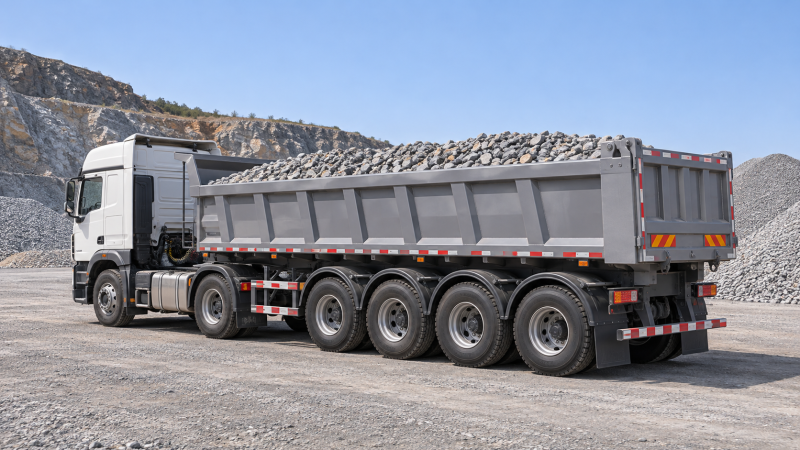
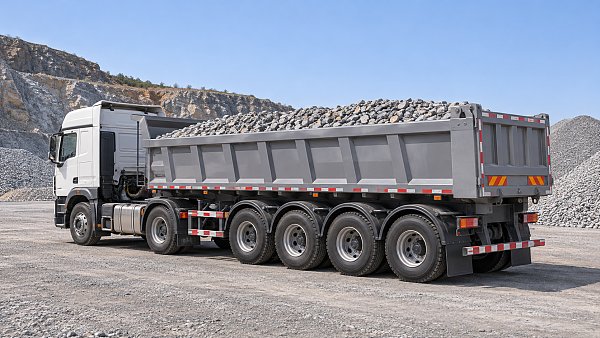
A four-axle rear dump semi-trailer should be selected around the material, route and unloading point—not axle count alone. For a project manager, the central question is whether the complete tractor-trailer combination can carry a useful legal payload, reach the discharge area and tip safely without creating delays elsewhere in the construction schedule.
Start with the heaviest aggregate likely to be carried, the actual tare weight of the proposed combination and the restrictions on every road, bridge and site entrance along the route. Then check the tipping surface, overhead clearance and space available for reversing. A trailer with ample body volume may be a poor choice if the permitted weight is reached before the body is full, or if its raised body cannot operate at the receiving point.
Define the haul before comparing trailers
Aggregate work varies from repeated quarry-to-plant deliveries to intermittent movements between temporary stockpiles. Prepare a short operating profile covering material type, expected moisture, loading equipment, trip distance, road conditions, discharge method and daily delivery window. Include the return journey: a rough unladen route can still affect tires, suspension and turnaround time.
Crushed rock, sand and gravel do not behave identically. Particle shape and grading affect abrasion and how material flows from the body. Wet or clay-contaminated loads may cling to the floor or walls, making discharge less predictable. If one trailer will handle several materials, identify the most demanding combination rather than selecting solely for the most common load.
For projects moving both aggregate and concrete, keep the two transport tasks separate in the equipment plan. A rear dump trailer is intended to discharge bulk material by tipping; a concrete mixer trailer serves a different delivery process. Their scheduling may be linked at a batching plant, but body capacity, discharge requirements and operating constraints should be evaluated independently.
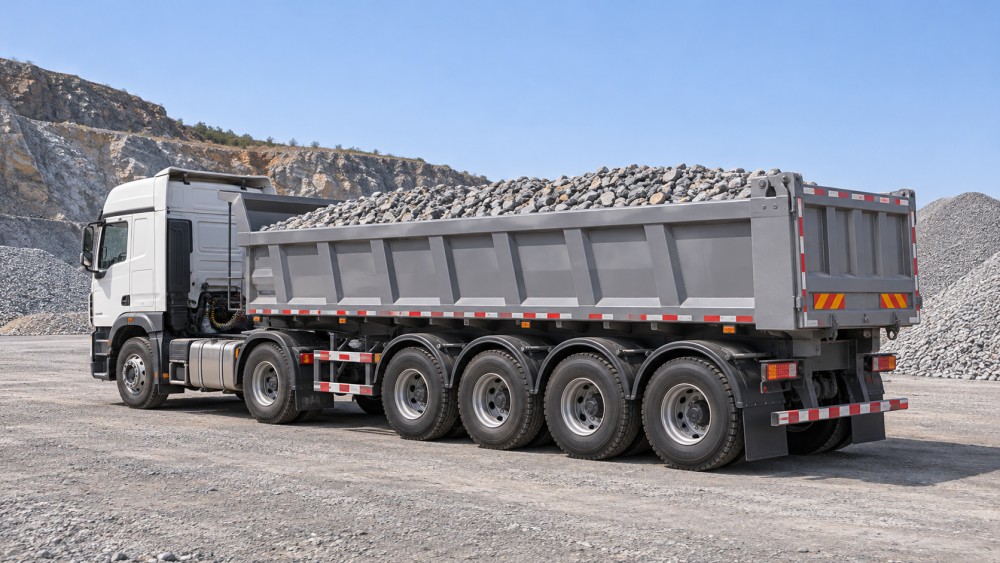
Calculate useful payload from the complete combination
Four trailer axles do not automatically establish a legal payload. The permissible gross combination weight and the distribution across the tractor and trailer depend on the applicable jurisdiction, axle spacing, vehicle configuration, permits and route restrictions. A bridge or access road may impose a lower limit than the general road allowance. Confirm the applicable rules with the relevant road authority and check the actual route before treating a quoted capacity as usable.
Build the payload calculation from documented weights. Start with the maximum permissible combination weight for the intended operation, then subtract the actual laden-ready tare of the tractor and trailer, including fuel, driver, spare wheel, sheeting equipment and other carried accessories. Check individual axle and axle-group loads as well as the total. A combination can be within its gross limit and still overload an axle if the load is poorly distributed.
Body volume supplies a separate limit. Estimate the material volume that corresponds to the allowable payload using the bulk density expected at loading, then compare it with usable body volume. Bulk density varies with material grading, moisture and compaction, so use measurements or supplier information representative of the material being hauled. Avoid relying on a single catalogue density for every aggregate.
For example, if a dense crushed aggregate reaches the weight limit with substantial space left in the body, paying for extra volume may add tare without increasing legal payload. Conversely, a lighter material may fill the body before the weight limit is reached. Where the same fleet carries both, compare the expected mix of loads rather than optimizing for only one material.
Match body construction to abrasion, impact and discharge
The loading method is as important as the material description. Large, angular rock dropped from height can impose concentrated impacts on the floor and sidewalls; fine aggregate may cause less impact but still wear surfaces through repeated movement. Ask the supplier to explain the proposed floor and sidewall materials, thicknesses, reinforcement and repair method in relation to the actual loading conditions.
A heavier body can provide useful resistance in demanding work, but it also consumes part of the payload allowance. The decision is not simply thick versus thin. Examine where reinforcement is placed, how the floor meets the sidewalls, whether worn components can be replaced and what local repair capability is available. A liner may be appropriate for some materials, but its weight, attachment and effect on discharge need review.
Body shape also deserves attention. Internal ledges or damaged panels can retain material, while the tailgate opening and latch arrangement influence how readily the load exits. For wet or cohesive material, ask how the proposed body is expected to discharge and what cleaning access is available. No body design eliminates the need to inspect for carryback between loads.
When comparing dump special trailers, request drawings that show the body profile, tailgate operation, tipping geometry and critical dimensions. These details make it easier to judge whether a four-axle rear dump configuration suits the aggregate and the receiving site; a nominal body capacity alone does not answer that question.
Check the unloading site before approving the specification
Rear tipping changes the stability conditions of the vehicle as the body rises and the load moves rearward. Risk increases when the ground is uneven or unable to support the vehicle, when the load shifts or sticks, or when the trailer is not properly aligned. The UK Health and Safety Executive’s guidance, Safe use of tipping vehicles (HSE, INDG421), addresses ground conditions, overhead hazards, exclusion zones and the need for safe tipping procedures.
Survey the actual discharge area with the proposed combination in mind. A compact stockpile may provide enough room for a trailer to enter but not enough for a straight reverse, a stable tipping position and a clear exit. Confirm raised-body height and clearance from overhead lines, structures and equipment. Do not assume the body can be raised merely because the trailer fits beneath a gate or canopy while travelling.
The site should identify who controls the tipping area, how other workers and vehicles are kept clear, and what the operator must do if material fails to discharge. Follow the vehicle manufacturer’s instructions and the site’s safe system of work; a persistent sticking load is not a reason to improvise with workers near a raised body. The HSE guidance also covers the hazards of working beneath raised tipping bodies and the need for suitable support during maintenance.
Where a receiving point cannot provide firm, reasonably level ground or adequate clearance, reassess the operation rather than expecting the trailer specification to compensate. A different unloading location, material-handling arrangement or vehicle type may be necessary.
Verify tractor compatibility and running gear
The tractor and trailer must be treated as a system. Provide the supplier with the tractor’s coupling details, fifth-wheel height, available axle capacity, connections and hydraulic provision. Check that the proposed kingpin position and loaded trailer geometry produce suitable clearance and load distribution throughout turning and travel. Confirm compatibility through the manufacturers’ documentation rather than assuming that two units will work together because they can be coupled.
Review the tipping system as a complete arrangement: hydraulic power source, hose routing, controls, cylinder mounting and required operating conditions. The operator needs clear instructions for raising, lowering and securing the body. Maintenance staff need access to inspect hoses, pins and mountings without creating an unsafe working position.
Axles, suspension, brakes and tires should match the approved loads and duty cycle. Road mileage, repeated low-speed maneuvering and rough quarry access place different demands on components. Ask which parts are common service items, how wear is assessed and whether replacements are available within the project’s maintenance window. A specification that depends on a hard-to-source component can leave a hauling plan exposed even when the initial purchase price is attractive.
Compare cost per delivered load, not purchase price alone
Estimate the number of legal loads required for the planned material quantity using the payload established for the actual combination. Then consider the full cycle: loading, loaded travel, queuing, positioning, tipping, cleaning if needed, and return travel. A larger nominal body offers little schedule benefit if loading or discharge is the controlling constraint.
Include expected fuel and tire use, routine servicing, inspections, wear-part replacement and the cost of downtime. These figures will vary by route, operator, material and local prices, so use project assumptions and test them against alternatives. It is often useful to compare a lighter configuration with a more heavily protected body under both a normal-duty and a severe-duty scenario. The more robust option may cost more to buy and carry less per trip, yet require fewer wear repairs under abrasive conditions; the reverse may be true on gentler work.
Do not overlook waiting time at the destination. If the discharge point can accept only one vehicle at a time, adding trailer capacity or more vehicles may simply lengthen the queue. Coordinate the haul plan with stockpile access, loading equipment and the receiving crew before using trailer capacity as the basis for a delivery commitment.
Turn the specification into an acceptance checklist
A purchase order should distinguish required performance from items that remain subject to verification. Record the intended materials, route constraints, tractor details, site access conditions and required documentation. Ask suppliers to identify assumptions and deviations rather than submitting only a general brochure.
- Weights and dimensions: Obtain the specified unladen weight, axle arrangement, coupling dimensions, body volume and raised-body clearance. Confirm which accessories are included in the quoted weight.
- Structure and discharge: Document body and floor construction, reinforcement, tailgate arrangement, hydraulic equipment and any liner. Agree how workmanship and visible damage will be assessed at delivery.
- Compatibility and compliance: Obtain the documentation needed for registration and operation in the intended jurisdiction, and verify tractor-trailer connections and route-specific restrictions with the responsible parties.
- Handover and support: Request operating and maintenance instructions, inspection points, lubrication requirements, spare-parts identification and the process for resolving defects.
At delivery, compare the trailer with the approved drawings and purchase order. Inspect the body, welds, hydraulic lines, tires, lights, brakes, locks and connections for damage or missing items. Arrange functional checks under controlled conditions using the manufacturer’s procedure and qualified personnel. A weighbridge check of the complete, ready-to-work combination provides a stronger basis for payload planning than an assumed tare weight.
The most suitable four-axle rear dump semi-trailer is the one whose legal payload, body construction and tipping envelope fit the actual work. If any of those conditions remains unresolved, keep it as an open procurement item rather than converting a provisional specification into a fixed hauling schedule.
Have questions about this sector analysis, or seeking best practices specific to your niche? Drop us a line below and let the senior consultants at TF-Strategy assist you.
Related News
 Nov 11, 2026Choosing Equipment Capacity for Different Workloads and ApplicationsExplore equipment application by capacity to match machines to real workloads, reduce bottlenecks and choose cost-effective solutions with confidence.
 Nov 10, 2026Crane Performance Comparison: Load Capacity, Reach and Lifting SpeedCrane performance comparison made practical: evaluate load capacity, reach and lifting speed to choose the right crane for your site and work sequence.
 Nov 09, 2026Heavy Equipment Technology Systems: Telematics, GPS and Machine ControlExplore heavy equipment technology systems, from telematics and GPS to machine control, and learn how to choose the right tools for your fleet and site.
 Nov 10, 2026Selecting a Four-Axle Rear Dump Semi-Trailer for Aggregate HaulingExplore dump special trailers for aggregate hauling. Learn how to compare legal payload, body durability and tipping safety before choosing a four-axle rear dump semi-trailer.

Ms. Elena Rodriguez
Weekly Insights
Stay ahead with our curated technology reports delivered every Monday.