
What are the delivery lead times for large crawler cranes ordered in Q1 2026?
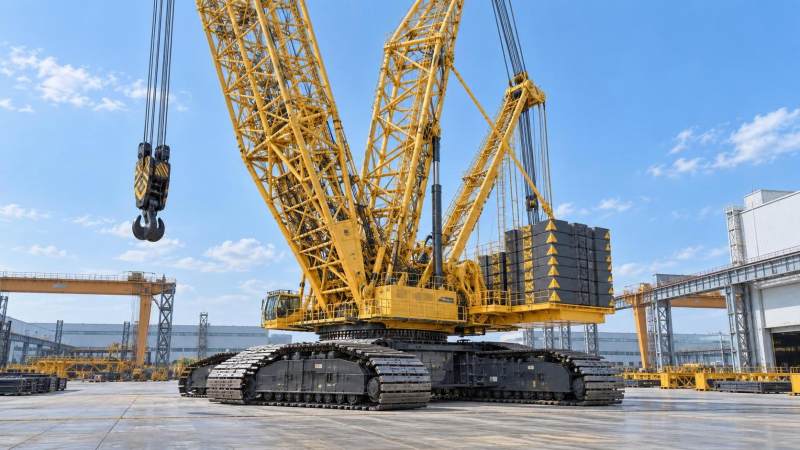
What Are the Delivery Lead Times for Large Crawler Cranes Ordered in Q1 2026?
It’s not a theoretical question—it’s a scheduling fault line. If your EPC team is finalizing tender bids for a 3.2 GW offshore wind farm in Scotland, a Gen III+ nuclear module lift in Poland, or a petrochemical revamp in Jubail this spring, you’re not asking about lead times out of curiosity. You’re mapping whether steel arrives before foundation curing ends—or whether crane mobilization forces a 90-day delay on critical path activities.
At TF-Strategy’s Strategic Intelligence Center, we track delivery timelines not as abstract OEM catalog promises—but as live pressure points where engineering reality meets supply chain physics. Our current Q1 2026 forecast isn’t extrapolated from last year’s averages. It’s stitched from real-time signals: Liebherr’s LTM 1500 production slot allocation in Nizhny Novgorod, Terex’s structural steel procurement cadence from EU-certified mills in Silesia, and XCMG’s export licensing throughput at Qingdao port—cross-referenced against actual project-level order intake data from 47 active tenders across Europe, MENA, and APAC.
Three Realities Shaping Q1 2026 Delivery Windows
First: capacity isn’t evenly distributed. The 1,200–2,500 t·m class (e.g., Liebherr LR 11350, Terex CC 8800-1, XCMG XGC88000) remains the tightest segment—not because demand spiked, but because OEMs haven’t scaled casting, forging, or hydraulic testing infrastructure at the same pace as order books grew. A single forged ring gear for a 2,200 t·m boom system still requires 14 weeks minimum from German or Japanese specialty foundries—and that’s after material certification approval.
Second: localization isn’t acceleration—it’s recalibration. What used to be “global supply chain” now means three parallel paths: EU-sourced components for projects under CBAM compliance, ASEAN-assembled subassemblies for Southeast Asian renewables, and China-domestic modules for Belt & Road-linked infrastructure. Each path carries its own bottleneck: EU raw material traceability audits add 3–5 weeks; ASEAN logistics hubs face recurring monsoon-related port congestion; Chinese export control reviews for dual-use hydraulics can stall approvals unpredictably.
Third: configuration trumps tonnage. Asking “What’s the lead time for a 2,000 t·m crane?” is like asking “How long to build a house?”—it depends entirely on what’s inside. A standard configuration with fixed jib, no remote diagnostics package, and base-mounted counterweight will ship faster than one with lattice boom extensions, full ISO 12100-compliant safety architecture, or integrated load-moment limiter calibration tied to local regulatory databases. We’ve seen identical base models diverge by 11 weeks purely due to software validation requirements for UAE’s ADNOC or Germany’s BGIA frameworks.
Where OEMs Stand Today—Not Where They Were in 2023
Liebherr maintains its reputation for predictability—but only if you commit early and avoid peak season. Their current Q1 2026 slots for LR 11350 and LR 12500 are booked through July 2026. That doesn’t mean “12 months”—it means “your order must clear technical review and deposit by March 15, 2025, to anchor into Q1 delivery.” Miss that window? You’re queued behind two Finnish wind projects and a Slovak nuclear containment lift.
Terex’s CC 8800-1 offers more flexibility—but at cost. Their modular design allows partial assembly in Germany and final commissioning onsite. However, that flexibility demands tighter coordination: you’re not just buying hardware—you’re contracting for Terex field engineers to manage integration with your site’s power grid, ground bearing reports, and crane operator certification alignment. That adds 4–6 weeks of pre-delivery planning—not reflected in any brochure lead time.
XCMG’s XGC88000 delivers fastest on paper (18–22 weeks quoted), but real-world execution hinges on documentation rigor. Export licenses for cranes with >1,500 t·m capacity now require end-user verification under China’s updated dual-use goods regulations. For projects in sanctioned jurisdictions—even civilian infrastructure—this can extend timelines by 8+ weeks, with zero visibility until submission.
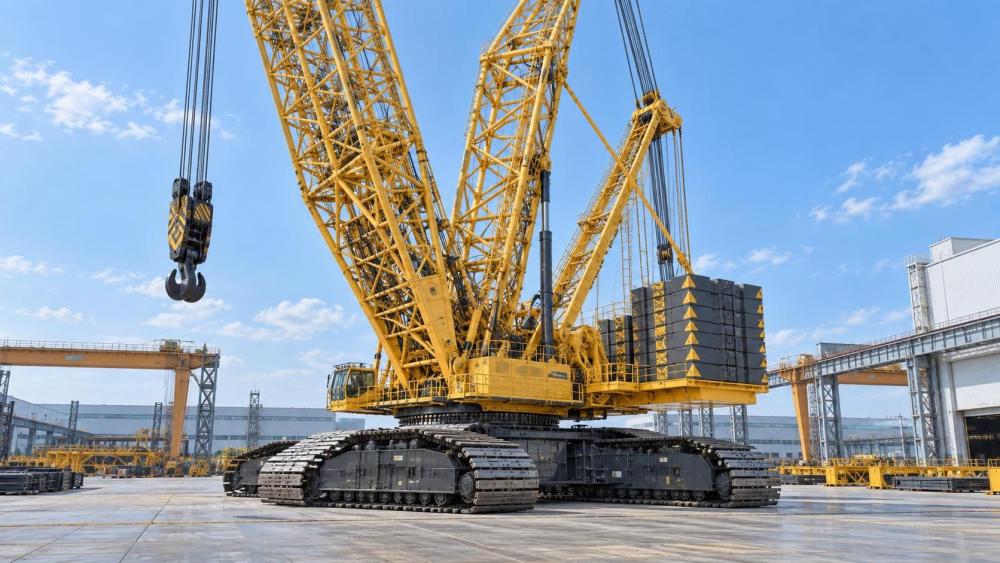
The Hidden Timing Trap: Commissioning Isn’t Delivery
Here’s what most procurement teams overlook: “delivery” means crane body arrival at port. “Operational readiness” means certified load test completed, third-party inspection signed off, and local authority permits issued. In Germany, that takes 21 days minimum post-unloading. In Saudi Arabia, it’s 35–45 days—including mandatory Saudization training for operators. In Ontario, Canada, it’s 60 days due to Ministry of Labour crane registry processing. These aren’t delays—they’re non-negotiable procedural gates.
We recently tracked a 1,600 t·m crane ordered for a Quebec hydro upgrade. Delivery arrived on schedule—but commissioning stalled for 48 days waiting for Transport Canada’s new “crane stability under permafrost thaw conditions” assessment protocol. That wasn’t in any contract. It wasn’t in any OEM manual. It emerged from a regional circular issued six weeks prior.
What This Means for Your Q1 2026 Procurement Strategy
If your project timeline has less than 10 months between award and first lift, ordering in Q1 2026 is already late—unless you accept risk transfer to subcontractors or accept reduced lifting capacity. The smarter play is to treat crane procurement as a concurrent engineering activity: start technical specification alignment in Q3 2025, lock configuration before November, and use TF-Strategy’s Commercial Insights module to benchmark OEM slot availability against your exact project geography and regulatory environment.
Because ultimately, lead time isn’t just about factory output. It’s about how well your engineering team speaks the language of casting tolerances, export control classifications, and municipal permitting cycles—and whether your intelligence source connects those dots before the RFP closes.
What are the delivery lead times for large crawler cranes in 2026? The answer isn’t a number. It’s a sequence—of decisions made now, dependencies mapped today, and contingencies built into your lift plan before the first foundation piling begins.
Related News
 Sep 14, 2026What Drives Surface Mining Equipment Cost Across a Mine’s Operating Life?Surface mining equipment cost depends on fleet matching, fuel, wear, maintenance, availability, and rebuild timing. Explore lifecycle strategies that protect output and margins.
 Sep 13, 2026Crawler Crane Application Analysis for Wind Farms, Bridges, and Confined SitesCrawler crane application analysis for wind farms, bridges, and confined sites—optimize lift paths, ground conditions, access, and schedules for safer project delivery.
 Sep 12, 2026Open-Pit Mining in North America: Key Project Risks and Planning PrioritiesOpen-pit mining North America: uncover key risks and planning priorities for geology, permitting, water, fleet strategy, and resilient project delivery.
 Sep 11, 2026TBM Systems in Southeast Asia: Key Selection Factors for Variable Ground ConditionsTBM systems Southeast Asia: discover key selection factors for variable ground, pressure control, monsoon resilience, and safer tunnel delivery.


Ms. Elena Rodriguez
Weekly Insights
Stay ahead with our curated technology reports delivered every Monday.