
Heavy Equipment Demand Forecast: What Contractors and Buyers Should Track by Region
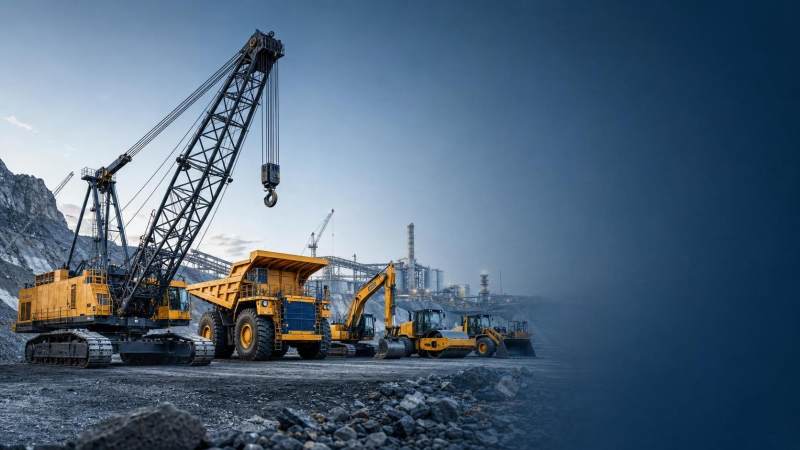
A credible heavy equipment demand forecast has become a planning tool, not a background statistic. Demand now moves unevenly across regions, shaped by public infrastructure budgets, mining cycles, energy transition projects, logistics bottlenecks, and labor availability. For organizations active in tunneling, open-pit mining, lifting, and roadbuilding, the real challenge is reading regional signals early enough to time fleet expansion, reduce ownership risk, and align capital decisions with projects that are actually moving.
Why regional demand now matters more than headline growth
A global growth figure can hide very different equipment realities. One market may be short of crawler cranes, while another faces idle earthmoving assets and delayed payments.
That is why a useful heavy equipment demand forecast must be regional first, category second, and project-driven throughout.
This is especially true in capital-intensive segments. TBMs depend on long-cycle urban rail and water projects. Mining dump trucks follow commodity confidence. Large road machinery responds to budget release and execution speed.
In practice, demand is no longer just about how much construction is planned. It is about which projects have permits, financing, grid connection, right-of-way clearance, and procurement momentum.
What a strong heavy equipment demand forecast should include
A serious forecast is not a simple sales outlook. It combines pipeline visibility, equipment suitability, delivery lead time, and operating economics.
The most reliable models usually track four layers at once: project volume, equipment intensity, replacement pressure, and fleet productivity constraints.
- Project volume: confirmed tenders, awarded contracts, and likely starts over the next 12 to 36 months.
- Equipment intensity: how many units, what size class, and what utilization level the project mix requires.
- Replacement pressure: aging fleets, emissions rules, safety upgrades, and electrification targets.
- Productivity constraints: operator shortages, spare parts access, maintenance support, and digital fleet control.
This is where intelligence platforms such as TF-Strategy add value. Market news alone is not enough. Demand becomes clearer when project tenders, geological conditions, machine specifications, and commercial logic are connected.
Regional signals worth tracking now
North America
North America remains supported by infrastructure renewal, LNG, data center construction, mining investment, and transmission expansion.
For a heavy equipment demand forecast in this region, watch public fund disbursement rather than headline allocations. Budget approval does not always convert quickly into machine demand.
Large cranes, road machinery, and specialized tunneling support equipment tend to benefit where energy, transport, and industrial projects overlap.
Europe
Europe shows mixed demand. Rail modernization, urban tunneling, offshore wind logistics, and grid reinforcement support selective equipment categories.
At the same time, higher financing costs and environmental compliance requirements can slow broad fleet expansion.
The regional heavy equipment demand forecast is strongest when it includes emissions regulation, low-noise construction rules, and the pace of clean energy permitting.
Middle East
The Middle East continues to support demand through megaprojects, industrial diversification, transport corridors, and utility expansion.
Crane demand, road machinery demand, and heavy earthmoving demand can rise quickly where project execution is concentrated and politically prioritized.
What matters most here is award timing, contractor mobilization speed, and whether specialized service support is available locally.
Asia-Pacific
Asia-Pacific is still the broadest engine for a heavy equipment demand forecast, but not as a single market.
India and Southeast Asia are shaped by roads, metro systems, ports, and industrial corridors. Australia leans more heavily on mining cycles and replacement demand.
TBMs, large excavators, and mining trucks all depend on different signals. Urban transport policy will not predict the same demand pattern as iron ore or copper expansion.
Latin America and Africa
These regions can show sharp growth where mining, corridor infrastructure, and energy access projects converge.
Yet the forecast quality depends heavily on currency risk, sovereign payment reliability, transport access, and aftersales capability.
A strong heavy equipment demand forecast here should discount announced projects that lack financing closure or import clarity.
How equipment categories respond differently
Not all heavy assets react to the same demand signals. Category-level discipline is essential.
TF-Strategy’s sector focus reflects this reality. Forecasting equipment demand is strongest when machine physics, site conditions, and project methods are evaluated together.
Cost pressure is changing purchase timing
Demand forecasts are increasingly tied to total cost of ownership, not just volume growth.
Fuel price uncertainty, parts lead times, financing costs, operator productivity, and idle-time exposure all affect whether to buy, rent, refurbish, or redeploy.
This is especially relevant for high-value assets with long delivery cycles. Ordering too early can trap capital. Ordering too late can miss project mobilization and revenue windows.
A practical heavy equipment demand forecast therefore needs a commercial lens. It should test margin resilience under different utilization and maintenance assumptions.
Technology shifts that can distort demand signals
Digitalization and energy transition can make traditional forecasting models less reliable if they only count unit volumes.
Remote-controlled excavation, predictive maintenance, alternative powertrains, and material upgrades can change replacement cycles and site productivity.
For example, pure electric mining trucks may alter fleet sizing logic. Improved TBM cutter materials may shift maintenance schedules and project economics.
That means a regional heavy equipment demand forecast should include technology adoption rates, not only traditional construction indicators.
How to use forecast signals in real decisions
The best use of a heavy equipment demand forecast is to narrow uncertainty before capital is committed.
- Map each target region by funded projects, not announced projects.
- Separate structural demand from one-off megaproject spikes.
- Match equipment categories to geology, haul profile, lifting height, or paving specification.
- Stress-test delivery timing against parts support and labor availability.
- Review whether emissions or electrification rules could shorten resale life.
- Use multiple forecast horizons: immediate demand, two-year pipeline, and strategic five-year direction.
This approach turns market intelligence into a working decision framework. It also reduces the chance of treating temporary volume as durable demand.
A clearer next step for market evaluation
The next phase of heavy equipment planning should start with a disciplined regional view. Compare project pipelines, equipment classes, and operating constraints side by side.
Then challenge the forecast against field realities: permit status, local service depth, material supply, and financing confidence.
A heavy equipment demand forecast becomes genuinely useful when it explains not only where demand may rise, but which machines fit, what risks remain, and how timing affects returns.
For organizations tracking TBMs, ultra-large excavators, crawler cranes, road machinery, and mining dump trucks, the most reliable advantage comes from combining regional project intelligence with machine-level insight. That is the point where forecast data starts improving actual deployment and investment decisions.
Related News
 Oct 12, 2026How to Assess a High-Altitude Mining Equipment Manufacturer for Remote ProjectsHigh altitude mining manufacturer assessment guide: compare derating, cold-climate reliability, remote service, parts resilience, and lifecycle risk for smarter project decisions.
 Oct 11, 2026What Drives TBM Cutter Head Material Cost and Life-Cycle Value?Cutter head material cost explained: compare TBM alloys, wear protection, downtime risk, and life-cycle value to choose the most reliable, cost-effective solution.
 Oct 13, 2026Mining Haulage Services Procurement Checklist for Uptime and Cost ControlMining haulage services procurement checklist for stronger uptime, safer fleet selection, transparent pricing, and better cost control across changing mine conditions.
 Oct 12, 2026How to Read Mining Equipment Performance Reviews Beyond Headline MetricsMining equipment performance reviews explained: learn to assess productivity, availability, maintenance risk, site conditions, and total ownership cost for smarter fleet decisions.



Prof. Marcus Chen
Weekly Insights
Stay ahead with our curated technology reports delivered every Monday.