
How Autonomous Control Improves Safety and Payload Efficiency in Haulage Equipment
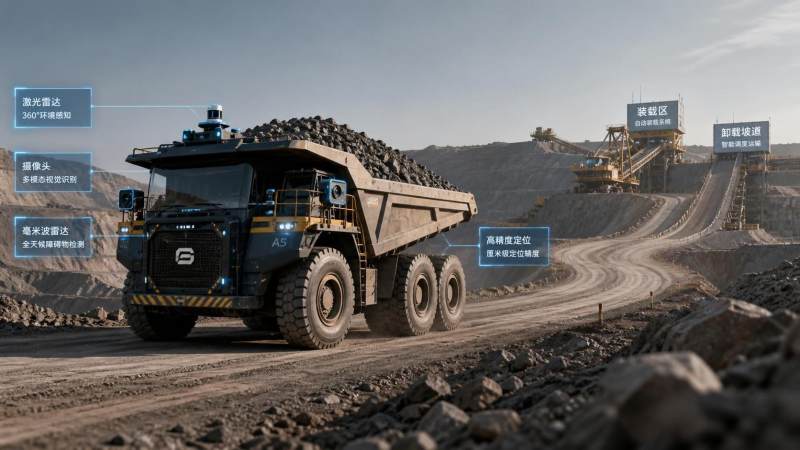
In modern mining and heavy-duty transport, haulage equipment autonomous control is reshaping how operators balance safety, cycle times, and payload accuracy. For technical evaluators, the key question is no longer whether autonomy works, but how it performs under harsh terrain, variable loads, and demanding production targets. This article examines how autonomous control enhances risk reduction, improves haul efficiency, and supports more consistent equipment utilization in real-world haulage operations.
What Technical Evaluators Actually Need to Confirm First
For most technical evaluators, the real issue is not the promise of autonomy, but whether the system can maintain safe, repeatable production under mine-specific operating conditions.
That means judging haulage equipment autonomous control through measurable outcomes: fewer exposure risks, tighter speed discipline, better payload consistency, reduced tire and brake stress, and stable cycle performance.
A useful overall judgment is this: autonomous control improves both safety and payload efficiency when the site has defined routes, disciplined dispatch logic, dependable sensing, and strong fallback procedures.
Where those conditions are weak, benefits may still appear, but the performance gap between theoretical autonomy and field autonomy becomes much more significant for any evaluation process.
Why Safety Improves When Driving Decisions Become Systematic
In conventional haulage, many serious incidents begin with variation in human behavior rather than a single mechanical failure. Fatigue, distraction, inconsistent braking, and poor visibility all increase operational risk.
Autonomous control reduces those variables by standardizing how haul trucks accelerate, decelerate, queue, corner, reverse, and interact with loading and dumping zones across every shift.
The main safety gain is not that autonomous trucks eliminate hazards completely. It is that they lower the frequency of unsafe decisions in repetitive, high-consequence transport cycles.
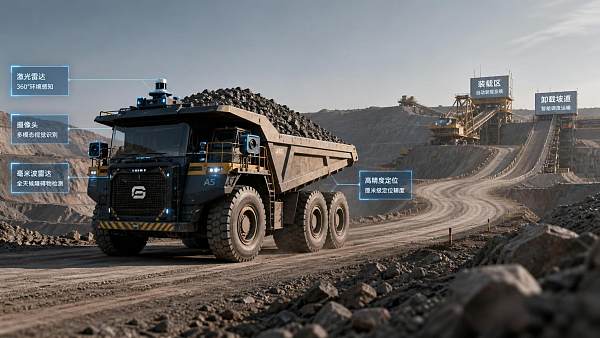
Well-designed systems continuously monitor vehicle position, route boundaries, obstacle detection inputs, speed envelopes, and stopping distance requirements, then adjust vehicle behavior before minor deviations become major events.
For technical assessment, this matters because safety improvement should be traced to control architecture, sensor redundancy, and exception handling, not just to broad marketing claims about driverless operation.
How Autonomous Control Reduces High-Risk Exposure Points
One of the clearest advantages of autonomy is reduced personnel exposure in hazardous zones. This is especially important at night, during dust events, in high-wall areas, and under severe weather.
When fewer operators are physically present inside haul trucks, mines can lower direct exposure to collision risks, rollover scenarios, poor-visibility driving, and fatigue-related errors over long production shifts.
Autonomous systems also make traffic interactions more predictable. Trucks follow predefined route logic, intersection priorities, spacing rules, and geofenced behaviors with far less variation than manual fleets.
That predictability is valuable in mixed environments where shovels, dozers, graders, water trucks, and light vehicles share haul roads. Consistency is often a stronger safety control than raw vehicle speed reduction.
Evaluators should still examine handoff points carefully. Loading zones, maintenance areas, refueling points, and manual intervention events are often where residual safety risks remain concentrated.
Payload Efficiency Improves Through Consistency, Not Just Speed
Many buyers first associate autonomy with faster haul cycles, but payload efficiency usually improves because the truck carries more consistently and moves with less avoidable variation.
Autonomous control helps maintain repeatable approach speeds, controlled spotting at the loader, smoother acceleration with full payload, and optimized braking on declines and haul road transitions.
Those behaviors reduce unnecessary load disturbance, improve body fill consistency, and support better matching between loader passes, truck capacity, and route conditions over time.
In practice, payload efficiency is not just tons per trip. It is the combination of accurate loading, stable transport, less spillage, fewer underloaded cycles, and reliable dispatch utilization.
For technical evaluators, this means the value case should include payload variance, queue behavior, loading precision, and cycle repeatability rather than only average truck speed.
Why Autonomous Haulage Often Delivers More Stable Cycle Times
Cycle-time stability is often more important than isolated peak performance. Manual operations may occasionally run faster, but they also tend to produce wider variation across operators and shifts.
Autonomous systems narrow that variation by enforcing route discipline and removing many of the small decisions that create inconsistency, such as corner entry speed or delayed departure from loading zones.
When dispatch logic is integrated properly, trucks can sequence more efficiently, reduce idle waiting, and maintain steadier flow between shovel, haul road, dump point, and return loop.
That consistency strengthens downstream planning. Production forecasting, maintenance scheduling, crusher feed management, and shift-level reporting all become more reliable when haul cycles are predictable.
Technical reviewers should therefore compare standard deviation in cycle times, not only average cycle duration, when judging autonomy performance across different operating windows.
What Makes Autonomous Control Effective in Harsh Terrain and Variable Loads
Not every site conditions autonomy equally well. Steep grades, slippery surfaces, narrow switchbacks, soft ground, and rapidly changing traction create more demanding control requirements.
Strong autonomous performance depends on how the system combines onboard sensing, localization accuracy, terrain modeling, payload state awareness, and control logic calibrated to actual road conditions.
Variable loads also matter. A truck behaves differently when lightly loaded, fully loaded, or carrying material with different density and center-of-gravity characteristics.
Advanced control systems account for these differences by adjusting acceleration limits, braking profiles, retarder strategies, cornering behavior, and stopping margins according to load and route context.
For evaluators, the key question is whether the autonomy stack adapts dynamically or simply follows a fixed operating script that loses efficiency when real-world conditions drift.
Sensor Reliability and Redundancy Are Central to the Safety Case
Any claim about safer autonomous haulage depends heavily on sensing performance. Cameras, radar, lidar, GNSS, inertial systems, and vehicle health signals all contribute to situational awareness.
But in mining and heavy transport, sensors work in dust, vibration, rain, fog, glare, mud contamination, and uneven lighting. That is where evaluation should become strict.
Technical teams should verify not only nominal detection range, but degraded-mode behavior, failure diagnostics, sensor cleaning strategies, localization confidence, and the logic used when data conflicts appear.
Redundancy matters because no single sensing channel is dependable in every condition. Better systems degrade gracefully, reduce speed intelligently, or shift to safe-stop behavior when confidence falls.
This is one reason haulage equipment autonomous control should be reviewed as a full operating system rather than a navigation feature layered loosely onto conventional truck hardware.
Integration with Dispatch, Loading, and Site Traffic Determines Real Value
Autonomy does not create maximum benefit in isolation. The strongest results usually appear when the trucks, dispatch system, loading tools, and traffic management rules are coordinated as one production system.
For example, autonomous trucks can arrive at the shovel more predictably, but that advantage shrinks if loader positioning discipline is poor or if queue logic remains manually improvised.
Similarly, dump-point efficiency depends on how well the autonomy system understands route priorities, stockpile assignments, crusher availability, and temporary road restrictions across the shift.
Technical evaluators should therefore ask whether the control platform exchanges data effectively with fleet management, maintenance systems, production reporting, and site communications infrastructure.
If integration is shallow, autonomy may still reduce driver-related risk, but payload efficiency improvements and cycle optimization will often remain below their practical potential.
How to Evaluate the Business Case Without Oversimplifying It
For technical teams supporting investment decisions, the business case should be built from operational physics and workflow evidence, not from headline claims about labor reduction alone.
Important measures include incident exposure reduction, payload distribution accuracy, cycle-time variance, road-speed compliance, tire life impact, fuel or energy consumption, and utilization stability.
Labor economics still matter, but they should be considered alongside reduced unplanned stops, lower event rates, improved shift continuity, and the possibility of 24-hour standardized operating performance.
It is also necessary to account for enabling costs such as connectivity, route digitization, control-center staffing, site mapping, integration engineering, and continuous system validation.
The most credible evaluations compare autonomy against the site’s actual best manual baseline, not against weak historical averages that exaggerate expected gains.
Common Concerns Technical Evaluators Should Pressure-Test
Several concerns should be examined early. One is whether autonomy can handle mixed fleets and temporary changes such as detours, road repairs, berm modifications, or changing dump geometries.
Another is how the system manages exceptions. Mines do not run in perfect loops, so evaluators should inspect manual override procedures, remote intervention rules, and restart logic after disruption.
Cybersecurity and communications resilience also deserve attention. If control depends on stable connectivity, the site needs clear performance thresholds and fallback states for partial communication loss.
Maintenance support is another practical issue. Sensors, compute hardware, and control modules add new reliability dependencies that must fit the mine’s service capability and spare-parts planning.
Finally, organizational readiness matters. Autonomous haulage succeeds faster when operating teams, maintenance crews, dispatch staff, and safety personnel share a clear governance model.
Where Autonomous Haulage Delivers the Strongest Results
Autonomous haulage usually performs best in large, repetitive operations with defined routes, substantial truck hours, disciplined road maintenance, and production systems that benefit from consistency.
Open-pit mines are the leading example, especially where long haul distances, elevation changes, night operations, and environmental extremes increase the cost of human variability.
The case also strengthens where safety exposure is structurally difficult to manage through supervision alone, such as remote sites, high-temperature regions, or operations with persistent visibility challenges.
By contrast, highly chaotic short-cycle environments with frequent route redesign and dense mixed-traffic improvisation may require more selective or phased autonomy deployment.
For technical evaluators, suitability is less about whether autonomy is advanced and more about whether the operating system around the trucks can support disciplined autonomous execution.
What a Sound Evaluation Framework Looks Like
A practical framework starts with site characterization: route geometry, grade distribution, weather profile, traffic density, material variability, and current safety exposure points.
Next comes system review: sensing stack, localization method, control logic, redundancy architecture, intervention process, integration depth, and functional limits under degraded conditions.
Then performance validation should test real production measures, including payload consistency, cycle-time spread, road interaction behavior, energy or fuel trends, and operational uptime.
Finally, evaluators should assess scalability. A pilot may succeed on one route, but network-wide value depends on expansion readiness, support maturity, and management discipline across multiple pits or phases.
That approach keeps the decision anchored to evidence and helps separate genuine operating improvement from short-term demonstration effects.
Conclusion
Haulage equipment autonomous control improves safety and payload efficiency primarily by reducing behavioral variability, standardizing truck response, and making production flow more predictable.
For technical evaluators, the strongest judgment is rarely based on autonomy alone. It comes from how well the system performs across sensing, control, dispatch integration, exception handling, and site readiness.
When those elements are aligned, autonomous haulage can reduce personnel exposure, stabilize cycle times, tighten payload outcomes, and improve equipment utilization in demanding operating environments.
When they are not aligned, benefits become narrower and more conditional. That is why rigorous evaluation should focus on field performance, operational fit, and measurable control quality.
In other words, the value of autonomous haulage is real, but it becomes decisive only when the mine treats autonomy as a production system, not simply as a truck feature.
Related News
 Oct 04, 2026Nuclear Lifting Equipment Cost: Budgeting for Compliance, Testing, and Lifecycle RiskNuclear lifting equipment cost explained: budget for compliance, proof-load testing, installation, documentation, and lifecycle risk to make confident procurement decisions.
 Oct 03, 2026How to Assess TBM Manufacturers for Hard-Rock Tunneling Projects?Choose the right tunnel boring machine manufacturer for hard-rock projects. Explore key criteria for design, lifecycle cost, factory quality, and service support.
 Oct 02, 2026How to Evaluate Heavy Equipment Technology Suppliers for Fleet Uptime and SupportHeavy equipment technology suppliers can make or break fleet uptime. Learn how to assess diagnostics, data access, parts, service coverage, and support terms before you buy.
 Oct 01, 2026How to Use Technical References to Benchmark Industrial Equipment PricesIndustrial equipment technical reference pricing: learn how to normalize specifications, scope, service life, and operating costs to benchmark quotes accurately and choose the best-value equipment.

Heavy Haulage Strategist
Weekly Insights
Stay ahead with our curated technology reports delivered every Monday.