
Tunnel Boring Machine Types Explained: Which TBM Fits Rock, Soft Ground, or Mixed Face?
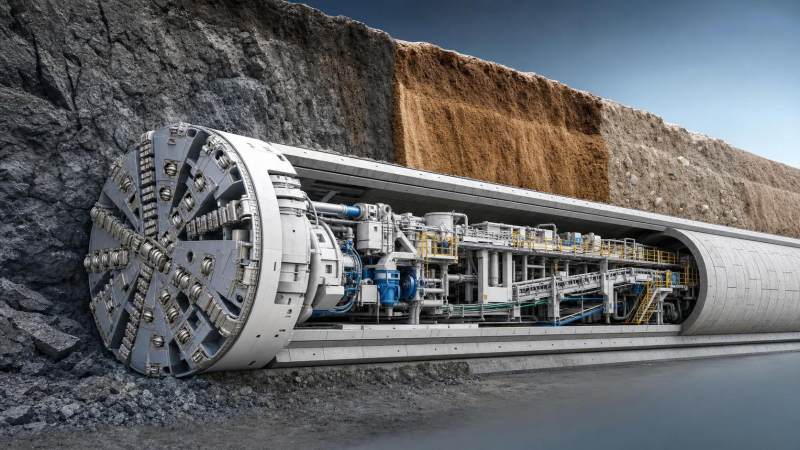
Selecting among tunnel boring machine types is rarely a narrow equipment choice. It is a project-definition decision shaped by geology, groundwater, settlement tolerance, schedule pressure, and total lifecycle cost.
A TBM that performs efficiently in competent granite can become a costly mismatch in water-bearing clay. A machine designed for soft ground control may also lose its advantage in stable hard rock.
That is why tunnel boring machine types remain a central topic across transport, water, utility, and energy infrastructure. In practice, the right choice depends less on catalog labels and more on ground behavior.
For intelligence-led platforms such as TF-Strategy, the value lies in linking machine parameters with construction methods and strategic project needs. TBM assessment now sits at the intersection of engineering performance, risk allocation, and long-term asset delivery.
What tunnel boring machine types really represent
At a basic level, tunnel boring machine types describe how the machine excavates, supports the face, manages spoil, and controls groundwater. Those four functions determine whether a TBM fits local ground conditions.
The market often groups TBMs into hard rock, soft ground, and mixed-face categories. That classification is useful, but it can hide important design differences inside each family.
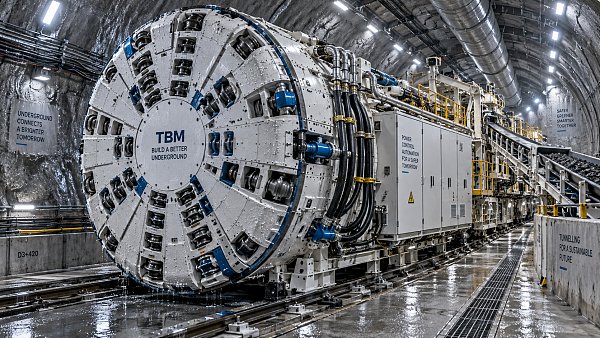
A gripper TBM, for example, advances by pushing against stable rock walls. An EPB machine relies on conditioned spoil to balance pressure at the tunnel face. A slurry shield uses pressurized fluid circulation.
These are not minor variations. They reflect different assumptions about rock competence, abrasivity, permeability, and the consequences of face instability.
Why the choice matters more now
Current projects are moving into denser cities, deeper alignments, and more variable geology. That raises the penalty for choosing the wrong TBM and increases the value of early technical screening.
At the same time, owners expect better forecasting of advance rates, maintenance intervals, cutter consumption, and intervention risk. Capital cost alone no longer supports a credible decision.
This is also where broader heavy-industry intelligence becomes relevant. TF-Strategy’s focus on machine performance, material evolution, and construction logic reflects a wider shift toward data-backed equipment decisions across infrastructure.
In TBM projects, that shift shows up in closer review of cutterhead design, digital monitoring, conditioning systems, and maintenance access under difficult ground conditions.
How major TBM categories match ground conditions
Hard rock TBMs
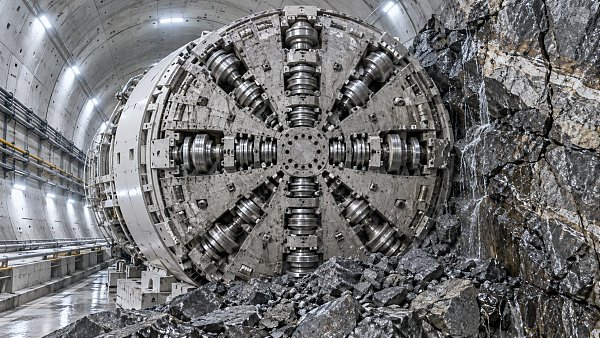
Hard rock tunnel boring machine types are usually selected for competent, relatively self-supporting rock masses. Typical examples include gripper TBMs and single shield or double shield machines.
Gripper TBMs work well where rock strength is high and deformation is limited. They can achieve strong advance rates because they do not depend on continuous segmental lining during each stroke.
Single shield machines are often preferred where lining installation must be integrated and ground support cannot wait. Double shield designs try to combine continuous boring efficiency with lining flexibility.
The main watchpoints are cutter wear, rock burst potential, fault zones, and downtime during cutterhead interventions. Competent rock does not automatically mean low risk.
Soft ground TBMs
Soft ground tunnel boring machine types are used where the face needs active support. This usually includes loose soils, silts, clays, sands, and formations with significant groundwater pressure.
EPB machines are widely used in urban tunneling. They control face pressure by managing excavated material inside the chamber, supported by foam, polymers, or other conditioning agents.
Slurry shield TBMs are better suited to highly permeable ground or elevated water inflow. The pressurized slurry circuit can offer stronger pressure control where conditioned soil alone is less reliable.
Here, the critical issues include settlement control, chamber pressure stability, separation plant performance, and the behavior of spoil during transport and treatment.
Mixed-face and variable ground TBMs
Mixed-face conditions are among the most difficult cases in tunnel boring. Part of the cutterhead may encounter rock while another part cuts soil, weathered material, or fractured water-bearing strata.
In these zones, tunnel boring machine types need flexibility more than theoretical peak performance. Convertible or hybrid shield concepts may help, but they do not eliminate geological uncertainty.
The challenge is uneven cutter loading, unstable pressure response, differential wear, and higher intervention frequency. Transitions can become more problematic than long stretches of uniform ground.
The ground report is only the starting point
Many TBM selection mistakes happen when geology is treated as a static label. Rock, soft ground, and mixed face are useful descriptions, but actual performance depends on more detailed variables.
UCS, RQD, fracture spacing, abrasivity, permeability, fines content, boulder frequency, and groundwater regime all influence machine behavior. So do alignment depth and surface sensitivity.
A nominally soft-ground drive under a historic district may demand tighter settlement control than a similar drive in an open corridor. A hard rock tunnel with frequent faulting may behave like a hybrid case.
This is why tunnel boring machine types should be assessed against a risk matrix, not a simplified geological headline.
What to compare during technical evaluation
A useful review goes beyond machine diameter and installed power. It asks how the TBM will behave during normal advance, difficult transitions, and maintenance under pressure.
- Face support method and pressure control range.
- Cutterhead opening ratio and suitability for expected spoil.
- Cutter consumption, replacement access, and intervention logic.
- Segment erection sequence and compatibility with expected deformation.
- Spoil handling chain, including slurry separation or screw conveyor limits.
- Ground conditioning requirements and material supply reliability.
- Digital monitoring, predictive maintenance, and data quality.
In broader business terms, these comparisons affect TCO, schedule resilience, and claims exposure. A lower purchase price can disappear quickly if the machine struggles in expected transition zones.
Where mixed-face decisions become strategic
Mixed-face drives often attract the highest debate because they compress geological, mechanical, and contractual uncertainty into one selection process. No single machine eliminates all compromise.
In these cases, the better question is not which TBM is universally best. It is which option fails more predictably, recovers faster, and maintains acceptable control during adverse transitions.
That framing aligns with how strategic equipment intelligence is increasingly used across heavy industry. The objective is not abstract optimization. It is dependable performance under real project constraints.
For tunnel boring machine types, that usually means testing assumptions against intervention scenarios, utility crossings, groundwater spikes, and logistics limits around segment supply or spoil disposal.
A practical way to narrow the shortlist
A disciplined shortlist usually starts with ground behavior, then filters through constructability and commercial exposure. That sequence keeps the evaluation anchored in project reality.
- Map the alignment by geotechnical domain, not by one average description.
- Identify the sections where face instability or water ingress would be unacceptable.
- Compare tunnel boring machine types by transition performance, not only best-case advance rate.
- Review consumables, maintenance windows, and intervention access early.
- Test the machine concept against local disposal, treatment, and logistics constraints.
- Align technical scoring with schedule sensitivity and contract risk allocation.
That approach produces a more realistic decision than relying on nominal machine category alone.
From machine type to decision quality
Understanding tunnel boring machine types is ultimately about understanding fit. Rock, soft ground, and mixed face are not just geological labels. They define how much control, flexibility, and intervention capacity a project needs.
The strongest evaluations connect machine design, subsurface risk, and business outcome in one view. That is also where sector intelligence becomes useful, especially when projects must balance performance, safety, and cost over long delivery horizons.
The next step is to turn the alignment into decision zones, compare tunnel boring machine types against those zones, and challenge the assumptions behind advance rate, support strategy, and maintenance access before procurement moves forward.
Related News
 Oct 11, 2026Payload Management Systems: Preventing Overloads Without Slowing ProductionPayload management helps prevent overloads, protect equipment, and keep production moving. Learn how accurate targets, pass planning, alerts, and calibration improve every load.
 Oct 09, 2026Ultra-Large Excavator Bucket Size: Capacity, Width, and Site Fit ExplainedUltra large excavator bucket size explained: compare capacity, width, payload, truck matching, and site conditions to select a reliable, high-productivity bucket.
 Oct 08, 2026How to Evaluate a Heavy Machinery Information Platform for Project Equipment SourcingHeavy machinery information platform guide: compare equipment fit, source reliability, lifecycle costs, supplier capability, and compliance to make smarter sourcing decisions.
 Oct 07, 2026How to Evaluate a Hydraulic System Component Supplier for Heavy Equipment UptimeChoose a hydraulic system component supplier with proven quality, technical fit, and reliable delivery to reduce heavy equipment downtime and lifecycle costs.
Geological Boring Fellow
Weekly Insights
Stay ahead with our curated technology reports delivered every Monday.