
How Can Project Teams Compare Excavation Equipment Productivity Across Brands?
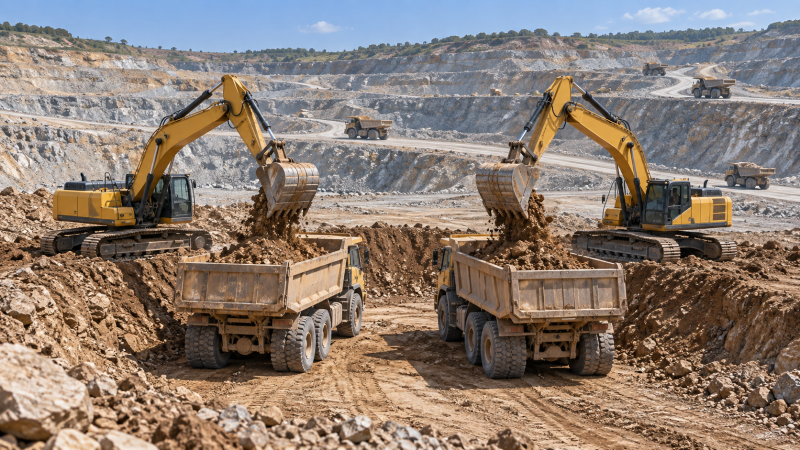
Brand comparison becomes unreliable when it starts and ends with rated horsepower, bucket size, or maximum digging force. Those figures describe machine capability under defined conditions; they do not show how many usable cubic metres a machine will move during a shift on a particular site. The productive excavator is the one that sustains the required output while matching material conditions, truck loading arrangements, operator workflow, maintenance support, and fuel or energy constraints.
A credible comparison therefore needs a common operating model. Every candidate machine should be measured against the same material, haul interface, bucket configuration, shift structure, and production definition. Without that discipline, a larger nominal bucket may be credited with volume it cannot consistently fill, or a lower fuel-burn figure may conceal slower truck loading and more idle time.
What should “productivity” mean when comparing excavators?
For most excavation, mining, and infrastructure work, productivity should mean saleable or usable material moved per operating hour, not merely theoretical bucket capacity. Depending on the contract and earthwork measurement basis, this may be expressed as bank cubic metres, loose cubic metres, tonnes, or truckloads completed per hour. The unit matters because different materials change volume after excavation.
Bank cubic metres refer to material in its undisturbed state. Loose cubic metres reflect the increased volume after digging due to swell. Tonnes can be more useful where density varies less than material volume, or where loading must stay within truck payload limits. A comparison that mixes these units can make one brand appear more productive simply because the measurement basis has changed.
A practical productivity equation is:
Hourly production = effective bucket payload × cycles per hour × job efficiency
Each element needs site-specific definition:
- Effective bucket payload is the material actually carried, not the bucket’s struck or heaped catalogue capacity.
- Cycles per hour depend on digging, swinging, dumping, returning, repositioning, and waiting.
- Job efficiency adjusts for unavoidable interruptions such as truck exchanges, bench cleanup, operator breaks, refuelling, routine inspections, and minor delays.
Even this equation is incomplete if the excavator is part of a loading fleet. An excavator that produces more tonnes at the face but creates truck queues, overloads vehicles, or forces frequent rehandling may reduce total system output.
Why brochure specifications cannot provide a fair answer
Manufacturers may state bucket capacity, engine power, breakout force, hydraulic flow, travel speed, and cycle-related features using different configurations and test conditions. These specifications remain useful for screening machines, but they are not a production guarantee.
Consider two machines with similar bucket capacities. One may fill quickly in fragmented rock because its hydraulic response and boom-stick geometry suit the face. The other may perform better in dense clay because its bucket geometry, crowd force, and traction allow more consistent penetration. In a shallow trench with frequent truck movement, swing acceleration and controllability may matter more than peak breakout force. On a high bench, reach, dump height, and stability can constrain output before engine power does.
Attachments also change the result. A heavy rock bucket can reduce payload or slow acceleration; a wear-protected bucket may retain volume better in abrasive material; a wider bucket can be unsuitable where density or material adhesion prevents full loading. Comparing one brand’s standard bucket to another’s optimized application bucket does not isolate machine performance.
How can project teams establish an apples-to-apples test?
The comparison should begin by fixing the operating scenario before any machine arrives on site. A short but controlled production trial is more valuable than a long test with changing conditions. Record the same working face, material classification, target excavation depth, loading position, truck fleet, bucket type, and operator shift arrangement for every candidate.
The test protocol should state what counts as productive time. Engine-on time is usually too broad. Working hours should distinguish between digging and loading, planned stoppages, truck waiting, repositioning, refuelling, service activity, and unplanned downtime. If telemetry is used, its event definitions should be reviewed carefully because different platforms may classify idle time, working time, or fuel consumption differently.
Where a direct side-by-side trial is impossible, teams can reconstruct comparable data from production records. The same corrections are still needed: normalize for material density, swell, bucket configuration, truck availability, haul distance effects on loading demand, operator allocation, and weather-related disruption. Historical data without these controls can support a preliminary ranking, but not a confident production commitment.
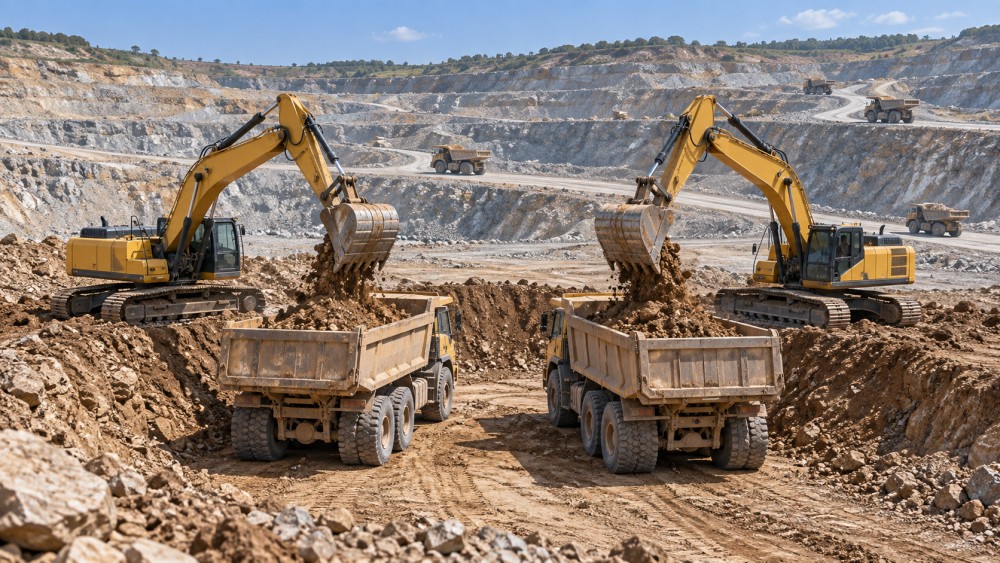
Which field measurements matter most?
Cycle time is the central operational measure. It should be broken into components rather than treated as one number:
- bucket penetration and fill time;
- loaded swing time;
- dump time and truck positioning interaction;
- empty return swing time;
- repositioning or face preparation time.
This breakdown identifies why a machine is faster or slower. A short swing cycle may be irrelevant if the bucket is underfilled. Fast hydraulic motions may not improve output if trucks are badly spotted. Conversely, a machine with a slightly longer nominal cycle can produce more if it maintains a higher fill factor and loads trucks with fewer passes.
Bucket fill factor deserves close attention. It is the relationship between actual payload and rated bucket capacity. Material type, fragmentation, moisture, bucket design, operator technique, and digging geometry all affect it. A nominal 5 m³ bucket is not automatically a 5 m³ production bucket. Material may bridge, stick, spill, or be limited by the machine’s safe lifting capability at the required reach.
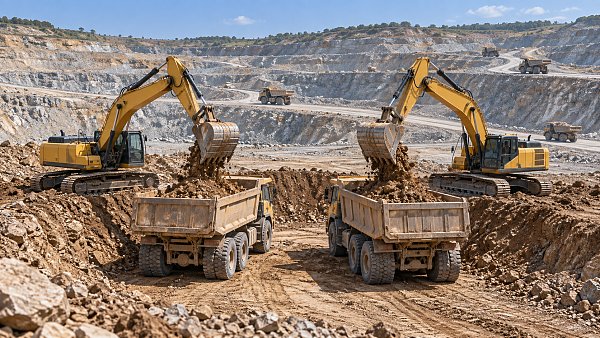
Pass match measures how well the excavator and truck fleet fit each other. Loading a truck in an efficient number of passes reduces truck dwell time and improves payload consistency. Too few passes can make payload control difficult; too many can make the excavator the bottleneck. The best pairing depends on material density, truck body volume, allowable payload, and the machine’s stable working payload rather than a simple bucket-to-body ratio.
Fuel per tonne or fuel per cubic metre is more decision-useful than litres per hour alone. A high-output machine can burn more fuel per hour but less fuel per tonne if it maintains superior production. The opposite can also occur when a large machine is lightly loaded, spends excessive time idling, or repeatedly waits for trucks. Fuel records must cover a representative duty cycle, including warm-up, idle, travel, and auxiliary loads where relevant.
Availability and utilization should not be combined into a single vague uptime figure. Mechanical availability asks whether the machine was capable of working when required. Utilization asks how much of the available time it actually worked. A machine can show good availability while producing poorly because of truck shortages, poor site organization, or unsuitable deployment. Separating the two prevents equipment reliability from being blamed for production system failures.
How should site conditions change the comparison?
Excavator productivity is highly sensitive to the job environment. A machine selected for high-volume truck loading on a mine bench may not be the best performer in confined urban excavation, trenching, demolition sorting, or slope work.
Material is the first constraint. Free-digging sand, blasted overburden, weathered rock, sticky clay, frozen ground, and fractured ore place different demands on the bucket, undercarriage, hydraulic system, and operator. Material density also changes payload. A bucket that is suitable by volume in low-density overburden can exceed lifting or truck payload limits in dense rock.
Bench elevation and face geometry affect digging depth, crowd angle, swing radius, and stability. Ground bearing capacity determines whether the machine can work at its intended reach without excessive matting or risk of instability. In restricted sites, tail swing, transport dimensions, noise constraints, and attachment changes may matter more than maximum production at an open face.
Altitude and ambient temperature deserve explicit treatment in remote or severe environments. Engine performance, cooling demand, hydraulic behavior, and fuel management may all change under extreme conditions. The relevant question is not whether a brand has a strong published specification, but whether the proposed configuration, cooling package, filtration arrangement, and service plan are appropriate for that operating environment.
Does operator performance make brand comparisons meaningless?
No, but it can distort them. Excavator productivity is affected by operator technique: bucket fill, machine positioning, swing discipline, truck loading accuracy, avoidance of unnecessary travel, and use of working modes. A comparison should therefore either rotate qualified operators between machines after familiarization or use multiple operators and analyze the range of results.
Operator-assist technology can be part of the comparison if it will be used in production. Grade control, payload monitoring, machine guidance, work-zone cameras, and automated functions may reduce overdigging, improve pass consistency, or make the operation less dependent on repeated manual checking. Their value should be assessed through the task they improve, not treated as a generic feature advantage.
A 2D or 3D grade-control system may be highly valuable in final trimming or complex excavation profiles, yet contribute little to bulk loading from a uniform bench. Payload systems are useful only if they are calibrated, used consistently, and integrated into loading practices. Machine technology should also be evaluated for subscription costs, correction-data requirements, operator training, interoperability with site systems, and support availability.
What reliability evidence should be requested from each supplier?
Reliability assessment should focus on the actual configuration and local support model. General brand reputation is not enough, particularly where machines will operate in remote areas, under high utilization, or with specialized attachments.
Useful questions include:
- Which wear components are expected to require routine replacement in the intended material?
- What are the recommended service intervals, and how much downtime does each service event require?
- Are critical filters, hydraulic components, ground-engaging tools, and electronic modules stocked locally or regionally?
- What response commitments apply to field service, and who performs diagnostics and major repairs?
- Can the supplier provide configuration-specific maintenance assumptions rather than generic lifecycle claims?
- Which telematics data can be exported, who owns the data, and can it integrate with the project’s fleet-management environment?
The cost of a missed production window is often larger than the difference in scheduled maintenance cost. For that reason, downtime risk should be evaluated in relation to the project schedule and fleet redundancy. A machine with a lower acquisition cost may carry greater exposure if its parts pipeline, dealer capability, or specialist technician access is weak at the work location.
How should total project value be calculated?
Purchase price is only one input. The economically stronger machine is not necessarily the cheapest machine or the one with the highest peak hourly output. A useful comparison brings production and cost into the same frame: cost per tonne, cost per bank cubic metre, or cost per completed production unit, alongside schedule confidence.
Relevant costs include acquisition or rental cost, financing, fuel or electricity, operator time, consumables, bucket and ground-engaging-tool wear, planned service, corrective maintenance, transport and assembly, insurance, and expected residual value. When loading trucks, the analysis should also include fleet consequences: truck waiting time, payload compliance, fuel consumed during queueing, and whether another truck is required to sustain the planned excavation rate.
Production assumptions should be tested at more than one operating condition. A base case may use expected material and normal truck availability. A constrained case can reflect wetter material, lower fill factors, partial truck shortages, or reduced effective working time. This does not require speculative forecasting; it shows whether the decision remains sound when the variables that drive output move within credible project conditions.
What are the most common mistakes in cross-brand productivity comparisons?
The first is comparing peak specifications instead of sustained production. The second is accepting manufacturer production estimates without checking the stated bucket, material, swing angle, truck interface, and efficiency factor. A third is treating rated bucket capacity as payload while ignoring density, fill factor, and safe lifting limits.
Another frequent error is evaluating fuel burn without production. Litres per hour can reward a machine that is underutilized or waiting for trucks. Fuel per tonne, combined with output and availability, reveals much more. Teams also underestimate configuration differences: track shoe width, counterweight, boom and arm combination, bucket profile, quick coupler, hydraulic attachments, and guarding packages can all change cycle time, stability, or useful payload.
Finally, a comparison can fail because it uses a short demonstration period as proof of long-term reliability. Demonstrations are valuable for validating controllability, cycle behavior, access, visibility, and application fit. They cannot by themselves establish parts performance, service response, component life, or lifecycle cost.
What decision record should remain after the comparison?
A defensible selection file should show the production basis, site assumptions, machine configuration, measured cycle data, bucket payload method, fuel records, downtime definitions, support assumptions, and the cost model used. It should also identify conditions under which the ranking could change—for example, a move from free-digging material to hard digging, a different truck class, restricted working space, or a requirement for precision grade control.
That record matters because excavation equipment is rarely deployed in exactly the conditions used for initial evaluation. When production later diverges from plan, the project team can distinguish between an equipment mismatch, changed material, fleet imbalance, operator familiarization, or an operational-control problem. Comparing excavation equipment productivity across brands is therefore not a search for a universal winner. It is a disciplined effort to identify which configured machine will deliver the most reliable output within the conditions the project will actually impose.
Related News
 Oct 04, 2026Nuclear Lifting Equipment Cost: Budgeting for Compliance, Testing, and Lifecycle RiskNuclear lifting equipment cost explained: budget for compliance, proof-load testing, installation, documentation, and lifecycle risk to make confident procurement decisions.
 Oct 03, 2026How to Assess TBM Manufacturers for Hard-Rock Tunneling Projects?Choose the right tunnel boring machine manufacturer for hard-rock projects. Explore key criteria for design, lifecycle cost, factory quality, and service support.
 Oct 02, 2026How to Evaluate Heavy Equipment Technology Suppliers for Fleet Uptime and SupportHeavy equipment technology suppliers can make or break fleet uptime. Learn how to assess diagnostics, data access, parts, service coverage, and support terms before you buy.
 Oct 01, 2026How to Use Technical References to Benchmark Industrial Equipment PricesIndustrial equipment technical reference pricing: learn how to normalize specifications, scope, service life, and operating costs to benchmark quotes accurately and choose the best-value equipment.

Hydraulic Power Analyst
Weekly Insights
Stay ahead with our curated technology reports delivered every Monday.