
How to Match Heavy Equipment Attachments to Soil, Material, and Jobsite Conditions
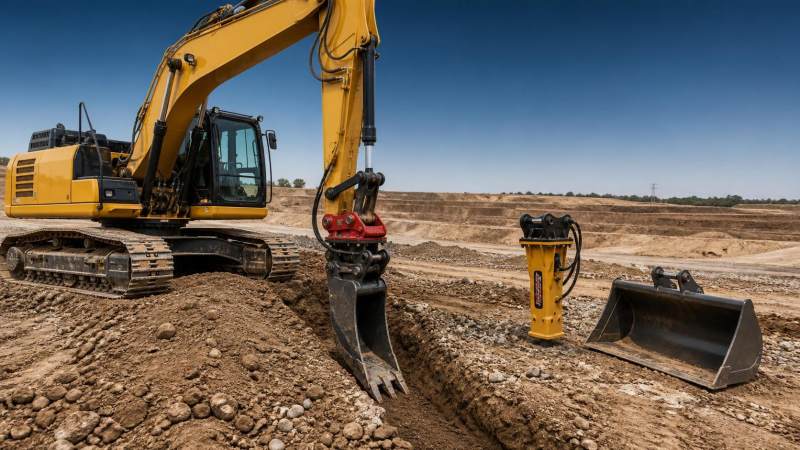
Selecting heavy equipment attachments is not a matter of choosing the largest bucket, the highest-impact breaker, or the attachment with the lowest rental rate. The correct choice depends on the interaction between three variables: what is in the ground, what must be moved or processed, and how the machine can work on the site.
An attachment that performs well in loose overburden can lose efficiency quickly in compacted clay. A breaker sized for occasional concrete removal may become a maintenance problem in continuous rock work. A wide grading bucket may improve finishing speed on open ground but become difficult to control beside utilities, retaining walls, or active traffic lanes.
The practical decision starts with the material and the task, then checks whether the host machine, hydraulic circuit, access conditions, and production target can support that choice. Reversing this sequence often leads to underused equipment, excessive wear, unstable operation, and avoidable downtime.
Begin with the material, not the attachment category
Job descriptions such as “excavation,” “trenching,” or “site preparation” are too broad to determine an attachment. The material must be described in operational terms: loose, compacted, abrasive, sticky, fractured, reinforced, frozen, saturated, or mixed. These characteristics affect penetration, breakout resistance, carryback, tool wear, and the force needed to complete each cycle.
Soil classification reports are useful, but they should be read alongside current site conditions. A granular fill may behave predictably in dry weather and become unstable or difficult to handle after prolonged rain. Clay can be easy to excavate when moisture is balanced, yet pack tightly into a bucket when wet. Weathered rock may look manageable from the surface while containing harder seams that change the production method.
Match bucket geometry to the excavation task
Buckets remain the most widely used heavy equipment attachments, but “bucket” is not a complete specification. Width, profile, side cutters, tooth system, reinforcement, and capacity all influence the result. The best geometry depends on whether the machine is digging, loading, trimming, trenching, cleaning, or placing material.
A general-purpose bucket is suitable when material varies and neither penetration nor abrasion is extreme. It offers a workable compromise for routine earthmoving, but compromise becomes expensive when conditions are demanding. In compacted soils, a narrower bucket with a more aggressive tooth arrangement can concentrate digging force and enter the face more effectively. In soft material, that same narrow bucket may unnecessarily limit production.
For trenching, bucket width should follow the required trench dimensions, pipe clearance, bedding plan, and spoil-handling space. Selecting a wider bucket simply because it appears more productive can increase restoration work, spoil volume, and the risk of disturbing adjacent ground. A trench that must remain stable or fit within a tight corridor often benefits from a purpose-sized trenching bucket rather than a standard digging bucket.
Rock buckets deserve separate consideration. Their structural reinforcement and wear protection are valuable in abrasive, high-impact loading, but they also add dead weight. This reduces the material that can be carried safely in each pass. In lighter materials, a rock bucket may make the excavator feel slow even though the machine itself is operating correctly.
Grading and ditch-cleaning buckets serve a different purpose. Their width and smooth profile support shaping, slope work, drainage finishing, and cleanup. They are poor substitutes for a digging bucket in hard ground because their broad cutting edge spreads force across too large an area. Use them after the ground has been opened or where material resistance is already low.
Do not size an attachment by machine weight alone
Host-machine compatibility is the point where otherwise reasonable attachment selections fail. Machine operating weight matters, but it is only one part of the decision. The attachment must also fit the machine’s hydraulic flow and pressure range, lifting capacity, linkage geometry, coupler interface, and stability limits.
A hydraulic breaker illustrates the problem clearly. A breaker needs the right oil flow and working pressure to operate within its intended range. Too little flow can reduce impact frequency and make the tool appear ineffective. Excessive flow or pressure can increase heat, accelerate component wear, and create reliability problems. The machine must also remain stable while the boom is extended and the tool is working against resistant material.
The same principle applies to augers, compactors, mulchers, shears, grapples, and hydraulic pulverizers. A high-flow attachment cannot deliver its expected output on a carrier with inadequate auxiliary hydraulics. Conversely, installing a small attachment on a machine with much greater available hydraulic capacity does not automatically improve performance. The attachment has its own operating limits.
Review the attachment manufacturer’s required hydraulic range and compare it with the actual auxiliary circuit configuration, not simply the base-machine brochure. Quick couplers, hose routing, return-line restrictions, and oil-cooling capability can affect performance in continuous-duty work. For a short, occasional task, these limits may be manageable. For a production-critical operation, they should be confirmed before equipment is mobilized.
Choose tools for the task sequence, not a single moment of the job
Many projects require several material-handling stages: breaking, digging, loading, sorting, placing, compacting, and final grading. Selecting one attachment to cover all stages can look efficient during planning but often slows the work once the site is active. The better question is whether changing attachments will cost less than forcing one tool through unsuitable work.
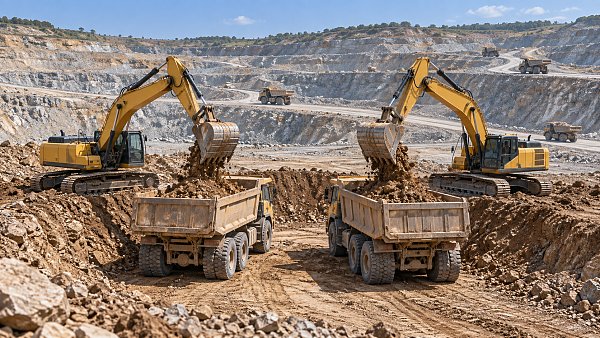
Consider utility installation in compacted ground with scattered rock. A breaker or ripper may be needed to open hard sections. A trenching bucket then removes material to profile. A grading bucket may clean the trench bottom and shape the surrounding area. If excavated material contains reusable aggregate or debris, a screening bucket or grapple may reduce separate handling. Each tool has a distinct role; productivity comes from assigning it to the stage where it performs best.
Attachment change time is still a real cost. A hydraulic quick coupler can reduce manual handling and make a multi-tool approach more practical, provided it is rated for the machine and the attachment loads involved. It also introduces its own inspection needs. Coupler engagement, locking condition, hose management, and attachment visibility should be part of the operating routine. A fast changeover has little value if it creates a dropped-load risk or encourages operators to skip checks.
Site constraints can outweigh raw production capacity
Open sites allow larger attachments and longer working arcs. Urban corridors, plant shutdown areas, tunnels, and congested industrial sites do not. In restricted spaces, visibility, swing clearance, noise, vibration, overhead obstructions, and ground-bearing capacity can become more important than nominal output.
A high-impact breaker may be technically capable of removing concrete, yet vibration restrictions near sensitive structures can make saw cutting, crushing, or controlled demolition a more appropriate method. A large grapple may handle more scrap per cycle, but its working envelope may interfere with adjacent operations. An auger may be suitable for the required hole diameter but impractical where underground services make accurate positioning and controlled depth essential.
Ground conditions also affect machine stability. Soft or saturated soils may limit the safe reach and lifting envelope of an excavator, especially when a heavy attachment is working at the side of the machine. On slopes, attachment weight changes the machine’s balance and may require a revised work position or benching arrangement. The attachment choice should therefore be considered with access routes, staging areas, and the planned operating stance, not only with the material at the work face.
Wear is a production variable, not just a maintenance issue
In abrasive material, the practical cost of heavy equipment attachments is strongly influenced by teeth, adapters, cutting edges, side protection, wear plates, seals, bushings, hoses, and hydraulic tools. A lower-cost attachment may be reasonable for intermittent use in mild ground. In continuous rock, aggregate, or demolition work, insufficient wear protection can create frequent stoppages and inconsistent digging performance.
Wear changes the attachment’s behavior. Blunt teeth increase resistance and fuel use. Worn bucket edges reduce penetration and leave poorer trench or grade control. A breaker tool with an unsuitable working profile can transfer energy inefficiently into the material. Operators may compensate by applying more force, working longer in one position, or using unfavorable boom angles. Those habits increase stress on both the attachment and the carrier.
Specify wear protection based on the material’s abrasiveness and the expected duty cycle. Then make inspection practical: identify the consumable parts, define replacement triggers, ensure spare availability, and include attachment condition in daily checks. This is especially important when the equipment is moving between sites with very different ground conditions.
A short pre-mobilization review prevents most mismatches
Before committing to a rental, purchase, or fleet allocation, document the job in a format that links conditions to equipment decisions. The review does not need to be complicated, but it should be specific enough to expose conflicts.
- Describe the material by hardness, moisture, abrasiveness, particle size, and expected variability.
- Define the task: excavation, loading, trenching, breaking, sorting, drilling, compacting, finishing, or controlled demolition.
- Confirm required production rate, expected operating hours, and whether the work is intermittent or continuous.
- Check carrier operating weight, lift capacity, auxiliary hydraulic flow, pressure, coupler type, and hose connections.
- Map site constraints, including access width, swing clearance, overhead hazards, underground services, slopes, nearby structures, and disposal routes.
- Estimate the attachment-change sequence instead of evaluating each tool in isolation.
- Plan wear-part inspection and service support before work begins.
This review also helps distinguish a temporary need from a recurring capability gap. Renting may suit a short demolition phase, an unusual auger diameter, or a one-time screening requirement. Owning may make more sense when the same attachment is needed across multiple projects and its condition can be maintained consistently. The decision should follow expected utilization and operating control, not the assumption that ownership is always cheaper.
Where selection decisions commonly go wrong
The most frequent mistake is choosing by rated capacity alone. Bucket volume, breaker class, or grapple opening size gives only a partial picture. Material density, attachment dead weight, machine reach, and hydraulic supply determine whether the stated capacity can be used productively.
Another mistake is treating the existing attachment inventory as the definition of the job method. A contractor may have a general bucket available, but availability does not make it the right tool for wet clay, narrow utility trenches, selective demolition, or abrasive rock. Equipment planning should challenge the assumed method when the ground or task indicates a different approach.
It is also risky to rely only on average site conditions. A project may be mostly soft excavation but include hard rock lenses, reinforced slabs, buried debris, or saturated sections. These exceptions should be planned as a separate work package with the appropriate attachment and safety controls. Keeping unsuitable equipment on site “just in case” usually produces slow, improvised work when conditions change.
Make the final choice around the limiting condition
The limiting condition is the part of the job most likely to stop production, damage equipment, or create an unsafe operating situation. It might be a hard layer beneath soft soil, a narrow work zone, a weak access road, a high-abrasion loading area, or restricted vibration near occupied structures. The attachment should be capable of handling that condition without making routine work inefficient.
For complex infrastructure, mining, tunneling, and heavy civil operations, equipment intelligence is most useful when it connects geology, machine parameters, construction method, and logistics. TF-Strategy’s focus on these links reflects the practical reality that attachment selection is not an isolated purchasing decision. It affects excavation sequencing, carrier utilization, maintenance planning, haulage balance, and the reliability of the wider operation.
A sound selection does not need to be the heaviest or most specialized tool available. It needs to fit the material, the machine, the site, and the work sequence well enough to deliver predictable cycles without creating unnecessary wear, fuel use, or safety exposure. Start with the ground, verify the carrier, then select the attachment that supports the actual method of work.
Related News
 Oct 19, 2026Sizing Industrial Hydraulic Power Packs: Pressure, Flow, and Duty CycleSize industrial hydraulic power packs with confidence. Learn how pressure, flow, and duty cycle affect performance, energy costs, and heat control—and avoid costly sizing mistakes.
 Oct 18, 2026How Equipment Specifications Affect Purchase, Installation, and Operating CostsExplore equipment specification planning cost factors that shape purchase, installation, and operating budgets. Compare lifecycle costs, avoid oversizing, and buy with confidence.
 Oct 17, 2026Tunnel Boring Machine Supplier List: Compare TBM Types and Service CoverageExplore our tunnel boring machinery supplier list to compare EPB, slurry and hard rock TBMs, assess service coverage and lifecycle costs, and build a smarter procurement shortlist.
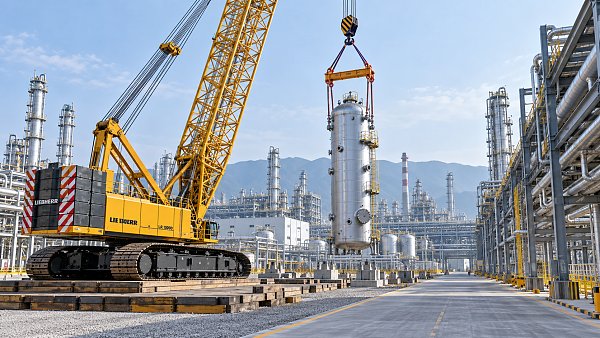
 Oct 16, 2026Heavy-Duty Petrochemical Lifting: Selecting Cranes by Load, Radius, and Site AccessExplore heavy-duty petrochemical lifting solutions. Compare cranes by load, radius, site access, and ground support to reduce project risk and optimize lifting costs.
Hydraulic Power Analyst
Weekly Insights
Stay ahead with our curated technology reports delivered every Monday.