
How Nuclear Turbine Hall Cranes Are Selected for Load Class, Span, and Redundancy
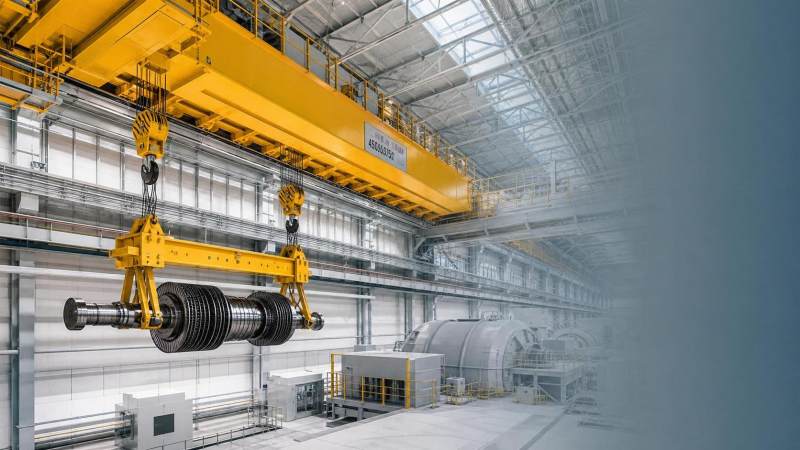
Selecting nuclear turbine hall cranes starts with a simple question that quickly becomes complex: what must the crane lift, where must it travel, and how much failure tolerance is acceptable inside a nuclear plant?
That is why load class, span, and redundancy are evaluated together rather than in isolation. In turbine hall service, the crane is part of plant availability, maintenance access, and risk control.
Within heavy industry intelligence, this topic matters because nuclear turbine hall cranes sit at the intersection of structural engineering, outage planning, and lifecycle reliability. TF-Strategy tracks that intersection closely across large lifting systems, energy infrastructure, and mission-critical equipment decisions.
Why turbine hall crane selection carries unusual weight
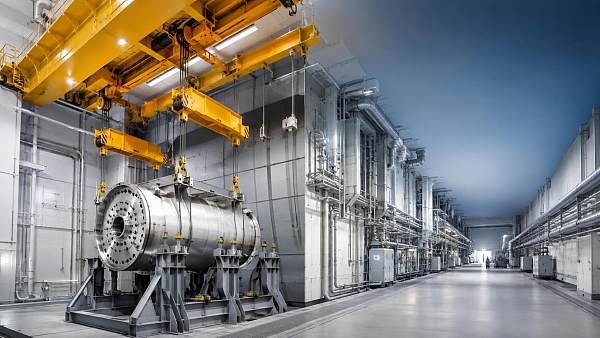
A turbine hall crane does more than move heavy parts. It supports installation, major maintenance, rotor handling, generator work, valve replacement, and occasional contingency recovery.
In conventional industrial buildings, a crane may be judged mainly by rated capacity and utilization. Nuclear turbine hall cranes are judged by those factors, but also by consequences of downtime, inspection traceability, and controlled operating conditions.
The decision therefore affects:
- plant layout and building steel design;
- maintenance sequence during planned outages;
- single-failure exposure during critical lifts;
- long-term inspection, refurbishment, and spare strategy;
- overall TCO across decades of plant operation.
This is one reason heavy-equipment intelligence platforms such as TF-Strategy increasingly connect machine parameters with project methods and infrastructure strategy, rather than treating lifting hardware as an isolated procurement line.
Load class is about real lifting duty, not only headline capacity
When specifying nuclear turbine hall cranes, the first visible number is usually safe working load. That number matters, but it is only the starting point.
Load class should reflect the heaviest verified lift case, including rigging, lifting beams, below-hook devices, tolerances, and any requirement for tandem or auxiliary hoisting.
More importantly, evaluators look at duty profile. A crane that rarely lifts the maximum load may still need a high classification if the lift is mission-critical, slow, and intolerant of interruption.
What is normally included in the load review
- Turbine rotor and generator stator masses
- Lifting accessories and spreader frames
- Dynamic effects from acceleration and braking
- Hook approach limits near walls and equipment
- Future maintenance scenarios not present on day one
This is where under-specification often begins. A crane sized only for current equipment can become a bottleneck when retrofit components, replacement rotors, or temporary lifting tools are introduced later.
For that reason, nuclear turbine hall cranes are often assessed with a forward-looking margin tied to maintenance philosophy, not just a nominal design load.
Span is a structural and operational decision at the same time
Span appears straightforward: it is the distance the bridge must cover. In practice, span selection shapes runway loads, building integration, hook coverage, and the ability to reach critical service zones cleanly.
A wider span may improve access across the turbine hall, but it also changes wheel loads, girder stiffness demands, deflection behavior, and runway beam requirements.
A narrower span can reduce some structural penalties, yet it may create dead zones, awkward lift paths, or limited alignment over turbine centerlines.
Questions that usually decide the span
The real issue is not the hall width alone. It is the usable lifting envelope inside the hall.
In other words, the correct span for nuclear turbine hall cranes is the one that preserves lifting coverage without creating avoidable structural cost or operational compromise.
Redundancy is where nuclear requirements become most distinctive
Redundancy is not a decorative feature. It is a response to consequence.
In nuclear turbine hall cranes, redundancy can include dual hoist drives, load path protection, duplicated brakes, independent rope reeving logic, backup power arrangements, and control architectures designed to avoid uncontrolled load loss.
The exact configuration depends on plant standards, local regulations, lift criticality, and the classification of components being handled. Still, the principle remains stable: one failure should not turn a controlled lift into a dropped-load event.
Redundancy must match lift consequence
Not every movement in the turbine hall carries the same risk. Routine handling of maintenance tools is different from lifting a turbine rotor over valuable equipment.
That is why evaluators often map redundancy to specific lift cases instead of applying one generic rule. The result may involve a main hoist with enhanced fail-safe features and an auxiliary hoist with a different architecture.
This distinction is especially relevant when balancing capital cost with outage resilience. Overdesign everywhere can be expensive, but weak redundancy in the wrong lift case is worse.
The plant layout often decides more than the crane catalogue does
Catalogue ratings cannot resolve plant-specific conflicts. The turbine hall arrangement usually controls final crane selection more strongly than generic brochure data.
Critical influences include turbine-generator alignment, laydown areas, shielded zones, access openings, maintenance staging, and the route needed to move components from storage to lift position.
A technically valid crane may still be a poor choice if it forces difficult hook approaches or consumes valuable outage time with repositioning steps.
In practice, the best evaluations link three models early:
- the lifting equipment model;
- the building and runway structural model;
- the maintenance and outage sequence model.
This integrated view fits the TF-Strategy method of connecting machine physics with construction and operating strategy across heavy infrastructure systems.
What current industry attention is focused on
Recent attention around nuclear turbine hall cranes goes beyond conventional sizing. Several themes now influence technical comparison.
- Digital monitoring for hoist health, brake condition, and load spectrum tracking
- Lifecycle spare planning for long asset service periods
- More explicit treatment of seismic design interaction
- Reduced tolerance for hidden single-point failures
- Closer scrutiny of maintainability during plant operation
These trends reflect a wider heavy-industry shift. Equipment is now judged not only by nameplate performance, but by inspectability, data visibility, and resilience under long operational horizons.
A practical framework for comparing options
A useful comparison matrix for nuclear turbine hall cranes usually combines hard parameters with scenario-based review.
That framework keeps the review grounded. It also helps distinguish between a crane that looks strong on paper and one that will actually support plant operation with lower uncertainty.
How to move the evaluation forward
The next step is usually not requesting more brochure data. It is building a clean lift-case register.
That register should list heavy components, maintenance frequency, route constraints, required headroom, outage timing, and failure consequences for each lift category.
From there, nuclear turbine hall cranes can be compared against the real operating envelope, not just nominal specifications. Span can be checked against coverage. Load class can be checked against verified duty. Redundancy can be checked against consequence.
For organizations working across large infrastructure assets, the strongest decisions usually come from combining structural review, lifting analysis, and lifecycle intelligence in one evaluation path. That approach reduces late redesign, protects outage efficiency, and gives nuclear turbine hall cranes a clearer basis for selection.
Related News
 Sep 27, 2026Heavy Equipment Selection Factors for Matching Machine Capacity to Jobsite ConditionsHeavy equipment selection factors for matching capacity to jobsite conditions, improving productivity, safety, fleet efficiency, and total project cost control.
 Sep 26, 2026How to Select Wind Rotor Lifting Equipment for Safe Blade and Hub InstallationWind rotor lifting equipment selection guide: ensure safe blade and hub installation with the right lift method, load control, crane compatibility, wind limits, and compliance.
 Sep 25, 2026What Drives Heavy Haulage Cost on Oversized Construction Equipment Moves?Heavy haulage cost explained: discover how load dimensions, route surveys, permits, escorts, lifting plans, and scheduling shape reliable oversized equipment transport budgets.
 Sep 24, 2026Supplier Management Frameworks That Reduce Delays on Large Construction ProjectsLarge-scale construction projects supplier management frameworks help prevent costly delays with risk-based controls, milestone tracking, quality oversight, and escalation plans for critical packages.

Structural Load Expert
Weekly Insights
Stay ahead with our curated technology reports delivered every Monday.