
Selecting Petrochemical Overhead Cranes for Hazardous Areas and Heavy Process Loads
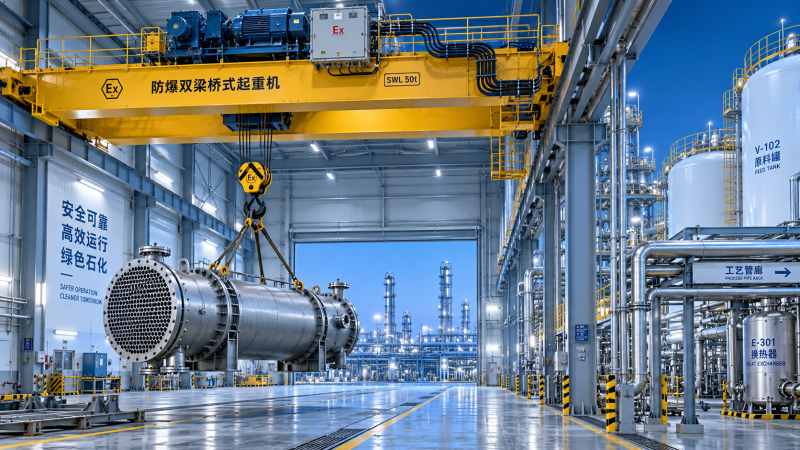
A crane specification can look adequate on paper—rated capacity exceeds the heaviest lift, span fits the bay, and a standard electric hoist is available—yet still be unsuitable for a petrochemical unit. The failure point is often not the load itself. It may be an ignition source inside a classified area, a brake that cannot hold safely during a power disturbance, a coating system that degrades under corrosive vapors, or a maintenance arrangement that forces intrusive work above live process equipment.
When selecting petrochemical overhead cranes, start by separating two questions that are frequently combined: what the crane must lift, and where it must operate. Capacity and duty determine the mechanical baseline; hazardous-area classification, atmosphere, access restrictions, and process consequences determine whether that baseline can be used safely. A technically sound selection process therefore begins with the process area and lift envelope, then develops the crane, hoist, electrical, control, and maintenance specification around those conditions.
Define the operating envelope before comparing crane models
Technical evaluations become unreliable when the inquiry states only “X-ton overhead crane.” A lifting capacity is necessary, but it does not describe the real operating demand. In a petrochemical facility, the same nominal load may be lifted occasionally during a shutdown, moved repeatedly during catalyst handling, or held near sensitive equipment while a maintenance team aligns a component. These are fundamentally different duties.
Build the evaluation around the actual handling scenario. Identify the heaviest item, but also identify its center of gravity, lifting points, dimensions, required orientation, and the space needed to rotate or translate it. A long exchanger bundle, agitator assembly, pump cartridge, vessel internals, or pipe spool may create side-clearance and hook-approach constraints that matter more than the simple gross mass.
- Maximum lifted load: Include below-the-hook devices, spreader beams, lifting frames, hooks, slings, and any temporary handling fixture. Do not compare the process component weight alone with the crane rating.
- Normal versus exceptional lifts: Distinguish routine maintenance lifts from rare installation or turnaround lifts. A crane intended for daily handling should not be sized and classified only around an infrequent peak event.
- Lift frequency and travel distance: Repeated short movements, long runway travel, and frequent inching place different demands on motors, brakes, wheels, gearboxes, and controls.
- Required positioning precision: Determine whether the operator is merely transferring material or aligning equipment to foundation bolts, rails, nozzles, or confined openings.
- Available headroom: Measure from the runway elevation to the highest permitted hook position, including obstructions such as pipe racks, ducts, lighting, cable trays, and fire-protection equipment.
The crane runway and supporting structure must be assessed at the same time. Wheel loads, longitudinal forces, buffer forces, and effects from skewing or acceleration can govern the structural review even where vertical capacity appears sufficient. A replacement hoist may also change wheel reactions or hook approach enough to expose a limitation in an existing bridge or runway.
Hazardous-area classification is a design input, not an accessory package
The most important early decision is whether any part of the crane will enter a classified area during normal operation, foreseeable upset conditions, or maintenance. Classification boundaries should be confirmed from the facility’s current hazardous-area documentation rather than inferred from the name of the unit. A crane may travel between a non-classified maintenance bay and a classified operating zone; in that case, equipment installed on the bridge, trolley, hoist, festoon system, pendant, and radio-control system must be evaluated for the parts of the travel path they actually occupy.
The specification should clearly state the applicable area classification system, zone or division, gas or vapor group, and temperature class. These details affect the selection of electrical enclosures, motors, brakes, limit switches, junction boxes, plugs, cable glands, lighting, warning devices, and control stations. It is not enough to request “explosion-proof equipment,” because that phrase does not establish compatibility with the site’s specific ignition-risk requirements.
Consider the full ignition-source picture. Electrical arcs and hot surfaces are obvious concerns, but mechanical sources require equal attention. Brake friction, wheel contact, impact at buffers, overheating bearings, rubbing cables, loose components, and static accumulation can all influence the design. The appropriate protective concept depends on the classified environment and local requirements, but the evaluation should confirm that the system addresses both electrical and non-electrical ignition risks.
Where hazardous-area scope is commonly missed
A frequent gap appears at interfaces. The main hoist motor may be correctly selected, while the pendant station, radio receiver, trolley-mounted junction box, anti-collision sensor, or maintenance socket is specified for a lower-risk environment. Another weak point is a local isolator located where personnel must use it in the classified area. Every energized component, including small ancillary devices, should appear on the equipment schedule with its required protection level.
Cable selection also deserves close scrutiny. Cable jackets, glands, strain relief, and support systems must tolerate the chemical environment and mechanical movement. Repeated flexing in a festoon or energy-chain system can expose weaknesses that would not be apparent in fixed plant wiring. The route should avoid snagging, sharp bends, pooling liquids, and locations where process leakage could directly affect the moving cable system.
Match duty class to the real work cycle
Two cranes with the same rated capacity can have very different useful lives if their duty assumptions differ. Duty classification considers load spectrum, number of operating cycles, starts, braking events, running time, and intended service life. A lightly used maintenance crane can often use a different mechanical and electrical arrangement than a unit supporting recurring production tasks.
Technical evaluators should ask operations and maintenance teams how the crane is used during routine periods, start-up, shutdown, and turnaround work. A crane that is idle for much of the year may still receive intense use during a short outage. That concentrated activity can create high thermal and mechanical demand, particularly where operators make repeated low-speed positioning movements.
Do not treat variable-frequency drives as automatically suitable or unsuitable. They can improve speed control and reduce shock loading, but their enclosure arrangement, heat management, electromagnetic compatibility, harmonic effects, safe-torque behavior, and hazardous-area suitability must be reviewed. Where drives are placed outside the classified area, the resulting motor and cable arrangement should still be checked for the whole system architecture.
Design for process hazards, corrosion, and recoverability
Petrochemical crane environments vary widely. An indoor maintenance bay may be relatively controlled, while a process structure can expose equipment to hydrocarbon vapors, salt-laden air, acid gases, high humidity, washdown, dust, heat, and temperature cycling. The evaluation should identify actual exposure mechanisms rather than applying a generic “industrial” paint specification.
Corrosion resistance involves more than topcoat selection. Material compatibility, surface preparation, fastener selection, sealed or drainable box sections, electrical enclosure integrity, cable protection, lubrication practices, and water-trap avoidance all affect serviceability. Areas around roof leaks, open louvers, cooling-tower drift, steam releases, or chemical wash points can create localized damage that differs from the general building environment.
Heat is another practical constraint. Elevated ambient temperature can reduce motor performance, shorten cable and insulation life, and alter the reliability of electronics. Low temperatures may affect lubrication and brake response. Where a crane crosses zones with different conditions, specify the limiting ambient range and any local radiant-heat exposure rather than relying on a general site climate description.
Recoverability should be evaluated alongside reliability. A hoist brake, limit switch, rope guide, wheel bearing, or contactor will eventually need inspection or replacement. The question is whether technicians can perform that work without extensive scaffolding, process isolation, or removal of adjacent equipment. Features such as accessible inspection points, protected lubrication locations, clear component identification, and practical electrical isolation can substantially reduce maintenance risk.
Control philosophy should reflect the consequence of a poor movement
Control selection is not simply a preference between pendant and radio operation. The operator needs adequate sightlines to the load, travel path, landing area, and pinch points. A pendant may keep the operator close to the load but can place them beneath suspended equipment or near process obstructions. Radio control can improve positioning and separation from hazards, but it requires reliable command integrity, a defined loss-of-signal response, battery management, and clear control of authorization.
For critical handling paths, determine whether the crane needs features such as independent upper and lower hoist limits, overload monitoring, travel limits, anti-collision measures, warning alarms, load display, restricted operating zones, or speed reduction near boundaries. These are not universal add-ons. Their value depends on the collision potential, load consequence, operator visibility, and layout of the process area.
Limit switches should not be treated as normal operating stops where a controlled stop is required. The intended function of each device must be explicit: routine travel limit, final limit, emergency protective function, overload protection, or interlock. This distinction affects how the system is wired, tested, inspected, and maintained.
A practical evaluation sequence
Starting with vendor quotations often locks the project into assumptions that have not been tested. A better approach is to issue a concise but technically complete basis of design before comparing equipment.
- Map the lift path. Record pick points, landing points, vertical and horizontal clearances, obstructions, operator locations, and areas where the load could pass above equipment or personnel.
- Confirm hazardous-area boundaries. Identify the classification applicable to every location occupied by crane components, including maintenance and parking positions.
- Develop the load cases. Include normal loads, below-hook gear, eccentric loads where applicable, installation loads, and foreseeable snagging or side-pull risks. A crane should not be selected to tolerate side pulling as a routine practice.
- Set the duty and speed requirements. Use expected cycles, load distribution, positioning needs, and outage activity to establish a credible service classification.
- Review runway suitability. Check span, rail condition, alignment, end stops, power supply, structural capacity, access, and wheel-load compatibility.
- Specify maintainability. Define access constraints, inspection expectations, isolation points, spare-parts requirements, documentation, and testing needed before handover.
- Evaluate deviations openly. A quotation may meet capacity while deviating in ambient limits, classification suitability, duty rating, corrosion protection, or control functions. Record each deviation rather than allowing it to disappear in commercial comparisons.
Questions that expose weak specifications
During technical clarification, a few targeted questions can reveal whether a proposed system is genuinely suited to the application. Ask what equipment is included within the hazardous-area scope, not merely whether the “crane” is suitable. Ask how brake torque and load holding are verified, what happens after loss of power or communication, and whether the selected duty classification is based on stated cycles and load spectrum.
Ask how the supplier has addressed high-temperature operation, corrosive exposure, cable travel, and access to wear components. Request the assumed hook approach, headroom, wheel loads, electrical load, and runway reactions. Where variable-speed control is proposed, confirm the minimum controllable speed under load, braking behavior, and the arrangement for fault conditions. These questions keep the assessment tied to operational evidence rather than broad product descriptions.
The best selection is rarely the crane with the highest nominal capacity or the longest list of options. It is the configuration whose hazardous-area suitability, mechanical duty, environmental resistance, controls, and maintenance access all match the actual lifting path. When those inputs are documented before procurement, the resulting crane is far less likely to become a constraint during a shutdown or a source of avoidable risk beside live process equipment.
Related News
 Oct 06, 2026Selecting Petrochemical Overhead Cranes for Hazardous Areas and Heavy Process LoadsPetrochemical overhead cranes for hazardous areas: learn how to match capacity, duty, controls, corrosion protection, and maintenance access for safer, reliable lifts.
 Oct 05, 2026Tunneling Equipment Specification Planning: Key Criteria for Ground and Project RisksEquipment specification planning tunneling: learn how to match TBM systems to ground risks, geometry, safety, logistics, and lifecycle cost for more reliable project delivery.
 Oct 04, 2026Nuclear Lifting Equipment Cost: Budgeting for Compliance, Testing, and Lifecycle RiskNuclear lifting equipment cost explained: budget for compliance, proof-load testing, installation, documentation, and lifecycle risk to make confident procurement decisions.
 Oct 03, 2026How to Assess TBM Manufacturers for Hard-Rock Tunneling Projects?Choose the right tunnel boring machine manufacturer for hard-rock projects. Explore key criteria for design, lifecycle cost, factory quality, and service support.
Structural Load Expert
Weekly Insights
Stay ahead with our curated technology reports delivered every Monday.