
How to Evaluate Petrochemical Components for Corrosion Resistance, Pressure, and Compliance
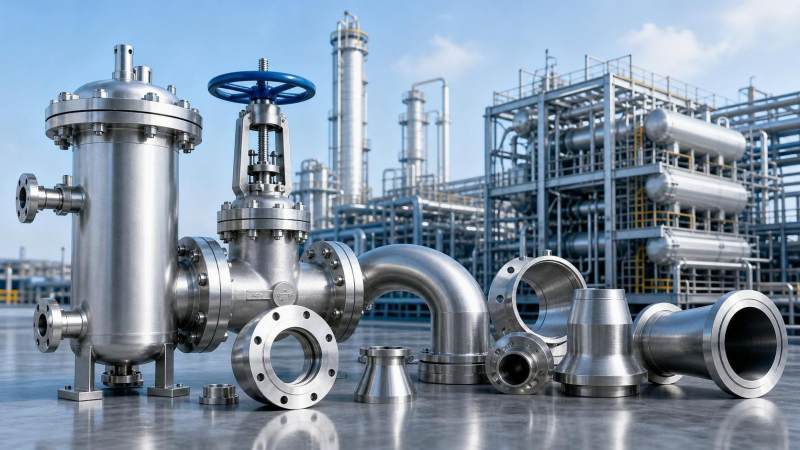
Evaluating petrochemical components is rarely a simple material check. In real projects, corrosion behavior, pressure limits, and compliance status interact with process conditions, shutdown risk, installation complexity, and lifecycle cost.
That is why selection decisions now sit closer to strategic asset management than to isolated specification review. A marginal error in a flange, valve body, pressure vessel shell, or piping segment can scale into leakage, fatigue, lost uptime, and safety exposure.
Across heavy industry, this matters even more where petrochemical components are fabricated, transported, lifted, and integrated into large capital systems. In the TF-Strategy view of power and precision, component evaluation links engineering detail with broader infrastructure performance.
Why petrochemical component evaluation has become more demanding
Operating envelopes are becoming less forgiving. Plants are pushing longer campaigns, handling more aggressive media, and facing tighter documentation demands from regulators, insurers, and project owners.
At the same time, procurement chains are more global. A component may be designed in one country, forged in another, machined elsewhere, and installed by an EPC team under compressed schedules.
Under those conditions, evaluating petrochemical components means checking whether the declared design intent still survives actual service conditions, manufacturing variation, transport loads, and inspection realities.
This is also relevant beyond plant boundaries. Crawler cranes lifting reactors, skids, and heat exchangers depend on reliable component integrity. Mining and infrastructure contractors increasingly encounter petrochemical modules in energy-linked projects.
Start with service reality, not the nameplate
The best evaluations begin with the service profile. A correct alloy on paper can still fail if temperature cycling, chlorides, sour service, solids erosion, or cleaning chemicals were underestimated.
Useful assessment starts by aligning five inputs: process medium, pressure regime, temperature range, flow pattern, and maintenance philosophy. Without that context, even a detailed datasheet stays incomplete.
Questions that define the real duty
- Is the fluid dry, wet, acidic, alkaline, abrasive, or contaminated by trace species?
- Does pressure stay stable, or does the system see surges, pulsation, vacuum events, or thermal shock?
- Is temperature continuous, intermittent, or cycling across brittle-to-ductile transition zones?
- Will inspection access be easy, limited, or delayed until the next major turnaround?
- Does the component face marine atmosphere, buried service, splash exposure, or insulation traps?
These questions often reveal that the risk sits in the interface, not the component alone. Weld zones, bolted joints, gaskets, supports, and coating transitions frequently decide actual durability.
Corrosion resistance is about mechanism, not just alloy grade
Many evaluations fail because corrosion is treated as a generic threat. In practice, petrochemical components face specific damage mechanisms, and each demands a different material or design response.
General corrosion can be relatively predictable. Localized attack is harder. Pitting, crevice corrosion, under-deposit corrosion, stress corrosion cracking, hydrogen damage, and sulfidation can move faster and hide longer.
What to review during corrosion assessment
Usually, the strongest approach combines material certificates with service-specific corrosion modeling and field evidence from comparable units. Historical failure data often exposes blind spots that standards alone do not catch.
Pressure evaluation goes beyond design pressure
Pressure tolerance is often misunderstood as a single number. Reliable evaluation looks at sustained pressure, transient pressure, cyclic loading, test pressure, and the consequences of restraint or misalignment.
For petrochemical components, geometry matters as much as metallurgy. Nozzles, reducers, branch connections, gasket seating faces, and wall transitions can concentrate stress even when nominal ratings appear sufficient.
Pressure-related checks worth prioritizing
- Compare design pressure with upset scenarios, not only normal operation.
- Verify temperature derating for flanges, valves, and pressure-containing bodies.
- Review fatigue exposure where compressors, pumps, or repeated start-stop cycles are present.
- Check wall-thickness tolerance against corrosion allowance and mill under-tolerance.
- Assess support loads, lifting loads, and transport loads for large fabricated items.
That last point is often underestimated. Large petrochemical components may satisfy process pressure criteria but still experience damaging local stress during heavy lifting, sea fastening, or modular installation.
This is where the TF-Strategy heavy-equipment perspective becomes useful. The same precision required in lifting ultra-heavy modules should inform technical review of lugs, reinforcement pads, temporary supports, and transportation constraints.
Compliance is a technical filter, not a paperwork exercise
Compliance review should confirm that petrochemical components are acceptable for the intended jurisdiction, service, and quality system. It should not end with a stamped certificate.
Depending on the project, relevant references may include ASME, API, ASTM, ISO, NACE, PED, local pressure equipment rules, and client-specific specifications. The key issue is consistency across the whole document chain.
Documents that deserve close attention
- Material test certificates and traceability records
- WPS, PQR, welder qualifications, and heat treatment logs
- NDE reports with acceptance criteria clearly stated
- Hydrotest or pneumatic test records
- Dimensional inspection reports and deviation approvals
- Coating, lining, or rubbering inspection results where applicable
A frequent problem is that every document looks valid individually, yet the package contains hidden contradictions. Material heat numbers may not align, hardness values may exceed sour-service limits, or design revisions may not flow into fabrication records.
Where evaluation priorities change by component type
Not all petrochemical components should be screened in the same way. The risk profile shifts depending on whether the item contains pressure, controls flow, seals a joint, or supports a critical transfer path.
This differentiated view helps prioritize inspection effort. It also prevents overchecking low-risk features while missing high-consequence details in critical petrochemical components.
A practical review sequence for better decisions
A strong workflow is usually simple. Begin with service conditions, then map likely failure mechanisms, then verify pressure design margins, then test compliance evidence against the actual specification stack.
After that, review fabrication quality and inspection accessibility. Finally, challenge whether the component remains suitable after transport, lifting, erection, startup, and expected maintenance intervals.
For large projects, it helps to classify petrochemical components into red, amber, and green risk bands. That makes technical review more consistent across packages and easier to communicate to project controls and construction teams.
Signals that justify deeper review
- Material substitution requests late in fabrication
- Repeated weld repairs in the same area
- Incomplete traceability at nozzle or fitting level
- Coating systems selected without confirmed chemical compatibility
- Pressure testing that does not represent actual operating vulnerability
Turning evaluation into action
Good assessment of petrochemical components should end with clearer decisions, not thicker files. The most useful outcome is a short list of verified acceptances, open risks, and inspection priorities tied to service conditions.
When the next review starts, focus on the interfaces between corrosion resistance, pressure behavior, and compliance evidence. That is where hidden risk usually sits, and where technical evaluation creates the most value.
For teams working across heavy industry, energy infrastructure, and modular construction, the same discipline applies: define the duty, test the assumptions, verify the records, and keep the component context visible from workshop to site.
Related News
 Sep 19, 2026Mining Truck Technology Trends: What Fleet Managers Should Prioritize for 2026Mining truck technology trends for 2026: prioritize electrification, autonomy, predictive maintenance, and road intelligence to improve fleet uptime, safety, and cost control.
 Sep 17, 2026How TBM Guidance Technology Maintains Alignment Through Curves and Variable GroundTunnel boring machine guidance technology helps teams maintain precise alignment through curves and variable ground, reducing risk, improving lining accuracy, and protecting schedules.
 Sep 16, 2026Infrastructure Equipment Market Reference: Demand, Pricing, and Supplier BenchmarksInfrastructure equipment market reference for buyers: assess demand signals, total cost, pricing risks, and supplier benchmarks for tunnels, mining, cranes, and road projects.
 Sep 15, 2026How to Evaluate Infrastructure Equipment Suppliers for Complex Project RequirementsInfrastructure equipment solutions supplier evaluation guide for complex projects: assess technical fit, lifecycle cost, reliability, local support, and contract risk.


Ms. Elena Rodriguez
Weekly Insights
Stay ahead with our curated technology reports delivered every Monday.