
What Drives Construction Safety System Cost Across Different Project Types?
Why can construction safety system cost swing so much from one project to another?
Because you are not really buying a single “system.” You are buying a package of controls, hardware, procedures, monitoring, training, maintenance, and reporting that has to match the risk profile of the jobsite.
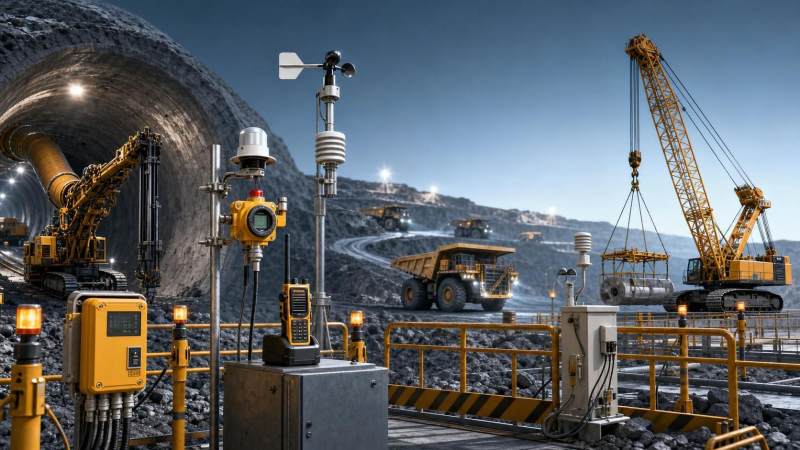
A road paving project with moving traffic, night shifts, and multiple subcontract crews will need a different safety setup than a tunneling job with confined spaces, ventilation demands, and emergency egress planning. An open-pit mining operation may need broader vehicle interaction controls, slope monitoring, dispatch integration, and fatigue-related safeguards. Heavy lifting work brings its own cost drivers: lift planning, exclusion zones, crane interface requirements, wind monitoring, and stricter controls around suspended loads.
That is why construction safety system cost often rises or falls based on site hazards, workforce density, equipment size, regulatory burden, and how much downtime the project can tolerate if something goes wrong.
Which project characteristics push cost up the fastest?
Three things usually move the budget fastest: risk concentration, operational complexity, and consequence of failure.
Risk concentration means hazards are stacked in the same place or the same work window. Think of a tunnel heading where people, electrical systems, ventilation, ground support activity, and machine movement all meet in a tight area. Complexity means more interfaces: more trades, more shifts, more machines, more temporary works, more handoffs. Consequence of failure means a single lapse can shut down a project, trigger investigation, damage equipment, or injure multiple people.
Projects with any two of those factors usually stop being “basic PPE and signage” jobs. They move into monitored, documented, and often technology-supported safety systems, which changes procurement cost significantly.
Does project type matter more than project size?
Often, yes. Size matters, but type changes the nature of what must be controlled.
A medium-size tunnel package can carry a higher construction safety system cost than a larger surface civil package because underground work adds ventilation, gas detection, communication redundancy, refuge or evacuation planning, equipment-person separation, and stricter response procedures. Likewise, a short but technically demanding heavy lift campaign can cost more to protect than a longer but repetitive earthworks package.
For procurement, that means you should not benchmark safety budgets by contract value alone. Compare by hazard class, operating environment, and machine interaction, not just by total tonnage or project duration.
What is usually included in construction safety system cost?
This is where many buyers underestimate spend. They price the visible equipment and miss the supporting layers that make the system workable.
- Site-specific risk assessment and safety planning
- Detection and monitoring devices, barriers, alarms, and communication tools
- Installation, calibration, commissioning, and testing
- Operator and workforce training
- Inspection routines, maintenance, replacements, and consumables
- Permit-to-work, reporting, incident logging, and document control
- Emergency response preparation and drills
- Integration with existing site systems or contractor workflows
If a quote only highlights hardware, it is incomplete for decision-making. A lower initial price can become expensive once you add deployment labor, recurring checks, software access, spare parts, and retraining for rotating crews.
Why do underground, mining, and heavy lifting projects usually carry higher safety system budgets?
Because the margin for error is narrower and the environment is less forgiving.
Underground work adds restricted access, low visibility, confined conditions, and emergency response constraints. Open-pit mining can involve mixed fleets, long haul routes, geotechnical exposure, and round-the-clock operations. Heavy lifting projects depend on precise sequencing, weather thresholds, exclusion discipline, and real-time coordination between crane crews, rigging teams, and surrounding trades.
In all three cases, the system has to do more than warn people. It has to support controlled movement, reliable communications, procedural compliance, and quick intervention when conditions change.
How much of the cost is driven by regulation and client requirements?
Sometimes a lot, especially on public infrastructure, energy, mining, and cross-border projects. But it is not just about legal compliance. Major clients often require documentation, approval workflows, audit trails, and reporting formats that go beyond the minimum needed to operate safely.
The expensive part is usually not the rule itself. It is the proof. If your team has to demonstrate training completion, inspection records, device test logs, lift permits, confined-space controls, or emergency drill readiness, the system needs administrative support and traceability. That means more time, more coordination, and sometimes more software or dedicated safety personnel.
Before comparing suppliers, gather the actual tender safety section, client specifications, method statement requirements, and reporting templates. That is where hidden cost often sits.
What should a project manager check before asking for quotes?
A quote request built on vague scope almost always produces misleading numbers. At minimum, define the operating conditions and control points the supplier is expected to cover.
Without that information, one supplier may price a bare minimum setup while another prices the real operating condition. On paper, the cheap bid wins. In practice, it often turns into change orders.
Is the lowest bid usually the wrong choice?
Not automatically. But the lowest number is frequently based on a narrower scope, shorter support period, or optimistic assumptions about site readiness.
A better comparison is total delivered cost over the period you actually need the system. Ask whether the quote includes mobilization, training refreshers, spare units, fault response time, recalibration, software access if applicable, and support for audits or incident reviews. Those items are easy to leave out and painful to add later.
Procurement teams also miss the cost of operational friction. A system that slows shift start, creates false alarms, or requires constant manual work may look affordable but add labor cost every day.
Where do projects most often underestimate safety system cost?
Usually in four places: temporary conditions, people turnover, interface zones, and lifecycle support.
Temporary conditions are things like launch shafts, crane assembly areas, traffic diversions, maintenance shutdowns, and emergency drills. They do not last the whole project, but they still require controls. People turnover matters because every new crew member, subcontractor, or shift reassignment creates another training and compliance event. Interface zones are where most surprises live: plant crossing pedestrian routes, lifting over adjacent activities, working near public access, or coordinating multiple contractors in a constrained area. Lifecycle support includes all the boring but necessary work after installation: testing, replacement, updates, logs, inspections, and repairs.
These are not edge cases. They are normal job conditions, and they should be in the budget from the start.
Can a more expensive system reduce total project cost?
Yes, when it prevents disruption that would otherwise be expensive. That is the real commercial argument.
For project managers, the cost question is not limited to purchase price. A stronger safety setup can reduce stoppages, rework after incidents, investigation delays, equipment damage, and productivity loss caused by poor traffic control or unclear operating boundaries. On high-value jobs, even a short shutdown can cost more than the difference between two competing safety solutions.
That said, “more expensive” only pays off when the controls match the risk. Buying sophisticated features that the site will not use is just another form of waste.
What is a practical way to compare options across different project types?
Use a comparison matrix built around exposure, not branding. Score each option against the hazards and management demands of the actual job.
- List the highest-consequence hazards for the project phase you are buying for.
- Map each supplier scope to those hazards, line by line.
- Add recurring operating costs, not just installation cost.
- Check what site data, staffing, and maintenance support the system needs from your team.
- Model the cost of one serious interruption and compare that against the price gap between options.
This method works better than asking, “Which system is best?” A tunnel contractor, a mine operator, and a heavy lift project team may all face serious risk, but the cost-effective answer is not the same for each.
So what is the clearest rule for budgeting construction safety system cost?
Budget to the operating reality, not to a generic project label.
If the work involves dense equipment interaction, confined conditions, critical lifts, public interface, or demanding audit requirements, your safety system will cost more because it has to do more. The smartest buying move is to define the hazard environment in detail before procurement starts, then compare suppliers on full-lifecycle scope. That is how you avoid both underbuying and paying for controls the site will never use.
Related News
 Sep 19, 2026Mining Truck Technology Trends: What Fleet Managers Should Prioritize for 2026Mining truck technology trends for 2026: prioritize electrification, autonomy, predictive maintenance, and road intelligence to improve fleet uptime, safety, and cost control.
 Sep 17, 2026How TBM Guidance Technology Maintains Alignment Through Curves and Variable GroundTunnel boring machine guidance technology helps teams maintain precise alignment through curves and variable ground, reducing risk, improving lining accuracy, and protecting schedules.
 Sep 16, 2026Infrastructure Equipment Market Reference: Demand, Pricing, and Supplier BenchmarksInfrastructure equipment market reference for buyers: assess demand signals, total cost, pricing risks, and supplier benchmarks for tunnels, mining, cranes, and road projects.
 Sep 15, 2026How to Evaluate Infrastructure Equipment Suppliers for Complex Project RequirementsInfrastructure equipment solutions supplier evaluation guide for complex projects: assess technical fit, lifecycle cost, reliability, local support, and contract risk.
Ms. Elena Rodriguez
Weekly Insights
Stay ahead with our curated technology reports delivered every Monday.