
How to Evaluate a Private Label Equipment Manufacturer for Quality, MOQ, and Lead Time
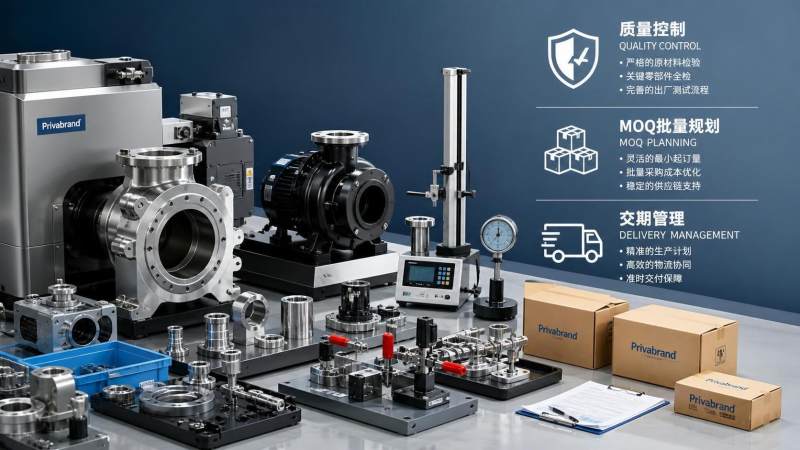
If you are comparing a private label equipment manufacturer, the real question is not simply “Who gives the lowest quote?” It is “Who can deliver consistent quality, in a workable batch size, on a schedule your business can actually live with?” For procurement teams, those three points—quality, MOQ, and lead time—usually decide whether a sourcing plan protects margin or creates expensive downstream problems. A low unit price can disappear fast if defect rates rise, reorders get delayed, or the supplier forces a volume commitment that ties up cash and warehouse space.
That is why experienced buyers look past the sales presentation early. They want to know how the factory controls variation, how flexible it is on order quantity, and whether its promised production window reflects actual capacity. A capable manufacturer should be able to explain these things clearly, not vaguely. If the answers stay generic, that is already useful information.
Start by checking whether the private label equipment manufacturer is built for your category
One common mistake is treating all OEM or private label suppliers as interchangeable. They are not. A factory that performs well in light consumer hardware may struggle with industrial equipment, heavy-duty assemblies, or products that must work reliably in harsh environments. Procurement people often see polished catalogs and assume manufacturing depth is there. Sometimes it is. Sometimes the supplier is mainly an assembler dependent on external sub-suppliers for the parts that matter most.
Before discussing price, verify what the manufacturer actually does in-house. Ask practical questions:
- Which components are produced internally, and which are outsourced?
- What part of the process is controlled by the factory: fabrication, machining, coating, testing, packaging, labeling?
- What product types make up most of its current output?
- How much of its business is custom private label work versus standard catalog products?
If your equipment needs stable hydraulic performance, structural durability, or precise tolerances, this matters more than branding support. In heavy-equipment-related supply chains, the weak point is often not final assembly but process consistency in key components. That is where buyer risk usually sits.
A short answer here: the best private label equipment manufacturer is rarely the cheapest one on first quote. It is the one whose production scope, process control, and order model match your actual operating needs.
Quality is not a claim. It is a system.
Many suppliers say they have “strict quality control.” That phrase means very little unless they can show how quality is managed from incoming materials to final inspection. Buyers who focus only on finished-product samples can miss the bigger issue: one good sample does not prove repeatability.
What you need to evaluate is whether the factory can deliver the same result across multiple batches, operators, and raw material lots. That is the difference between a sourcing relationship that scales and one that causes recurring claims.
Look for evidence in four areas.
First, incoming material control. If the factory cannot explain how it checks critical raw materials or bought-in parts, final quality will be hard to stabilize. For equipment products, material grade, surface treatment quality, motor source, seals, bearings, and electronics can all affect field performance.
Second, in-process control. Ask where defects are most likely to happen and how they are caught before assembly is complete. A strong factory will usually talk about checkpoints, operator instructions, test records, and nonconformance handling. A weak one jumps straight to “we inspect before shipment.” That usually means problems are found too late.
Third, final testing. For equipment, testing should reflect use conditions, not just visual inspection. Depending on the product, that may include load testing, run testing, pressure testing, dimensional checks, electrical safety checks, or packaging drop resistance. The exact method depends on the equipment category and should be verified against the intended market.
Fourth, traceability. If a defect appears six months later, can the supplier trace the production batch, material source, or test record? If not, every quality issue turns into a debate instead of a root-cause investigation.
In practice, procurement teams should ask for inspection forms, sample test records, and a description of corrective action flow. You are not trying to audit them like a certification body. You are trying to see whether quality is managed as a repeatable process or handled only when a customer complains.
MOQ should fit your sales risk, not just the factory’s convenience
MOQ gets discussed as a pricing topic, but it is really a risk allocation topic. When a manufacturer sets a high minimum order quantity, they are pushing part of their production efficiency risk onto the buyer. That may be acceptable in some cases. It may also be a bad fit, especially for a new market test, a regional launch, or a product line with uncertain demand.
Buyers often assume low MOQ is always better. Not necessarily. Very low MOQ can increase unit cost, reduce packaging efficiency, and sometimes create production instability if the supplier squeezes your order between larger jobs. The point is not to chase the smallest number. The point is to get an MOQ structure that fits your demand visibility.
Ask the manufacturer how the MOQ is built. Is it driven by:
- raw material purchasing thresholds,
- tooling or setup time,
- packaging customization,
- label printing quantities,
- production line efficiency,
- or simple policy?
This question often reveals room for negotiation. For example, the supplier may insist on a high MOQ for custom packaging, while the equipment itself can be produced in a smaller run. In that case, you may be able to start with neutral packaging, shared cartons, or phased branding. Sometimes the real blocker is not the machine but the box.
There is also a difference between factory MOQ and commercial MOQ. A supplier may technically produce 100 units, but only quote competitively at 500. Procurement should model both: the smallest feasible batch and the first economically sensible batch. That distinction helps avoid false comparisons between vendors.
Lead time is only useful when you understand what is inside it
A quoted lead time of 30 days sounds clear. It usually is not. Does it include raw material purchase? Tooling confirmation? sample approval? packaging approval? export booking? peak season congestion? If those assumptions are unstated, the number has limited value.
When evaluating lead time, break it into stages:
- engineering or sample confirmation time,
- material preparation time,
- production cycle time,
- inspection and rework allowance,
- packing and dispatch readiness.
Serious suppliers can usually explain this breakdown. That matters because delays do not happen evenly. Some factories are fast at assembly but slow at component sourcing. Others can produce quickly once the schedule starts but have long queues before your order enters the line.
Another point buyers sometimes miss: lead time consistency is often more valuable than the shortest quoted lead time. If one supplier says 25 to 30 days and another says 40 days with strong on-time performance, the second option may create less total cost if your inventory planning depends on reliability.
For equipment categories connected to construction, mining support, road work, or industrial maintenance, schedule disruption can create a chain reaction. Late delivery may affect dealer commitments, installation windows, or project mobilization. In those cases, ask about peak-season capacity, backup suppliers for key parts, and historical bottlenecks. If the supplier avoids specifics, assume the lead-time risk is higher than stated.
What to request before you shortlist a supplier
You do not need a giant audit package at the first stage, but you do need enough evidence to filter out weak candidates. A practical shortlist request usually includes:
- current product specifications and tolerance standards,
- quality control flow or inspection checklist,
- sample policy and sample lead time,
- MOQ by SKU, by packaging version, and by branding option,
- standard lead time and peak-season lead time,
- warranty or claims handling process,
- main export markets and applicable compliance experience.
That last point matters if you are buying for markets with specific technical, safety, or labeling requirements. If the factory has never supplied your destination market, that does not automatically disqualify them. It does mean you should verify documentation and test expectations carefully instead of assuming familiarity.
For buyers in more technical segments, market intelligence can also help before direct negotiation. Platforms such as TF-Strategy are useful less as vendor endorsements and more as context tools. If you source equipment related to heavy infrastructure, road machinery, excavation support, or lifting operations, understanding sector demand, material shifts, and project cycles can make supplier evaluation more grounded. It helps you judge whether a “long lead time” is a factory-specific issue or part of a broader market condition.
Red flags that usually show up early
Most sourcing problems give warning signs before the first purchase order is placed. Buyers sometimes ignore them because the quote looks attractive.
- The supplier changes MOQ or lead time after sample approval without a clear reason.
- Technical answers stay at sales level and never reach the process level.
- Inspection records are unavailable, overly generic, or obviously prepared only for presentation.
- The sample quality is good, but the supplier cannot explain how batch consistency is maintained.
- Communication is fast when discussing price and slow when discussing tolerances, testing, or claims.
- The factory accepts every custom request immediately, with no discussion of tradeoffs or constraints.
That last one deserves attention. Experienced manufacturers usually push back on something. They may say your target price is too low for the material grade, or your packaging design will lengthen lead time, or your MOQ is below efficient production level. That kind of pushback is often healthy. A supplier that says yes to everything may be protecting the order, not the project.
How experienced buyers balance quality, MOQ, and lead time
There is rarely a perfect score on all three. The real job is choosing the right compromise for the purchasing situation in front of you.
If the product is new and demand is uncertain, prioritize MOQ flexibility and communication quality. You can accept a slightly higher unit price if it reduces inventory exposure and lets you validate the market.
If the product is mature and claims are expensive, prioritize process stability and defect control. In that case, the cheapest ex-factory quote can become the most expensive option once returns, field service, and reputation costs are counted.
If your downstream schedule is tight, treat lead-time reliability as a cost issue, not just an operations issue. A delayed launch, missed tender window, or empty distributor shelf has a real commercial price.
In other words, do not evaluate the private label equipment manufacturer in isolation. Evaluate the fit between the supplier model and your commercial risk.
FAQ
Is a lower MOQ always better for procurement?
No. Lower MOQ reduces inventory risk, but it can raise unit cost and sometimes weaken production priority. The better question is whether the MOQ matches your forecast and cash-flow tolerance.
How many samples are enough before placing the first order?
One visual sample is rarely enough for equipment. If the product has performance or durability requirements, ask for samples that reflect final materials, packaging, and key functional testing.
Can a fast lead time be a warning sign?
Yes. If the quoted lead time seems much shorter than the market norm, verify whether materials are already in stock, whether your order will be inserted between other jobs, and what assumptions are missing.
What matters more: certification or actual process control?
Both matter, but process control is what protects day-to-day consistency. A certificate can support credibility; it does not replace batch discipline, testing, and traceability.
When should a buyer walk away from a supplier?
Usually when technical answers stay vague, commercial terms keep changing, or the supplier cannot explain how it manages defects, capacity, and delivery risk.
The best sourcing decisions are usually made before the PO is issued. If you are screening a private label equipment manufacturer, focus on evidence that the supplier can repeat quality, support a realistic MOQ, and deliver on a lead time built on actual capacity. That is the part that protects cost, not just price.
Internal link anchor text suggestions
- equipment supplier audit checklist: supplier evaluation guide or resource page
- how to reduce total cost of ownership in heavy equipment sourcing: procurement insight article
- OEM vs private label equipment manufacturing: comparison page or educational article
- lead time risk in industrial supply chains: operations or sourcing analysis page
- quality control standards for machinery procurement: technical knowledge page
External authoritative source directions
- industry association guidance on machinery manufacturing quality systems
- government or customs authority pages on import compliance and product labeling requirements
- official technical documentation from major component brands used in industrial equipment
Related News
 Oct 09, 2026Ultra-Large Excavator Bucket Size: Capacity, Width, and Site Fit ExplainedUltra large excavator bucket size explained: compare capacity, width, payload, truck matching, and site conditions to select a reliable, high-productivity bucket.
 Oct 08, 2026How to Evaluate a Heavy Machinery Information Platform for Project Equipment SourcingHeavy machinery information platform guide: compare equipment fit, source reliability, lifecycle costs, supplier capability, and compliance to make smarter sourcing decisions.
 Oct 07, 2026How to Evaluate a Hydraulic System Component Supplier for Heavy Equipment UptimeChoose a hydraulic system component supplier with proven quality, technical fit, and reliable delivery to reduce heavy equipment downtime and lifecycle costs.
 Oct 06, 2026Selecting Petrochemical Overhead Cranes for Hazardous Areas and Heavy Process LoadsPetrochemical overhead cranes for hazardous areas: learn how to match capacity, duty, controls, corrosion protection, and maintenance access for safer, reliable lifts.


Ms. Elena Rodriguez
Weekly Insights
Stay ahead with our curated technology reports delivered every Monday.