
How to Evaluate a Hydraulic System Component Supplier for Heavy Equipment Uptime
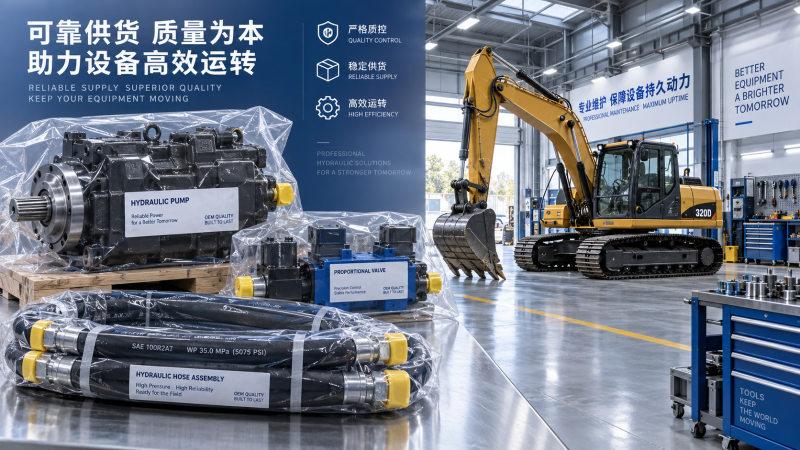
For a heavy-equipment fleet, a hydraulic component purchase can determine whether a planned maintenance stop stays contained or turns into a lost production shift, a delayed lift, or a machine stranded far from parts support. That is why evaluating a hydraulic system component supplier should start with the operating consequence of failure, not with a unit-price comparison.
A supplier may offer a part that matches the requested description, fits the mounting envelope, and arrives at a competitive price. None of those points alone proves that the part will perform acceptably in a high-duty excavator, tunnel boring machine, crawler crane, road machine, or mining truck. Procurement teams need evidence that the supplier can support the actual pressure, contamination exposure, temperature range, duty cycle, control requirements, and recovery expectations of the equipment being maintained.
The practical objective is simple: reduce the probability and duration of hydraulic-related downtime while keeping lifecycle cost visible. A lower purchase price is worthwhile only when it does not increase installation risk, troubleshooting time, repeat failures, inventory exposure, or the cost of a machine being unavailable when the project schedule cannot absorb it.
Start with the failure consequence, not the catalog description
Hydraulic components do not carry equal operational risk. A hose fitting used in a non-critical auxiliary circuit should not be sourced under the same approval process as a main pump, proportional valve, slew motor, cylinder seal kit, pressure sensor, or high-pressure hose assembly serving a safety-sensitive function.
Before comparing suppliers, classify the requested components according to their effect on uptime and safety. This prevents procurement from applying either too little control to critical parts or excessive qualification effort to routine consumables.
This classification should reflect the machine and jobsite, not only the supplier’s product family. A component that is ordinary on a surface excavator may be difficult to replace on a tunnel project with restricted access. A hose that is inexpensive to buy may still be operationally critical when its failure immobilizes a haul truck on a narrow ramp or suspends a lifting operation.
Ask maintenance and operations teams a direct question: if this part fails, how quickly can the machine return to service, and what happens while it is down? The answer should shape qualification depth, acceptable lead time, safety-stock policy, and whether a second approved source is required.
Verify application fit beyond part-number matching
Part-number matching is useful, but it is not a complete engineering review. Hydraulic systems are sensitive to small differences in pressure rating, flow characteristics, port geometry, seal compound, fluid compatibility, internal clearances, electrical connectors, response curves, and cleanliness requirements. A part can appear interchangeable and still create poor control behavior, excessive heat, leakage, noise, accelerated wear, or recurring fault codes.
A capable hydraulic system component supplier should be able to discuss the installed application in technical terms. For critical items, procurement should expect the supplier to confirm more than dimensions and nominal pressure. The review should consider the machine model, original component reference, circuit function, working and peak pressure, fluid type, ambient conditions, duty cycle, and any modifications made to the machine.
This is particularly important when sourcing alternatives to original equipment parts. “Equivalent” can describe many different things: a dimensional replacement, a functionally similar item, a reverse-engineered component, or a part built to an independently controlled specification. Those categories should not be treated as identical.
For example, an alternative cartridge valve may physically install in the same cavity while having a different pressure-flow curve or hysteresis behavior. A replacement seal may fit the groove but degrade prematurely if it is not compatible with the fluid temperature and additive package. A hydraulic pump with a similar displacement may still have different control logic, case-drain limits, shaft interface requirements, or contamination tolerance.
Procurement does not need to reproduce the engineering department’s work. It does need to ensure that someone accountable has validated fit for the intended application and that the decision is documented. For high-consequence components, the purchase order should reference an approved technical specification, drawing, original part number, or written compatibility confirmation rather than relying on a salesperson’s general assurance.
Questions that expose weak technical support
- Can the supplier identify the original part and explain any difference between the offered part and the requested specification?
- Can it provide material, pressure, flow, electrical, or dimensional information relevant to the component type?
- Who reviews application compatibility when the machine has been modified or the original part is obsolete?
- Is there a defined process for handling serial-number-dependent variations?
- Can the supplier distinguish an approved substitution from a visually similar replacement?
- Will documentation identify the supplied item clearly enough for future maintenance and warranty analysis?
Vague answers at this stage are useful warning signals. A supplier does not need to disclose proprietary manufacturing details, but it should be able to establish what it is supplying, why it is suitable, and where its responsibility begins and ends.
Quality is a control system, not a certificate on a website
Certificates and quality statements can be relevant, especially where a customer or project requires them. They should not replace a review of the supplier’s actual controls. The central question is whether the supplier can deliver the same specified component repeatedly, in a condition suitable for installation, with enough traceability to investigate a problem later.
For hydraulic parts, this usually includes incoming inspection, product identification, storage conditions, packaging, contamination control, test or inspection records where applicable, and procedures for handling nonconforming goods. The level of evidence should rise with the criticality of the component.
Cleanliness deserves specific attention. A precision hydraulic component can be damaged before it reaches the machine if it is handled or packaged poorly. Open ports, missing protective caps, damaged bags, unsealed hose ends, and unclear preservation periods are not minor warehouse issues. They can introduce particles or moisture that later affect pumps, valves, cylinders, and control systems.
Seal and hose products also require disciplined storage. Rubber and polymer materials can be affected by age, heat, light, ozone exposure, and storage practices. If a supplier cannot identify batch information or manage stock rotation, procurement may receive parts that look acceptable but have reduced remaining service value.
For high-risk components, request a sample documentation pack before placing a larger order. The purpose is not to create administrative work for its own sake. It allows the buyer to see whether labels, packing lists, certificates where relevant, test records, and serial or batch identification connect clearly to the delivered item. When a field failure occurs months later, that chain of information can determine whether the issue is isolated, systemic, installation-related, or impossible to trace.
Measure lead-time reliability in the way downtime is experienced
Quoted lead time is often less useful than a supplier’s ability to deliver the correct component when promised. A supplier that routinely quotes a short lead time but revises it after order placement may be more disruptive than one that provides a longer, realistic commitment.
For procurement teams supporting remote mines, tunneling projects, large lifting campaigns, or distributed contractor fleets, delivery risk has several layers. There is supplier stock availability, manufacturing lead time, export documentation, freight handoff, customs exposure, and final delivery to the site. A component can be “in stock” at one location and still be unavailable when the machine needs it.
Ask suppliers to distinguish clearly between their own inventory, inventory held by a manufacturer, expected production availability, and an uncommitted market search. These are materially different supply positions. The supplier should also state whether its lead time refers to dispatch, carrier collection, arrival at a regional hub, or delivery to the named destination.
For recurring consumption parts, a stock agreement or defined replenishment model can be more valuable than repeated spot purchasing. For long-lead critical components, procurement should work with maintenance planners to identify items whose absence would stop an asset for an unacceptable period. Those parts may justify local holding, consignment arrangements, repairable exchange units, or approved alternate-source plans.
Inventory decisions should be based on downtime exposure rather than a generic rule such as holding a fixed number of every component. Carrying duplicate low-risk parts ties up capital. Failing to hold a difficult-to-source servo valve, pump controller, cylinder seal kit, or specialized hose assembly can create far larger costs than the carrying expense of a carefully selected spare.
Look at the full cost of a hydraulic purchase
Unit price remains important, but it should be placed within the cost of getting a working machine back into service. A cheaper component may create additional cost through fitment work, repeat installation, oil loss, contamination cleanup, expedited freight, labor overtime, diagnostic delays, or a shortened replacement interval.
A useful evaluation compares suppliers across four cost areas:
- Acquisition cost: quoted price, freight, duties, packaging, inspection, and payment terms.
- Installation cost: time required to fit, adapt, calibrate, flush, or test the part.
- Failure cost: expected impact of leakage, performance loss, machine stoppage, safety controls, and collateral damage.
- Recovery cost: warranty administration, return logistics, technical diagnosis, replacement lead time, and site labor.
This approach does not require speculative financial models for every purchase. It is most useful for the components whose failure can halt production or trigger extensive troubleshooting. For standard filters or readily available fittings, a simpler landed-cost and availability comparison may be sufficient. The discipline is to match the depth of analysis to the operational consequence.
Be cautious with supplier proposals that frame cost savings only as a percentage off the original equipment price. The relevant comparison is not always OEM versus non-OEM. It may be a choice between an immediately available approved component, a lower-cost part requiring technical validation, a repaired unit with a known condition report, or a new unit whose delivery date threatens project output. The best option depends on the equipment’s role, remaining project duration, maintenance capability, and tolerance for uncertainty.
Test the supplier’s response before an urgent failure does
Technical competence and logistics discipline become most visible when something goes wrong. Procurement should evaluate the supplier’s escalation path before awarding critical business. Determine who owns an incorrect shipment, suspected defect, missing documentation, damaged package, or compatibility dispute. A generic customer-service inbox is rarely enough for equipment that may be costing substantial money while idle.
Useful indicators include the availability of a named technical contact, a clear returns process, realistic warranty conditions, documented response times, and the ability to support fault isolation without immediately shifting responsibility to the installer or machine owner. No supplier can eliminate every field issue, particularly where hydraulic contamination, improper installation, or machine defects may be involved. The practical measure is whether it investigates methodically and helps preserve the evidence needed to reach a defensible conclusion.
For important suppliers, begin with a controlled trial rather than moving an entire category at once. Select a defined set of applications, record part identity and installation conditions, monitor early performance, and review delivery accuracy and documentation quality. This is especially prudent for replacement pumps, motors, valves, electronic hydraulic controls, and components used in severe temperature, dust, vibration, or continuous-duty environments.
Build an approval process that operations can use
The strongest supplier evaluation process is usually simple enough to be followed under time pressure. It separates routine purchases from controlled technical decisions and makes responsibilities clear among procurement, maintenance, engineering, warehouse teams, and site operations.
For critical hydraulic parts, an approval record should capture the required specification, machine and circuit application, approved supplier and manufacturer, accepted alternatives, required documentation, target lead time, warranty route, and stocking decision. It should also identify when procurement must escalate a substitution for technical review.
That last point matters. Many costly mistakes begin with an apparently harmless change: a different seal material, connector style, hose construction, valve revision, or part suffix. Procurement teams should be empowered to stop an ambiguous substitution rather than being measured only on speed or purchase-price variance.
A reliable hydraulic system component supplier brings more than inventory to the relationship. It provides technical clarity, repeatable quality controls, credible delivery commitments, and a workable response when the supplied item is questioned. For heavy equipment uptime, those capabilities are part of the component’s value. The purchase decision should reflect them before the machine is waiting for a part.
Related News
 Oct 07, 2026How to Evaluate a Hydraulic System Component Supplier for Heavy Equipment UptimeChoose a hydraulic system component supplier with proven quality, technical fit, and reliable delivery to reduce heavy equipment downtime and lifecycle costs.
 Oct 06, 2026Selecting Petrochemical Overhead Cranes for Hazardous Areas and Heavy Process LoadsPetrochemical overhead cranes for hazardous areas: learn how to match capacity, duty, controls, corrosion protection, and maintenance access for safer, reliable lifts.
 Oct 05, 2026Tunneling Equipment Specification Planning: Key Criteria for Ground and Project RisksEquipment specification planning tunneling: learn how to match TBM systems to ground risks, geometry, safety, logistics, and lifecycle cost for more reliable project delivery.
 Oct 04, 2026Nuclear Lifting Equipment Cost: Budgeting for Compliance, Testing, and Lifecycle RiskNuclear lifting equipment cost explained: budget for compliance, proof-load testing, installation, documentation, and lifecycle risk to make confident procurement decisions.
Ms. Elena Rodriguez
Weekly Insights
Stay ahead with our curated technology reports delivered every Monday.