
Industrial Equipment Sourcing Checklist: How to Compare Lead Time, Compliance, and Total Cost
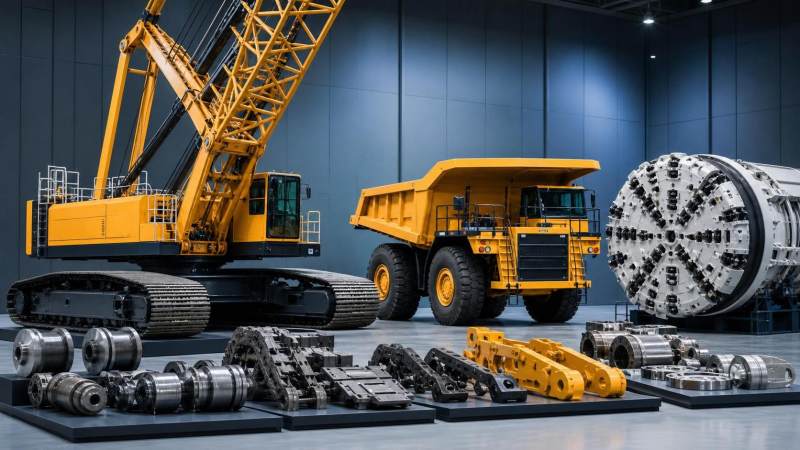
Industrial Equipment Sourcing Checklist: How to Compare Lead Time, Compliance, and Total Cost
Industrial equipment sourcing can decide whether a project stays on schedule or drifts into cost overruns.
That is especially true in heavy sectors such as TBM systems, mining fleets, crawler cranes, and road machinery.
A low quoted price rarely tells the full story.
Lead time, compliance exposure, logistics complexity, and lifetime operating cost usually matter more than the initial number.
For that reason, industrial equipment sourcing needs a practical checklist that supports consistent decisions across suppliers and project conditions.
Start With the Operating Context
Before comparing suppliers, define the jobsite reality in measurable terms.
Industrial equipment sourcing often fails when teams compare machines without matching them to real operating demands.
For example, a mining dump truck for high altitude work faces different cooling, payload, and brake requirements than one in a temperate basin.
A TBM procurement package also depends on geology, tunnel diameter, cutterhead wear rates, and local safety codes.
Build the sourcing brief around these inputs:
- Required output, capacity, reach, lifting load, or daily haulage volume
- Site temperature, altitude, ground conditions, and duty cycle
- Power source, fuel availability, and grid constraints
- Available maintenance skills and spare parts access
- Delivery window linked to project milestones
- Local import, emissions, and safety requirements
When this foundation is clear, industrial equipment sourcing becomes a decision process instead of a pricing exercise.
Compare Lead Time Beyond the Factory Promise
Lead time is one of the most misread variables in industrial equipment sourcing.
Many quotations show production lead time only, while the real project clock includes several additional stages.
Check each phase separately:
- Engineering confirmation and drawing approval
- Long-lead component availability
- Manufacturing and assembly schedule
- Factory acceptance testing
- Export packing and inland transport
- Ocean freight, customs clearance, and final delivery
- Site installation, commissioning, and operator training
In practice, two suppliers with the same quoted delivery date may carry very different schedule risk.
One may control key hydraulic systems internally.
Another may depend on outside vendors for drives, bearings, or electrical cabinets.
That difference matters when supply chains tighten or design revisions appear late.
Ask for evidence, not just dates:
- Current order backlog by product family
- Critical component sourcing plan
- Recent on-time delivery performance
- Penalty or remedy terms for delays
- Contingency plan for port or customs disruption
Good industrial equipment sourcing treats lead time as a chain of dependencies, not a single line item.
Verify Compliance Before Commercial Negotiation Deepens
Compliance should be screened early because fixing gaps later is expensive.
This is a common blind spot in industrial equipment sourcing for cross-border projects.
A machine can be technically strong and commercially attractive, yet still fail local approval.
Review compliance in four layers:
1. Product Certification
Check required standards such as CE, ISO, ANSI, MSHA, or market-specific electrical and pressure certifications.
2. Environmental and Emissions Rules
Confirm engine stage, noise limits, fluid handling rules, and any restrictions tied to urban, mining, or protected areas.
3. Site Safety and Operational Controls
Safety interlocks, emergency systems, guarding, remote monitoring, and operator visibility can all affect acceptance.
4. Documentation Quality
Documentation is part of compliance.
Request certificates, manuals, material traceability, welding records, test reports, and maintenance instructions in the required language.
A disciplined industrial equipment sourcing process scores suppliers on proof provided, not claims made in presentations.
Calculate Total Cost, Not Purchase Price Alone
Total cost is where strong sourcing decisions usually separate themselves.
In heavy equipment, the initial quote may represent only part of the financial exposure.
A realistic industrial equipment sourcing model should include:
- Base equipment price
- Optional systems and customization costs
- Tooling, attachments, and consumables
- Freight, insurance, duties, and inland transport
- Installation, commissioning, and training
- Fuel or energy consumption
- Routine maintenance and spare parts
- Expected downtime and service response costs
- Resale value or end-of-life disposal
This matters even more for high-intensity assets.
An excavator with lower fuel burn and longer component life may outperform a cheaper model within one operating season.
The same applies to TBM cutterhead wear, crane maintenance intervals, or electric truck charging infrastructure.
Industrial equipment sourcing should therefore compare cost across the asset lifecycle, ideally over three to seven years.
Assess Supplier Strength and Delivery Reliability
Supplier capability is not only about factory size.
Reliable industrial equipment sourcing also depends on engineering depth, service discipline, and communication quality.
Use a supplier review checklist like this:
- Track record in similar projects and climates
- Reference customers with comparable equipment scope
- Financial stability and export experience
- Quality system maturity and audit readiness
- Spare parts stocking strategy
- Regional service network and response time
- Ability to support digital diagnostics and remote troubleshooting
Recent market shifts make this even more important.
More equipment is technically advanced, but not every supplier can support that complexity in the field.
In industrial equipment sourcing, weak after-sales support often turns into hidden downtime cost.
Build a Scoring Model That Supports Clear Decisions
A weighted scoring model helps teams compare options without relying on opinion.
It also keeps industrial equipment sourcing aligned with project strategy.
Typical scoring areas include:
Weights should reflect project priorities.
A fast-track tunnel project may prioritize delivery certainty.
A long-life mining asset may give more weight to energy efficiency and parts support.
That simple discipline makes industrial equipment sourcing more transparent and easier to defend internally.
Common Mistakes That Raise Sourcing Risk
Several mistakes appear repeatedly in industrial equipment sourcing:
- Choosing the lowest bid without modeling downtime cost
- Accepting generic compliance statements without document review
- Ignoring long-lead subcomponents
- Underestimating commissioning and training time
- Failing to define spare parts packages upfront
- Comparing offers with different technical scopes
Most of these issues are avoidable when the checklist is used early and updated during supplier clarification.
Final Checklist for Better Industrial Equipment Sourcing
Before award, confirm these points:
- The equipment matches the actual operating environment.
- Lead time covers engineering, production, logistics, and commissioning.
- Compliance documents are complete and verified.
- Total cost includes operation, service, and downtime assumptions.
- Supplier capability is supported by references and service coverage.
- Commercial terms address delay risk, warranty, and parts support.
Industrial equipment sourcing works best when decisions are grounded in evidence, not urgency.
That is increasingly important as global infrastructure projects face tighter timelines, stricter compliance demands, and greater pressure on lifecycle cost.
For complex assets, the strongest sourcing outcome usually comes from connecting machine data, construction method, and long-term operating economics.
Use this checklist as a working tool, and each industrial equipment sourcing decision becomes easier to compare, justify, and execute with fewer surprises.
Related News
 Sep 27, 2026Heavy Equipment Selection Factors for Matching Machine Capacity to Jobsite ConditionsHeavy equipment selection factors for matching capacity to jobsite conditions, improving productivity, safety, fleet efficiency, and total project cost control.
 Sep 26, 2026How to Select Wind Rotor Lifting Equipment for Safe Blade and Hub InstallationWind rotor lifting equipment selection guide: ensure safe blade and hub installation with the right lift method, load control, crane compatibility, wind limits, and compliance.
 Sep 25, 2026What Drives Heavy Haulage Cost on Oversized Construction Equipment Moves?Heavy haulage cost explained: discover how load dimensions, route surveys, permits, escorts, lifting plans, and scheduling shape reliable oversized equipment transport budgets.
 Sep 24, 2026Supplier Management Frameworks That Reduce Delays on Large Construction ProjectsLarge-scale construction projects supplier management frameworks help prevent costly delays with risk-based controls, milestone tracking, quality oversight, and escalation plans for critical packages.
Ms. Elena Rodriguez
Weekly Insights
Stay ahead with our curated technology reports delivered every Monday.