
Large-Scale Infrastructure Projects: How to Assess Schedule, Risk, and Budget Control
Why large-scale infrastructure projects need different assessment lenses
Large-scale infrastructure projects rarely fail because of one visible mistake.
More often, schedule slippage, unmanaged risk, and weak budget control build quietly across design, equipment, logistics, and site execution.
That is why assessment must go beyond milestone reporting.
In practice, the right question is not whether progress looks acceptable today.
The real question is whether the current delivery pattern remains viable under changing ground conditions, supply pressure, and equipment constraints.
This matters even more in heavy-industry environments.
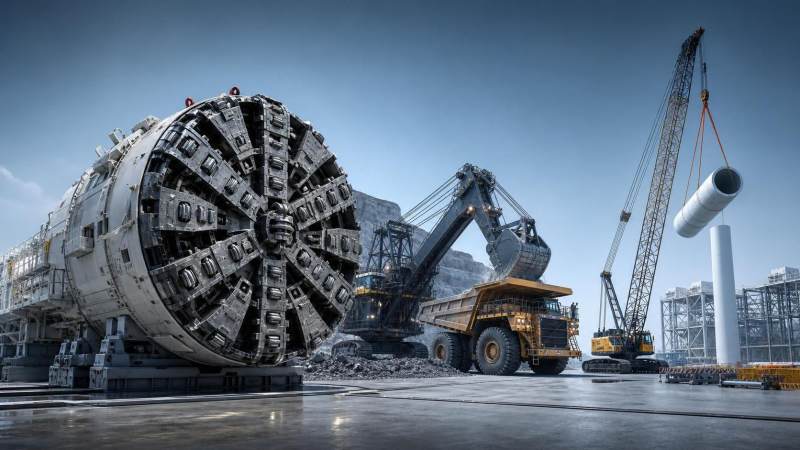
A tunnel boring campaign, an open-pit mine expansion, and a wind-component lifting program may all be called large-scale infrastructure projects.
Yet their schedule logic is different, their risk triggers differ, and their budget control methods cannot be copied from one site to another.
This is where an intelligence-led view becomes useful.
TF-Strategy follows TBM systems, ultra-large excavators, crawler cranes, road machinery, and mining dump trucks because physical equipment behavior often explains commercial project outcomes earlier than reports do.
In underground works, schedule confidence depends on geology more than optimism
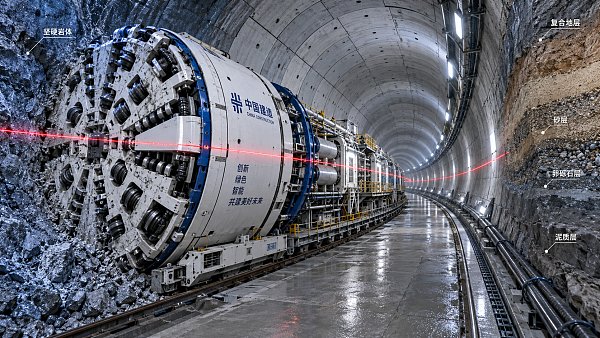
For tunnel-driven large-scale infrastructure projects, a calendar baseline can look healthy while actual schedule confidence is weak.
The main reason is simple.
TBM performance is tied to geology, cutter wear, spoil handling, shaft readiness, and segment supply at the same time.
When one variable shifts, the delay is rarely isolated.
It spreads into maintenance windows, labor sequencing, and cash flow.
What to check before calling the schedule realistic
- Compare planned advance rates with actual geology transitions, not only average daily meters.
- Review cutterhead intervention assumptions and the lead time for replacement parts.
- Check whether segment production and transport can sustain the excavation rhythm.
- Confirm utility relocation, shaft access, and spoil disposal capacity.
A common misread is to treat a stable early drive as proof of long-term predictability.
In reality, mixed ground, water ingress, and abrasive strata can change the budget control picture in a few weeks.
In this setting, risk assessment should follow the chain from geology to downtime cost, not sit in a separate register.
Open-pit expansion calls for a different balance between production and budget control
Mining-related large-scale infrastructure projects usually look equipment-heavy, but the real challenge is system coordination.
Ultra-large excavators and mining dump trucks only deliver schedule gains when haul roads, maintenance planning, fuel or power supply, and dispatch logic stay aligned.
This creates a different assessment focus from tunneling.
The issue is less about one breakthrough event and more about sustained production reliability.
Budget control here depends on cycle-time discipline, tire wear, operator consistency, and weather exposure.
High altitude or extreme temperature conditions can distort equipment utilization far faster than desktop estimates suggest.
A useful judging method is to separate nominal capacity from reliable capacity.
If the fleet is rated for peak output but only sustains lower output over a quarter, the schedule may still miss even with adequate asset count.
TF-Strategy often tracks these signals through equipment evolution, powertrain choices, and remote-control adoption because those details influence total cost of ownership directly.
Lifting-intensive projects rise or stall on sequencing discipline
Large-scale infrastructure projects in wind power, petrochemical construction, and nuclear assembly are often judged by component delivery dates.
That view is incomplete.
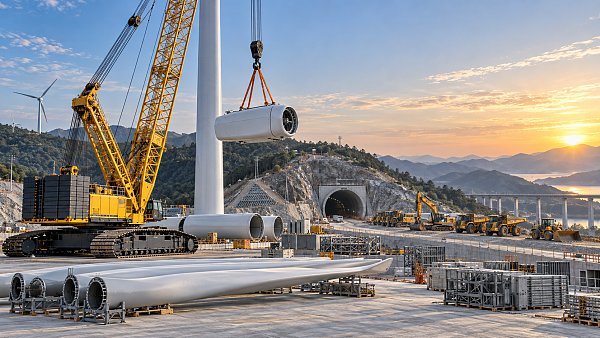
For crawler crane operations, schedule, risk, and budget control hinge on lift sequencing, ground bearing conditions, weather windows, and assembly logistics.
One delayed module does not just shift one day.
It can idle support crews, extend crane rental periods, and force re-engineering of lift plans.
More careful assessments look at readiness density.
That means checking how many upstream conditions must all be true before the lift begins safely and economically.
If access roads, laydown areas, lifting frames, and permit approvals are only partially aligned, apparent progress can be misleading.
In these scenarios, risk assessment should combine engineering tolerance with site logistics reality.
Budget control also needs to include standby costs, escort transport, and weather-related utilization loss, not just crane procurement or lease rates.
Road networks and linear projects often hide small delays that become large claims
Linear projects use a different rhythm again.
Large road machinery can deliver impressive paving rates, but schedule reliability depends on material consistency, plant output, traffic management, weather timing, and quality hold points.
The budget control risk is subtle.
A few percentage points of rework, uneven compaction, or supply interruption can quietly consume contingency.
The project still appears active, yet margin deteriorates underneath.
This is one of the more common differences between visible activity and real project health.
A stronger assessment approach compares daily production with quality acceptance and downstream readiness together.
If paving output is high but test failures increase, schedule acceleration may actually weaken risk and budget performance.
Different project conditions change what should be measured first
The table below shows why large-scale infrastructure projects need scenario-specific judgment instead of one universal dashboard.
Where large-scale infrastructure projects are often misjudged
Several mistakes appear across sectors, even when the equipment mix is different.
- Treating procurement progress as the same thing as execution readiness.
- Using vendor-rated performance without testing site constraints.
- Watching direct cost closely while ignoring downtime and interface losses.
- Assuming similar project types share the same risk timing.
- Separating commercial review from engineering reality.
The last point matters more than it seems.
In large-scale infrastructure projects, a schedule recovery plan that ignores machine wear, haul distance, or lift congestion usually shifts cost risk forward rather than removing it.
This is why intelligence platforms focused on heavy equipment, raw materials, and project tenders can add value without becoming sales material.
They help connect machinery parameters with delivery risk before the project absorbs the cost.
A practical way to strengthen assessment before problems compound
A useful next step is to build one review frame for each operating scenario rather than one generic control sheet.
That frame should tie schedule, risk, and budget control to a short list of physical realities.
- Map the project around equipment bottlenecks, not only contractual milestones.
- Test optimistic production assumptions against difficult site conditions.
- Track hidden cost drivers such as standby time, wear parts, and rework.
- Review whether design, logistics, and field sequencing remain aligned.
- Use external intelligence to compare local assumptions with global operating patterns.
Large-scale infrastructure projects become easier to judge when the assessment matches the actual work environment.
That means clarifying the scenario first, then checking which variables truly control delivery.
From there, schedule confidence, risk exposure, and budget control become measurable in a way that supports better decisions rather than late explanations.
Related News
 Sep 19, 2026Mining Truck Technology Trends: What Fleet Managers Should Prioritize for 2026Mining truck technology trends for 2026: prioritize electrification, autonomy, predictive maintenance, and road intelligence to improve fleet uptime, safety, and cost control.
 Sep 17, 2026How TBM Guidance Technology Maintains Alignment Through Curves and Variable GroundTunnel boring machine guidance technology helps teams maintain precise alignment through curves and variable ground, reducing risk, improving lining accuracy, and protecting schedules.
 Sep 16, 2026Infrastructure Equipment Market Reference: Demand, Pricing, and Supplier BenchmarksInfrastructure equipment market reference for buyers: assess demand signals, total cost, pricing risks, and supplier benchmarks for tunnels, mining, cranes, and road projects.
 Sep 15, 2026How to Evaluate Infrastructure Equipment Suppliers for Complex Project RequirementsInfrastructure equipment solutions supplier evaluation guide for complex projects: assess technical fit, lifecycle cost, reliability, local support, and contract risk.


Ms. Elena Rodriguez
Weekly Insights
Stay ahead with our curated technology reports delivered every Monday.