
What Determines Heavy Haulage Prices for Oversized Project Cargo?
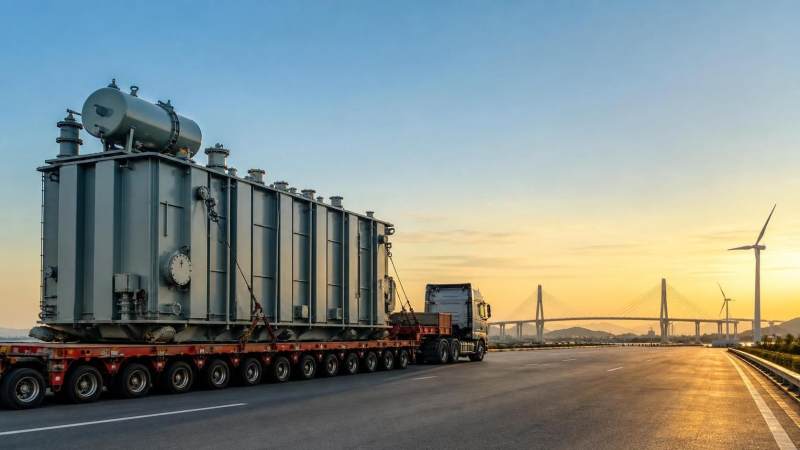
A Heavy Haulage Price Is a Route-and-Risk Calculation, Not a Simple Freight Rate
For oversized project cargo, the quoted heavy haulage price rarely comes down to a basic formula of tonnes multiplied by kilometres. A transformer, TBM shield, crawler crane component, mining excavator module, or wind-energy structure may travel only a moderate distance yet require weeks of engineering, authority coordination, road preparation, and carefully timed execution. Conversely, a long movement on a proven industrial corridor can sometimes be simpler and more predictable than a short move through a congested urban area.
This is why procurement teams should be cautious when comparing heavy transport quotations line by line. Two carriers can appear to be pricing the same movement while making very different assumptions about permits, trailer configuration, escort vehicles, loading responsibility, route modifications, or waiting time. The cheapest headline figure may exclude the exact activities that determine whether the cargo arrives safely and on schedule.
In heavy industry, transport is often inseparable from construction methodology. A TBM component delivered to a constrained urban launch shaft, a large excavator heading to an open-pit mine, or a crawler crane boom section moving to a wind or petrochemical site all create different logistical constraints. Good sourcing decisions begin by understanding what is actually being priced.
Cargo Geometry Often Matters More Than Gross Weight
Weight is the first figure everyone asks for, but it is not always the most decisive one. Heavy-haul planning depends on the full cargo envelope: length, width, height, centre of gravity, axle-load distribution, lifting points, support conditions, and whether the item can be dismantled. A relatively light but extremely wide vessel can create more route restrictions than a compact and much heavier machine module.
The transport contractor needs enough information to select equipment that distributes load safely and legally. Depending on the cargo and route, that may mean a modular hydraulic trailer, a multi-axle low-bed arrangement, a steerable trailer, beam configuration, or another specialised setup. Each choice affects mobilization, operating cost, turning radius, road occupancy, and the permissions required.
Procurement teams should avoid issuing a request for quotation with only a total weight and broad dimensions. Ask engineering, OEM, or site teams for a transport data sheet that identifies the precise lifting or jacking method, centre of gravity, allowable support points, transport saddle requirements, and any components that must remain attached. If these details change after award, the heavy haulage price can move sharply because the entire trailer concept may need to be revised.
There is also a practical commercial question: should the cargo travel as one piece? Breaking down a crane, excavator, or TBM assembly may reduce abnormal-load costs, but disassembly, preservation, reassembly, testing, and lost installation time can outweigh the freight saving. The right comparison is total installed cost and schedule exposure, not simply the road-transport invoice.
The Route Survey Is Where the Real Cost Picture Emerges
A heavy haulage quote is only as credible as the route information behind it. For ordinary freight, a digital map may be enough to estimate distance. For abnormal cargo, the route must be checked against bridge capacities, overhead lines, rail crossings, roundabouts, gradients, pavement conditions, road width, construction zones, street furniture, and access at both ends.
A route survey may identify issues that are invisible in an early budget quote. A bridge might require a different axle arrangement. A tight junction may need temporary removal of signs or barriers. A low clearance can force a detour, lower trailer deck, utility adjustment, or partial cargo disassembly. At a remote mine or hydropower site, the last kilometres may be the most expensive part of the movement because site roads were not designed for large modular transporters.
It is reasonable to request a budgetary number before the survey is complete, particularly during tender planning. But buyers should distinguish clearly between a preliminary estimate and a firm route-based offer. If a quotation says “subject to route approval,” “subject to permit,” or “based on standard access,” those conditions are not boilerplate. They represent cost and schedule variables that still need to be closed.
Questions worth asking before bid comparison
- Has the carrier physically surveyed the route, relied on available mapping, or priced on an assumed corridor?
- Are bridge assessments, road-owner approvals, utility coordination, and route modifications included or excluded?
- Is the final-mile site route included, including gates, internal roads, unloading areas, and turning space?
- What happens if the approved route differs from the assumed route?
- Which party carries the cost of temporary civil works or reinstatement after the move?
These questions can expose a false economy early. A lower bid that assumes unrestricted access is not necessarily cheaper than a higher bid built around a verified route.
Permits, Escorts, and Traffic Windows Can Become Major Cost Drivers
Oversize and overweight movements commonly need permits from more than one authority. Requirements vary by jurisdiction, cargo dimensions, axle loads, route classification, and the nature of the load. Some permits can be routine; others require technical review, police support, bridge analysis, or coordination with highway and utility operators. Procurement teams should not assume that one national permit covers every segment of a cross-border or multi-region movement.
Escort requirements are another source of variation. Pilot vehicles, police escorts, traffic-management crews, utility representatives, and temporary road closures may be mandatory in certain locations or at particular dimensions. Their availability can shape the schedule as much as the transporter itself. A contractor with the right trailer fleet but no confirmed escort window may not be able to execute when the project needs it.
Night travel is sometimes proposed as a solution to traffic congestion, but it should not be treated as a universal cost saver. It can reduce interference with public traffic, yet it may increase staffing needs, escort complexity, lighting requirements, and site-readiness demands. Some areas restrict abnormal loads to specific hours; others prohibit night movement. The practical answer depends on local rules and route conditions, not preference.
Equipment Availability and Mobilization Explain Why Similar Quotes Differ
Specialised trailers, prime movers, ballast tractors, jacking systems, and transport crews are finite resources. The price of heavy haulage can change when the required equipment is already committed to wind, mining, refinery, port, or infrastructure work. In project logistics, capacity is not always interchangeable. A carrier may have many trucks but only limited modular axle lines, experienced operators, or suitable power units for a steep route.
Mobilization deserves separate attention. The trailer and crew may need to travel empty from another region, be assembled near the loading point, or remain on standby while permits are finalized. Where cargo movements are isolated rather than part of a sequence, these fixed costs can be substantial relative to the actual loaded kilometres. A buyer comparing bids should confirm whether the transport company has priced one-way mobilization, return demobilization, equipment standby, and any cross-border repositioning.
This is especially relevant for equipment-intensive sectors tracked by TF-Strategy, including tunnel construction, open-pit mining, ultra-large lifting, major roadworks, and mine haulage. A project’s machinery delivery plan should be aligned with broader demand for the same specialist resources. The commercial value of market intelligence is not simply knowing that a major project exists; it is understanding whether it may absorb the trailers, cranes, escorts, or port slots your own movement depends on.
Loading, Securing, and Unloading Are Not Minor Add-Ons
A heavy haulage price may cover road transport while leaving major handling work outside the scope. That distinction can cause expensive disputes. Loading may require cranes, gantries, skid systems, self-propelled modular transporters, hydraulic jacks, temporary foundations, or engineered lifting plans. At delivery, the site may need to provide level ground, adequate bearing capacity, crane access, a controlled exclusion zone, and personnel authorized to receive the load.
Cargo securing is equally important. The contractor must account for the cargo’s approved lashing points, support design, vibration sensitivity, and transport orientation. For high-value machinery, improper supports can create damage that may not be visible at handover. Buyers should clarify who approves the transport frame or saddles, who signs off on loading, and what inspection record is required before departure.
One recurring mistake is treating “delivery to site” as a complete scope description. Does it mean delivery to the gate, the laydown yard, a nominated crane position, or the final installation point? On large industrial sites, those locations can be kilometres apart and separated by restrictive roads or operating hazards.
Timing Creates Both Direct Cost and Hidden Project Risk
Heavy transport is vulnerable to waiting time. A permit delay, late vessel discharge, incomplete civil works, weather disruption, unavailable unloading crane, or missed site access window can leave expensive equipment and crews idle. Carriers typically address this with standby provisions, demurrage-style clauses, or rebooking charges. Those terms deserve as much scrutiny as the base freight rate.
For critical-path cargo, price should be evaluated alongside execution certainty. If an oversized transformer is needed before energization, or a TBM drive component is needed before a scheduled assembly phase, a delayed movement can affect far more than logistics cost. The lowest-cost carrier is not automatically the lowest-risk choice if its permit strategy, backup equipment, or site coordination process is unclear.
A better procurement approach is to establish realistic readiness gates: approved cargo drawings, confirmed route, permit submission, surveyed loading area, receiving-site sign-off, and defined weather or contingency arrangements. This reduces the habit of booking capacity before the project is genuinely ready to use it.
How to Compare Heavy Haulage Quotations on a Like-for-Like Basis
A structured bid comparison should separate fixed transport charges from variable and conditional items. It is not enough to compare a single all-in number if the inclusions are vague. Ask each bidder to state its assumptions in writing and identify exclusions that could become change orders.
It is also useful to ask bidders to identify the three assumptions most likely to change their price. An experienced heavy-haul provider should be able to explain where uncertainty sits. A vague answer is not proof of poor capability, but it is a signal that the scope may not yet be mature enough for a firm comparison.
The Best Cost Control Happens Before the Transport Order
The most effective way to control a heavy haulage price is to involve logistics planning before the cargo is fully packaged, dispatched, or committed to a port. Early review can influence shipment break-bulk decisions, packing dimensions, delivery sequencing, laydown design, and even the selected construction access route. These choices are difficult and expensive to reverse once equipment is in transit.
For buyers managing complex infrastructure and resource projects, the right question is not “Who offered the lowest heavy haulage price?” It is “Which proposal delivers the required cargo, by the required date, through an approved route, with the fewest unresolved assumptions?” That is the comparison that protects the project budget when oversized cargo stops being a transport task and becomes an operational dependency.
Related News
 Oct 12, 2026How to Assess a High-Altitude Mining Equipment Manufacturer for Remote ProjectsHigh altitude mining manufacturer assessment guide: compare derating, cold-climate reliability, remote service, parts resilience, and lifecycle risk for smarter project decisions.
 Oct 11, 2026What Drives TBM Cutter Head Material Cost and Life-Cycle Value?Cutter head material cost explained: compare TBM alloys, wear protection, downtime risk, and life-cycle value to choose the most reliable, cost-effective solution.
 Oct 13, 2026Mining Haulage Services Procurement Checklist for Uptime and Cost ControlMining haulage services procurement checklist for stronger uptime, safer fleet selection, transparent pricing, and better cost control across changing mine conditions.
 Oct 12, 2026How to Read Mining Equipment Performance Reviews Beyond Headline MetricsMining equipment performance reviews explained: learn to assess productivity, availability, maintenance risk, site conditions, and total ownership cost for smarter fleet decisions.



Ms. Elena Rodriguez
Weekly Insights
Stay ahead with our curated technology reports delivered every Monday.