
How Project Leaders Can Assess New Energy Construction Projects Before Mobilization
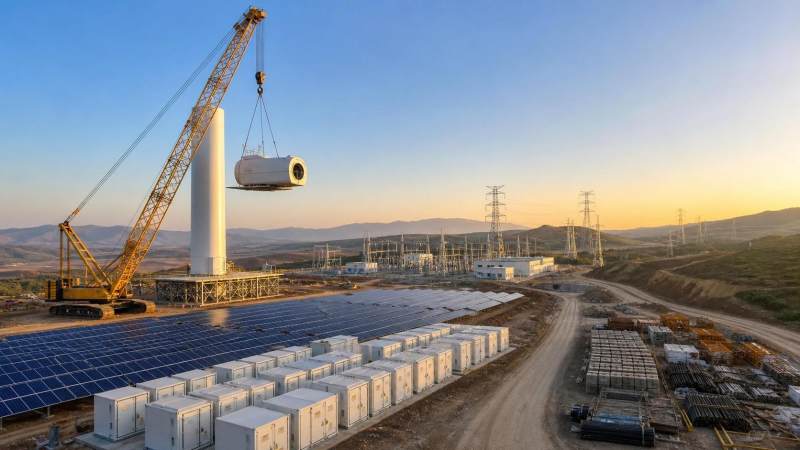
Before mobilization begins, project leaders must determine whether a new energy construction project is genuinely executable, rather than merely approved in principle. A signed EPC contract, a land lease, an interconnection offer, or a completed basic design package does not by itself mean that the site can absorb heavy equipment, specialist crews, long-lead components, and a compressed installation schedule.
This distinction matters across utility-scale wind, solar, battery energy storage systems (BESS), green hydrogen facilities, transmission-connected substations, and hybrid projects. These assets are often described as modular or repeatable. In practice, each project is shaped by local ground conditions, transport constraints, permitting interfaces, grid requirements, weather windows, contractor capacity, and equipment availability. Problems that appear manageable in a planning meeting can become critical once cranes, piling rigs, excavators, or electrical installation teams are committed to site.
A disciplined pre-mobilization assessment is therefore not a final administrative gate. It is the point at which project leaders test whether the execution strategy matches physical conditions, commercial obligations, and the available supply chain.
Start with construction readiness, not notice-to-proceed status
New energy construction projects commonly reach financial close or receive a notice to proceed while important execution assumptions remain open. The usual pressure is understandable: developers want to preserve revenue dates, equipment suppliers need release decisions, and lenders expect visible progress. Yet premature mobilization can lock the project into costly workarounds.
Construction readiness should be assessed as a set of linked conditions:
- the site is legally accessible and physically workable;
- design information is sufficiently mature for the intended work package;
- permits and environmental constraints allow the planned sequence;
- critical equipment and materials can arrive when needed;
- the grid and owner interfaces have defined responsibilities and dates;
- the contractor has a credible resource plan, including contingency capacity;
- the project has a workable safety, quality, logistics, and emergency-response framework.
These conditions should not be rated independently and then averaged into a reassuring score. A project can be strong in procurement and weak in access, or advanced in civil works but exposed by an unresolved substation protection design. One blocked interface can idle several high-cost work fronts. The relevant question is whether the critical path is executable under realistic field conditions.
Ground conditions can overturn the preferred construction method
For solar, wind, BESS, and transmission projects, geotechnical uncertainty is often treated as a civil-engineering issue rather than a programme issue. That is a mistake. Ground conditions affect machine selection, road design, foundation approach, crane standing areas, drainage, excavation support, cable trenching, and restoration obligations.
A desktop study and widely spaced boreholes may be adequate for initial investment decisions, but they are not always enough to release full-scale construction. Variability across a large solar site can change pile refusal rates, required embedment depth, corrosion protection, or the viability of driven versus screwed foundations. In wind projects, a localized weak zone may affect turbine foundation design, crane pad construction, or heavy-haul routes. In BESS and hydrogen facilities, ground improvement, flood protection, and containment design can become significant schedule drivers.
Project leaders should ask whether the investigation programme reflects the actual construction footprint rather than only the asset footprint. It must cover access roads, laydown yards, crane pads, cable routes, substations, drainage channels, batching areas, and temporary works. A geotechnical report that supports conceptual design but does not address the locations where heavy machines will operate is not sufficient for mobilization planning.
The assessment should also connect ground findings to equipment decisions. A crawler crane may have the nominal lifting capacity required for a wind component, but its practical deployment depends on bearing pressure, travel path preparation, slope limits, and available assembly space. Similarly, choosing a high-output piling rig for a solar project may appear efficient until refusal, rock layers, or wet-season ground access reduce daily production below the baseline assumption.
Validate the lifting strategy as an engineered work package
Large renewable projects frequently underestimate lifting complexity because the principal equipment is delivered as factory-manufactured modules. Turbine towers, nacelles, blades, transformer units, battery containers, electrolyser skids, and prefabricated electrical buildings still require controlled lifting in constrained and weather-sensitive conditions.
A credible lifting assessment goes beyond identifying crane tonnage. It should establish:
- the actual component weights, dimensions, centres of gravity, and lifting points;
- the required radius, hook height, boom configuration, and counterweight arrangement;
- ground-bearing capacity and temporary crane pad design;
- assembly, travel, and tailing-crane requirements where applicable;
- wind-speed limits and the likely availability of weather windows;
- road geometry, bridge limits, turning radii, and site-entry restrictions;
- availability of qualified lifting supervisors, riggers, transport coordinators, and rescue capability.
Crane selection should be made against the site-specific lift plan, not against a generic component list. Onshore wind projects are particularly exposed: the crane that is technically capable of the main lift may be difficult to mobilize through local road restrictions, unavailable during the required period, or commercially impractical if it must remain on standby through uncertain weather. A lower-capacity but more mobile configuration can sometimes improve schedule resilience if the turbine installation sequence and supplier requirements permit it.
For BESS and substation work, lifting risks may be less visible but no less consequential. Containerized systems, transformers, switchgear, and prefabricated control buildings may arrive in sequences that conflict with civil readiness, energized-area restrictions, or incomplete fire-safety infrastructure. The lifting plan must therefore be integrated with commissioning and access-control plans, not treated as a logistics attachment.
Separate equipment availability from equipment accessibility
In heavy construction, a machine can be available in the market and still be unavailable to the project. Mobilization depends on transport permits, border procedures, local registration requirements, operator certification, service support, fuel arrangements, spare parts, and the contractor’s ability to secure the machine for the required duration.
This issue is especially important where new energy construction projects are located in remote regions, on islands, at high altitude, or in jurisdictions with limited heavy-lift and earthmoving fleets. Imported cranes, excavators, piling equipment, or specialized transport may face port congestion, customs documentation delays, seasonal road closures, or restrictions on oversized loads. Mobilization estimates based only on sailing time or rental availability are unreliable.
Project leaders should require an equipment deployment plan that identifies the actual machine, its current location, transport route, ownership or rental status, planned maintenance window, operator source, and backup arrangement. For high-consequence assets, the contingency should not simply state “alternative equipment available.” It should identify whether an alternative can meet lift geometry, ground pressure, certification, and delivery timing requirements.
The same discipline applies to support equipment. Projects often focus on a flagship crane or piling rig while overlooking telehandlers, low-loaders, compactors, water trucks, generators, welding equipment, temporary power distribution, and recovery equipment. A missing support fleet can slow production as effectively as the loss of a major machine.
Test whether grid interfaces are buildable, not merely contracted
Grid connection is among the most persistent sources of delay in renewable energy development. A connection agreement may define a point of interconnection and broad obligations, but construction teams need a much more operational answer: what must be complete, tested, witnessed, and accepted before energization?
The pre-mobilization review should map the interface between the generating asset, collector system, substation, transmission line, utility facilities, communications network, and control room. This map should identify design ownership, approval authority, test responsibilities, outage requirements, protection settings, SCADA and telemetry protocols, cyber-security obligations where applicable, and the sequence of energization.
Particular attention is needed where owner-supplied equipment, utility-supplied equipment, and EPC-supplied systems meet. Cable termination details, protection coordination, control logic, metering, and communications are often treated as late-stage commissioning matters. They should instead be reviewed before field mobilization, because unresolved interfaces can influence trench routes, building layouts, cable schedules, equipment foundations, and commissioning resources.
Projects should also distinguish between mechanical completion and revenue-ready operation. A facility can be physically complete while awaiting grid studies, telecom links, protection approval, or a scheduled outage. If the commercial model depends on a fixed commercial operation date, these external dependencies deserve the same management attention as turbine or module delivery.
Review logistics as a production system
Logistics planning is not limited to arranging deliveries. It is the system that determines whether labor, materials, plant, storage capacity, and installation fronts remain synchronized. This is where apparently efficient procurement decisions can create field inefficiency.
For example, early delivery of modules, battery containers, tower sections, or electrical equipment can protect against supply disruption, but only if the site has secure storage, appropriate handling equipment, drainage, fire controls, inventory management, and insurance arrangements. Conversely, just-in-time delivery may reduce storage exposure but leave the project vulnerable to port delays, road restrictions, or a missed transport window.
A practical logistics review should model the site’s daily and weekly handling capacity. How many heavy vehicles can enter, unload, turn, and leave without blocking construction traffic? Is there enough laydown area to separate incoming components from inspected, released, damaged, and installation-ready materials? Can temporary roads remain passable after rain? Are local communities, schools, agricultural activity, or permit conditions limiting delivery hours?
These questions matter because a project’s planned installation rate is only as credible as its material flow. A solar installation crew cannot sustain productivity if pallets arrive irregularly or if internal roads do not support distribution. A wind erection programme cannot recover lost weather days if blade and tower deliveries are not positioned ahead of the next workable lifting window.
Assess schedule resilience, not just baseline duration
Many construction schedules are technically possible in ideal conditions. The more useful test is whether they can absorb predictable disruption without damaging the commercial completion date.
Project leaders should challenge the schedule at the interface level: what happens if access roads are delayed by two weeks; if a transformer shipment moves by a month; if high winds prevent major lifts; if a protection test fails; if a local permit prohibits work during a sensitive environmental period; or if the civil contractor and electrical contractor need the same work area?
Schedule contingency should be visible in time and resources. A programme that has no weather allowance, no float at critical interfaces, and no alternative work fronts is not aggressive; it is fragile. Recovery plans should be specific. They may include resequencing, parallel work packages, additional crews, extended shifts where permitted, alternative transport routes, or pre-approved equipment substitutions. Each option must be checked for safety, quality, contractual, and labor implications.
This is also the stage to examine the contractor’s productivity assumptions. Unit rates borrowed from another market may not transfer to a site with different soil, climate, labor experience, transport distances, or inspection requirements. Benchmark data is useful, but actual output should be adjusted for the project’s constraints.
Make lifecycle cost part of the mobilization decision
Pre-mobilization choices are often justified through immediate construction cost, yet they can materially affect operating cost and asset availability. Examples include inadequate drainage around inverter stations, insufficient access for future maintenance cranes, cable routes that complicate fault repair, undersized laydown areas for replacement components, or road designs that cannot support later transformer or blade transport.
The right question is not whether an alternative is cheaper at mobilization. It is whether it lowers total cost of ownership without transferring disproportionate risk into operations. This is particularly relevant for assets expected to operate for decades and for remote projects where maintenance mobilization is expensive.
Operations personnel should therefore participate in readiness reviews before major civil and logistics decisions are locked. Their contribution is often most valuable where construction teams see a temporary solution and operators see a recurring access, safety, drainage, or maintainability problem.
Use a decision gate that can stop, defer, or conditionally release work
The purpose of a pre-mobilization assessment is not to create a perfect project file. It is to make explicit decisions before cost and complexity rise. A useful gate has three possible outcomes: proceed, proceed with defined conditions, or defer mobilization until critical issues are resolved.
A conditional release can be appropriate when early works are genuinely independent of unresolved issues. Site fencing, surveys, limited access improvements, temporary facilities, or selected procurement actions may proceed while a grid interface or foundation design is finalized. However, conditional mobilization should have a written boundary. Teams need to know which work is authorized, what assumptions it relies on, who owns each open item, and what event triggers a stop or redesign.
The weakest outcome is broad mobilization based on optimism that field teams will “solve it as they go.” That approach can consume contingency before the main construction phase even starts.
For project leaders, the value of this assessment lies in converting uncertainty into choices. New energy construction projects succeed when technical design, heavy-equipment strategy, supply-chain timing, grid obligations, and site realities are aligned early enough to influence the plan. Mobilization should be the start of controlled execution—not the moment when unresolved assumptions become expensive facts.
Related News
 Oct 13, 2026OEM Equipment Suppliers in Europe: Vetting Quality, Lead Times, and SupportCompare OEM equipment Europe suppliers on quality, lead times, and after-sales support. Discover practical vetting steps to reduce downtime and buy heavy equipment with confidence.
 Oct 12, 2026How to Assess a High-Altitude Mining Equipment Manufacturer for Remote ProjectsHigh altitude mining manufacturer assessment guide: compare derating, cold-climate reliability, remote service, parts resilience, and lifecycle risk for smarter project decisions.
 Oct 11, 2026What Drives TBM Cutter Head Material Cost and Life-Cycle Value?Cutter head material cost explained: compare TBM alloys, wear protection, downtime risk, and life-cycle value to choose the most reliable, cost-effective solution.
 Oct 13, 2026Mining Haulage Services Procurement Checklist for Uptime and Cost ControlMining haulage services procurement checklist for stronger uptime, safer fleet selection, transparent pricing, and better cost control across changing mine conditions.




Ms. Elena Rodriguez
Weekly Insights
Stay ahead with our curated technology reports delivered every Monday.