
What Should Be Included in a TBM Equipment List for Tunnel Projects?
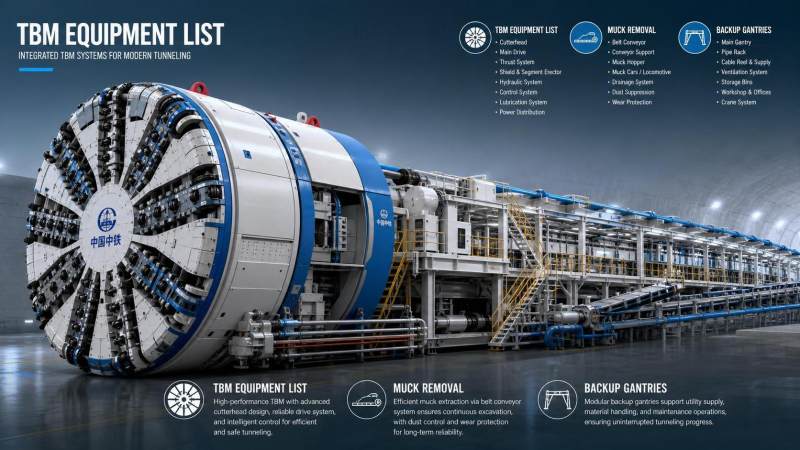
A tunnel project can absorb enormous time and capital long before the machine starts boring. In many cases, the early problem is not choosing a TBM in the abstract; it is building a practical TBM equipment list that reflects geology, tunnel alignment, logistics, support systems, and the realities of maintenance underground. For project managers, that list is not just a procurement schedule. It is a risk map.
When the list is incomplete, gaps usually show up later in the form of interface conflicts, slower advance rates, unexpected downtime, or hurried last-minute sourcing. A well-prepared TBM equipment list helps teams align technical scope with construction method, site constraints, and operating strategy from the start.
The question is not simply “what equipment does a TBM need?” It is “what must be defined early enough to avoid downstream surprises?” That is where experienced heavy-industry intelligence platforms such as TF-Strategy tend to add value: not by treating the TBM as a standalone machine, but by connecting machine parameters, boring conditions, support systems, and delivery logic into one decision framework.
Start with the machine type, not the shopping list
Before listing components, the project team needs clarity on the TBM type. An earth pressure balance TBM, slurry TBM, hard rock single-shield machine, double-shield TBM, or mixshield setup will not require the same support architecture. The core equipment list changes significantly depending on groundwater pressure, abrasive wear, rock strength, mixed-face conditions, settlement sensitivity, and segment lining strategy.
That sounds obvious, but many equipment lists become too generic because they are drafted before geotechnical interpretation is mature. As a result, critical systems such as slurry separation, conditioning foam dosing, dewatering, or probe drilling packages are underdefined. In practice, the first version of a TBM equipment list should be tied to a geotechnical baseline, even if some items remain provisional.
Core TBM systems that should always be specified
At the center of the list is the TBM itself, but “the TBM” is really a group of interdependent systems. A useful equipment list should separate them clearly enough for engineering, procurement, transport planning, and maintenance preparation.
Cutterhead and excavation system
This section should include the cutterhead structure, cutting tools, tool arrangement, drive system, rotation parameters, wear monitoring provisions if applicable, and cutter inspection or intervention concept. For hard rock machines, disc cutters and replacement strategy matter. For soft ground and mixed-face drives, the list should capture scrapers, rippers, conditioning injection points, and access arrangements for interventions under pressure if required.
Project leaders often focus on installed power and forget maintainability. Yet cutter consumption, intervention frequency, and accessibility can change schedule performance as much as nominal thrust.
Shield, thrust, and articulation systems
The shield body, main bearing arrangement, sealing systems, thrust cylinders, articulation cylinders, and steering provisions belong here. These are not minor details. They affect how the machine handles alignment corrections, ring building tolerance, and friction along the shield skin. In squeezing ground or long drives, shield friction management can become a major operational issue, so lubrication and overcut arrangements may also need to appear on the equipment list.
Muck removal system
No TBM equipment list is complete without a detailed spoil handling section. Depending on machine type, this may include screw conveyors, slurry circuits, stone crushers, belt conveyors, transfer conveyors, muck cars, pumps, pipelines, valves, and separation plant interfaces. If spoil handling is treated as an external package rather than an integrated system, the risk of underperformance rises quickly.
This is especially true on urban projects where disposal routes, shaft footprint, and environmental controls are tight. A machine may be technically capable of advancing faster than the spoil system can support.
Segment erection and lining support
Where precast segmental lining is used, the list should include the erector, segment feed system, vacuum or mechanical lifting devices, grout lines, tail seal grease system, annular gap grouting equipment, and consumable supply arrangements. Segment handling is often underestimated in early planning, even though it directly affects ring build time, alignment quality, and tail void control.
Backup gantries are not “secondary” equipment
Project teams sometimes spend weeks discussing cutterhead torque and barely enough time on the backup train. That is a mistake. The backup gantries carry the practical life of the operation: transformers, switchgear, ventilation equipment, operator cabins, grout systems, hydraulic power units, spare parts, workshops, hose reels, cable handling, water tanks, and control cabinets.
A serious TBM equipment list should identify how many gantries are needed, their functional allocation, axle load or wheel load considerations, transport arrangement inside the tunnel, and compatibility with curve radius and tunnel cross-section. On constrained alignments, the backup configuration can limit operations more than the cutterhead does.
Utility systems that determine whether the TBM can actually run
A large share of project disruption comes from utility systems being vaguely defined. A TBM equipment list should name them explicitly rather than burying them under “auxiliaries.”
The exact scope depends on the project delivery model. Some utilities may be supplied by the contractor as site infrastructure rather than by the TBM manufacturer. What matters is that interfaces are visible. A missing interface is often more dangerous than a missing component because nobody owns it until the problem appears.
Guidance, control, and monitoring deserve more attention than they usually get
Modern tunnel projects increasingly depend on data, not just mechanical output. A TBM equipment list should include guidance systems, survey integration, operator controls, PLC and SCADA elements, machine health monitoring, ground conditioning controls, pressure monitoring, and data logging architecture.
This is not only about automation. It is about traceability. When alignment drift, abnormal wear, grout consumption changes, or face pressure instability show up, the project team needs usable records. TF-Strategy often frames this as the connection between physical parameters and construction methodology, and that is exactly the right lens. The most advanced machine still creates operational blind spots if monitoring scope is too narrow or reporting structure is fragmented.
Don’t leave out intervention, maintenance, and recovery equipment
A procurement list built only around normal operation is incomplete. Tunnel projects rarely fail because crews forgot the cutterhead exists. They struggle because maintenance access, spare parts philosophy, rescue provisions, and recovery tools were underplanned.
A realistic TBM equipment list should cover:
- Critical spare parts for wear, seals, hydraulics, sensors, and electrical systems
- Lifting devices and workshop tools within the backup area
- Cutter change equipment and access arrangements
- Probe drilling and grouting systems where ground treatment may be needed
- Emergency and rescue equipment required by site safety planning
- Fire detection and suppression systems, where specified by project standards or local rules
Some of these items are easy to postpone on paper. Underground, they are much harder to improvise.
Logistics outside the shield matter just as much
A good TBM equipment list reaches beyond the machine envelope. Segment transport, rail or rubber-tyred logistics, conveyor extension, shaft cranes, slurry treatment area, spoil discharge equipment, and storage arrangements all influence advance continuity. On long drives, belt extension strategy and consumable replenishment frequency can become operational bottlenecks.
This is one reason why tunnel managers increasingly look for intelligence that crosses equipment categories. A portal like TF-Strategy, with coverage spanning TBMs, heavy lifting machinery, road systems, and large mining equipment, reflects a useful reality: major infrastructure projects are never only about one machine. Lifting plans, haulage constraints, and site layout decisions often shape the TBM package more than early equipment brochures suggest.
Common mistakes when preparing a TBM equipment list
Several patterns show up repeatedly in tunnel planning:
- Using a generic list from another project without adjusting for ground conditions or tunnel geometry
- Defining the TBM but not the spoil treatment, segment logistics, or utility interfaces
- Underestimating maintenance consumables and critical spares
- Assuming monitoring and reporting systems can be added later with no integration penalty
- Leaving ownership of site-installed versus machine-supplied systems unclear
None of these are unusual, but each can become expensive. The list is not only a technical document; it is a coordination document between design, construction, procurement, operations, and EHS teams.
What project managers should confirm before freezing the list
Before finalizing a TBM equipment list, it is worth pressure-testing a few issues: whether the machine concept truly matches the expected ground behavior; whether all site utilities and off-machine systems have clear ownership; whether wear parts and intervention methods are aligned with the expected drive length; whether transport and assembly constraints at the launch site have been checked; and whether data, safety, and maintenance systems are specified deeply enough to support actual operations.
If those questions still produce vague answers, the list is probably not ready.
The strongest TBM equipment lists are rarely the longest ones. They are the ones that expose interfaces early, tie machinery to ground and method, and leave less room for costly assumptions. For tunnel projects under schedule pressure, that discipline matters more than elegant formatting. If the next step is procurement, review each line item against geotechnical data, tunnel logistics, and maintenance strategy before issuing it. That extra round of scrutiny usually costs far less than fixing omissions once the machine is underground.
Related News
 Sep 22, 2026How to Evaluate a High-Altitude Mining Solutions Manufacturer for Remote ProjectsEvaluate a high-altitude mining solutions manufacturer with proven derating, cooling, service logistics, and lifecycle-cost support for remote projects.
 Sep 21, 2026Industrial Supplier Evaluation: A Risk-Based Scorecard for Quality, Capacity, and DeliveryIndustrial supplier evaluation made practical: use a risk-based scorecard to assess quality, capacity, and delivery reliability, reduce project risk, and select suppliers with confidence.
 Sep 20, 2026Comparing Heavy Equipment Warranty Suppliers: Coverage, Claims, and Downtime RiskSupplier comparison for heavy equipment warranty: evaluate coverage, claims speed, service networks, and downtime risk to protect uptime and project costs.
 Sep 19, 2026Mining Truck Technology Trends: What Fleet Managers Should Prioritize for 2026Mining truck technology trends for 2026: prioritize electrification, autonomy, predictive maintenance, and road intelligence to improve fleet uptime, safety, and cost control.


Ms. Elena Rodriguez
Weekly Insights
Stay ahead with our curated technology reports delivered every Monday.