
Axle Loads and Payload Planning for Rear Dump Semi-Trailers
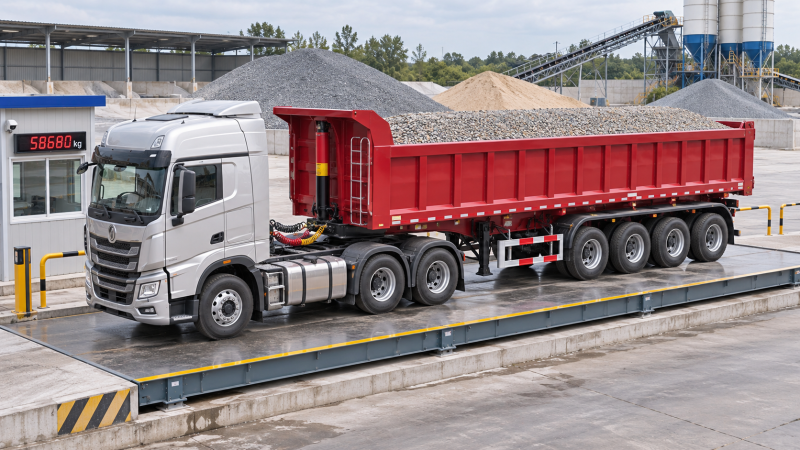
A rear dump semi-trailer can be below its stated gross weight and still overload an axle group, exceed a tractor limit, or become unstable during unloading. Payload planning therefore starts with the complete vehicle combination and its route, not with body volume or the trailer’s advertised capacity alone. The position of the load is as important as its total mass: material placed too far forward increases the load on the tractor coupling, while material concentrated toward the rear increases the load on the trailer running gear.
For technical evaluators, the practical task is to establish a loading range that works across the expected materials, tractor configurations, road restrictions, and tipping conditions. A useful specification connects these factors to measurable acceptance criteria rather than treating them as separate purchasing decisions.
Gross capacity is only the starting point
Several weight limits apply to a semi-trailer combination. The trailer has a rated gross capacity and individual component ratings; the tractor has its own axle, coupling, and gross combination limits. Roads and bridges may impose different restrictions according to jurisdiction, axle spacing, permits, or route conditions. The usable payload is constrained by whichever applicable limit is reached first, not necessarily by the highest figure on the trailer data plate.
Begin with the actual unladen combination, including the intended tractor, driver, fuel, spare wheel, tools, and any equipment carried in normal service. Subtract that measured mass from the lowest applicable gross combination limit to establish an initial payload ceiling. That calculation is necessary but incomplete: the resulting payload must also fit within each axle group and coupling limit once its position is taken into account.
A vehicle’s empty mass can change after a quotation is issued. A heavier liner, additional body reinforcement, a different tarp system, or a change of tractor all reduce or redistribute the available payload. Procurement documents should therefore distinguish a preliminary calculated tare from a measured, ready-for-service tare.
In the United States, federal limits on the Interstate System include axle and gross weight provisions, with additional bridge-formula requirements and exceptions; state and local rules also need to be checked for the actual route. Source: Federal Highway Administration, Freight Management and Operations: Truck Size and Weight, including its bridge formula guidance. Other markets require their own jurisdiction-specific review.
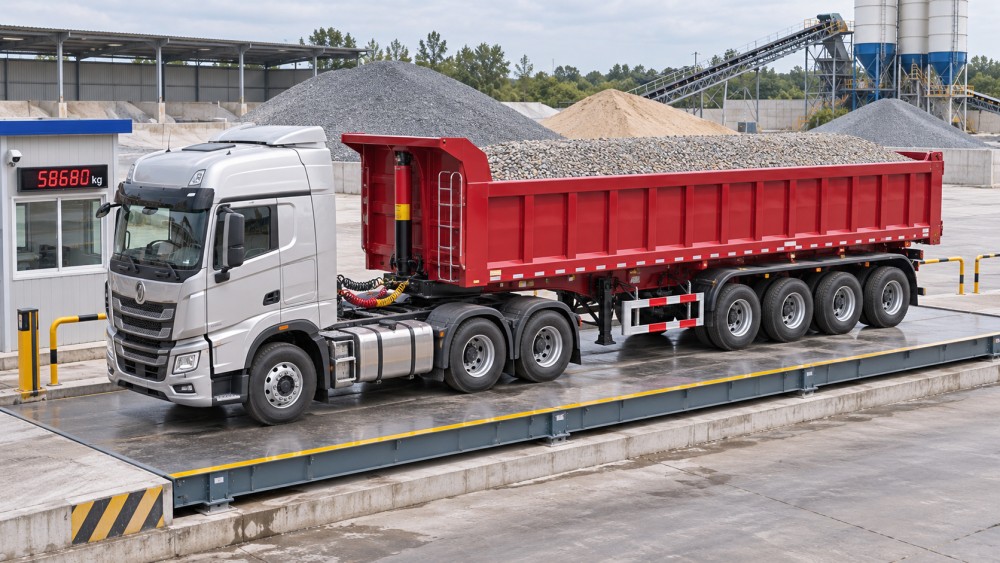
How payload position changes axle reactions
A semi-trailer transfers load to the tractor through the kingpin and fifth wheel and to the ground through its axle group. For a simplified static calculation, the trailer can be treated as a beam supported at the kingpin and at an equivalent axle-group support point. A load placed nearer the kingpin sends a larger share of its weight to the tractor; the same load placed nearer the axle group sends a larger share to the trailer axles.
Let L be the distance from the kingpin to the equivalent axle-group support point, and x the distance from the kingpin to the payload’s center of gravity. In this simplified model, the payload contribution to the axle group is payload × x/L; the remainder is carried at the kingpin. Add these contributions to the measured empty reactions before comparing them with allowable loads.
For illustration only, assume a payload of 24 tonnes, a support distance of 8 metres, and a payload center of gravity 5 metres behind the kingpin. The simplified calculation assigns 15 tonnes of the payload to the trailer axle group and 9 tonnes to the kingpin. Moving that center of gravity forward by 1 metre changes the calculated shares to 12 tonnes and 12 tonnes, respectively. Neither result is a complete axle-weight assessment: the empty vehicle reactions and tractor axle distribution still have to be added.
This model is useful for comparing loading positions, not for certifying an individual axle. Actual reactions depend on suspension geometry and equalization, frame deflection, road slope, and the position of the fifth wheel. A movable or lifting axle can change the support arrangement altogether. The tractor’s steer and drive axle loads also depend on its wheelbase and fifth-wheel position, so kingpin load cannot simply be assigned to the drive axle.
The underlying relationship follows static equilibrium: forces and moments must balance for a stationary vehicle. Source: OpenStax, University Physics Volume 1, section “Conditions for Static Equilibrium.”
Translate body volume into a workable load plan
Volume is useful for estimating how much material a body can contain, but it does not establish a legal or structurally acceptable payload. Bulk density varies with material, moisture, grading, and compaction. A body filled to the same visible level may carry substantially different masses on different days. Obtain a representative density range from the material supplier or from site measurements, and use the heavier expected condition when checking whether the intended fill level could exceed the payload limit.
Material distribution matters as much as average density. A loader can create a high mound at the front, an uneven ridge along one side, or a concentration near the tailgate. Each pattern shifts the center of gravity. A practical load plan should specify the intended loading zone, an approximate profile, and any material-specific restrictions. Drivers and loader operators need a shared reference, such as body markings backed by verified scale readings, rather than relying on a nominal bucket count.
For evaluators comparing dump special trailers, a four-axle rear dump configuration is a relevant reference point, but axle count alone does not establish permissible payload. Axle spacing, suspension ratings, tyre capacities, coupling load, empty mass, and route rules determine whether the additional running gear is useful for a particular operation. It may increase carrying capability under one set of constraints while adding tare or manoeuvring demands under another.
Check the route and the unloading site together
A trailer selected for road compliance can still be poorly matched to its delivery point. Tight turns, uneven access tracks, soft shoulders, overhead obstructions, and limited space behind the tailgate affect the choice of body and chassis. Confirm the fully raised body clearance for the proposed tractor-trailer combination, and check that the operator can position the vehicle without approaching excavations, slopes, or traffic unnecessarily.
Rear tipping changes the load case. As the body rises, the remaining material and the body itself are elevated; sticky or frozen material may release unevenly or remain lodged near the front. Side-to-side lean, inadequate ground support, or an obstructed tailgate can aggravate the risk. The UK Health and Safety Executive identifies uneven ground, unstable loads, and material sticking in the body among hazards associated with tipping vehicles. Source: HSE, Workplace transport safety: Tipping and loading vehicles.
Specify a level, firm tipping area appropriate to the vehicle and load, with an exclusion zone and a process for stopping if the load does not discharge as expected. The manufacturer’s operating instructions and the site risk assessment should govern the actual procedure. Raising or lowering the body should not be treated as a remedy for uncertain ground conditions or a blocked load.
Construction logistics may also involve concrete mixer trailers, but they perform a different transport function. A mixer carries concrete in an agitated drum, while a rear dump body discharges a bulk load by tipping. If a fleet handles both materials, each vehicle needs its own load-distribution and site-access assessment; a mixer’s drum and operating equipment cannot be represented by the loading assumptions used for an open dump body.
Separate structural ratings from road limits
A compliant road load does not automatically demonstrate that every trailer component is suitable for the duty cycle. The body, chassis rails, suspension attachments, hoist mountings, kingpin assembly, tyres, wheels, and brakes must be rated and configured for the intended application. Conversely, a high component rating does not override an applicable road limit.
Ask the supplier to identify the governing design load cases and the assumptions behind them: material type, loading method, load distribution, road severity, tipping conditions, and expected operating environment. An impact-resistant liner may help protect the body when coarse material is loaded, but its mass consumes payload and can change empty axle reactions. A lighter body may improve the payload calculation while requiring closer examination of wear allowance and repair strategy. These are application-specific trade-offs, not universal rankings of materials or designs.
Suspension equalization deserves particular attention on a multi-axle trailer. A group rating is not proof that every axle or tyre will carry an acceptable share under every condition. Request the axle and suspension manufacturer’s ratings and operating assumptions, including the treatment of lift axles where fitted. Verify tyre load capacity against the actual tyre specification, inflation pressure, speed, and service conditions using the applicable tyre manufacturer’s documentation.
Use scale tests to validate the calculation
The most useful acceptance test compares the predicted distribution with measured axle weights on the intended combination. Use a suitable, calibrated weighbridge or axle weighing system and follow its operating procedure. Record the tractor configuration, fifth-wheel position, tyre condition, fuel level, equipment, and loading profile so the result can be reproduced.
- Weigh the ready-for-service combination empty, recording individual axles or axle groups as the weighing equipment permits.
- Load a known quantity of representative material using the proposed normal loading pattern. Record the material condition and where it was placed.
- Reweigh the combination and compare gross, axle-group, and individual axle results with the applicable limits and component ratings.
- Repeat with a plausible forward or rearward loading variation if that variation can occur in routine work. Adjust loading instructions or equipment settings before approving the operating envelope.
Single-axle readings may be affected by the weighing method, suspension condition, and whether the vehicle is level. If results are close to a limit or inconsistent with the calculated distribution, investigate the measurement setup and vehicle condition rather than assuming the average group load resolves the issue. A test conducted on a substitute tractor should be clearly labelled as such; its results may not transfer to the intended unit.
Make the specification auditable
A purchase specification should record the intended materials and density range, payload target, expected loading pattern, operating routes, tractor coupling information, and site constraints. Request a general arrangement drawing showing axle spacing and kingpin position, a tare breakdown, component ratings, and a predicted axle-load calculation for the stated load cases. Where required by the destination market, obtain the applicable conformity and registration documentation before delivery.
Acceptance records should retain the measured empty and loaded weights alongside the final equipment configuration. If a body liner, tailgate, tarp, or tractor is changed later, review the calculation and reweigh where appropriate. The defensible payload is the amount that remains within the relevant limits with a realistic load position and a safe unloading arrangement—not simply the largest number appearing in a catalogue.
Have questions about this sector analysis, or seeking best practices specific to your niche? Drop us a line below and let the senior consultants at TF-Strategy assist you.
Related News
 Nov 09, 2026Axle Loads and Payload Planning for Rear Dump Semi-TrailersPlan safer, compliant loads for dump special trailers. Explore axle weight distribution, payload calculations, route limits, and practical scale-test tips.
 Oct 18, 2026Construction Equipment Load Planning: Balancing Payload, Cycle Time, and Site AccessConstruction equipment load planning: optimize payload, cycle time, and site access to improve productivity, reduce delays, and keep every haul operation safe.
 Oct 16, 2026What Mining Operators Need From Dump Truck Fleet MRO Service ContractsExplore dump truck fleet MRO services for mining market: contract essentials for uptime, parts support, measurable SLAs, lifecycle cost control, and safer haulage operations.
 Oct 14, 2026When Does Mining Hauling Equipment Need Repair, Rebuild, or Full Overhaul?Mining hauling equipment repair and overhaul market insights: learn when to choose repair, rebuild, or full overhaul to improve safety, uptime, and lifecycle value.

Heavy Haulage Strategist
Weekly Insights
Stay ahead with our curated technology reports delivered every Monday.