
What Mining Operators Need From Dump Truck Fleet MRO Service Contracts
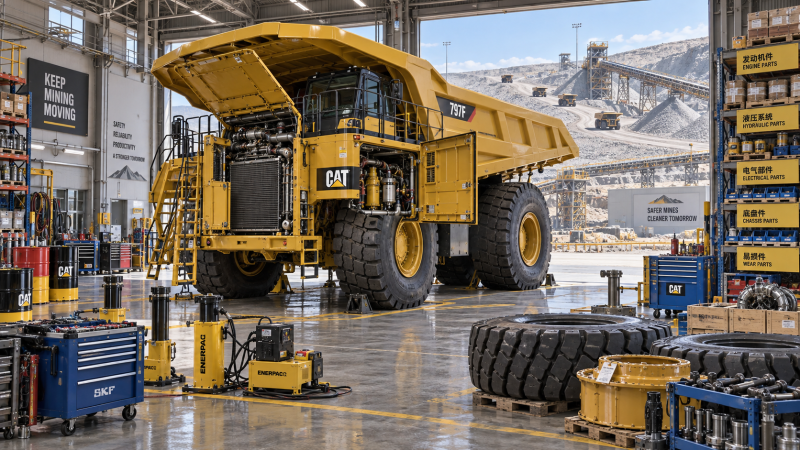
A dump truck can be mechanically sound at the start of a shift and still become a production bottleneck before the day ends. A delayed brake repair, an unavailable tire-related component, a missed oil-sampling alert, or a technician who cannot reach a remote pit quickly enough can leave haulage capacity below plan. For procurement teams, the result is not simply an unexpected maintenance invoice. It can affect dispatching, loader utilization, fuel efficiency, safety exposure, and the mine’s ability to move material at the required rate.
The right MRO contract should therefore be treated as an uptime and lifecycle-risk agreement, not as a catalog of scheduled services. Buyers assessing the dump truck fleet mro services for mining market should first establish whether a provider can support the actual operating environment: fleet age, truck mix, payload profile, haul-road condition, workshop capability, site remoteness, climate, and planned production hours. A lower headline service rate is rarely the best commercial outcome if parts lead times, exclusions, or response commitments leave the mine carrying the real operational risk.
Start with the operating condition, not the supplier’s standard package
Standard MRO offerings often assume a relatively predictable maintenance environment. Mining fleets rarely operate that way. Trucks may work extended shifts, face abrasive dust, climb steep grades, idle during loading queues, or operate under significant temperature variation. These conditions change the practical life of filters, cooling-system components, brakes, suspension elements, electrical connectors, tires, and structural assemblies.
Before requesting proposals, procurement should work with maintenance, operations, and site safety personnel to define the fleet’s current operating baseline. This avoids comparing contracts that appear similar but are priced against very different assumptions.
- Identify each truck model, configuration, serial range, age, engine hours, and major component history.
- Separate planned production units from standby, seasonal, or end-of-life trucks.
- Document average payload, route length, grade, road surface, cycle time, ambient conditions, and operating hours.
- List recurring failure modes, deferred repairs, component backlogs, and known reliability concerns.
- Clarify what the mine will provide: bays, lifting equipment, lubrication infrastructure, site access, warehousing, utilities, and local labor support.
This baseline is also where a buyer should decide what problem the agreement is meant to solve. A newer fleet with an established workshop may need parts planning, technical support, inspections, and periodic specialist work. An older mixed fleet in a remote location may require resident technicians, component management, emergency repair coverage, condition monitoring, and stronger inventory commitments. Treating both needs as the same “full-service” requirement invites vague pricing and later disputes.
Define service scope in operational terms
Service descriptions such as “preventive maintenance,” “field support,” or “full fleet coverage” are not sufficiently precise for a commercial agreement. The contract should state which activities are included, what triggers the work, who authorizes it, and who pays for labor, travel, consumables, replacement parts, and external services.
Planned maintenance should specify the maintenance intervals used, whether they follow manufacturer guidance or site-adjusted intervals, and who can approve deviations. Mining conditions can justify changes to service frequency, but those changes should be documented through a controlled process. Otherwise, either party may later argue that additional work was outside scope.
Separate routine work from corrective work
Routine work commonly includes scheduled inspections, lubrication, fluid and filter changes, basic adjustments, defect reporting, and maintenance record updates. Corrective work may include diagnostics, breakdown response, welding or fabrication, driveline repairs, cooling-system work, electrical fault tracing, hydraulic repairs, and replacement of major components. These categories carry different cost and availability consequences, so they should not be bundled under a single undefined labor rate.
Ask suppliers to show how they classify work found during a planned service. For example, if an inspection identifies abnormal brake wear or contamination in a hydraulic system, does the provider have authority to make the unit safe, or must the mine approve all work before action begins? The answer should distinguish between immediate safety intervention, limited-value corrective work, and larger repairs requiring a formal quotation.
Major components need their own treatment. Engines, transmissions, final drives, wheel motors, hydraulic pumps, alternators, and cooling packs may be repaired, exchanged, rebuilt, or replaced. A contract should indicate whether these items are excluded, priced separately, supplied on an exchange basis, or covered by an agreed component-management program. Without this distinction, a contract can look comprehensive while leaving the highest-value failure events outside its commercial boundary.
Availability commitments must be measurable
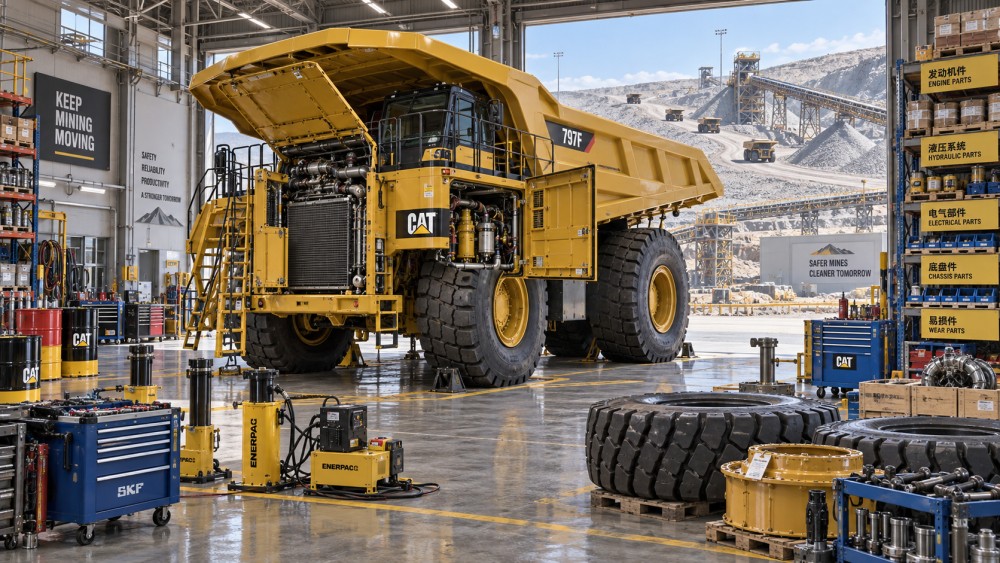
“Rapid response” is not a usable service level. Procurement needs commitments that can be measured from a defined starting point. That may include acknowledgment of a service request, remote diagnostic contact, technician mobilization, arrival on site, fault assessment, and return-to-service action. Each measure should account for the mine’s location and access restrictions rather than relying on urban service assumptions.
A useful agreement distinguishes between different event types:
Response time alone does not equal fleet availability. A technician can arrive quickly but lack diagnostic tools, access to technical information, lifting support, or the correct part. The contract should therefore include a practical escalation path for situations where the first response does not restore the unit. This may cover technical escalation, additional labor, component sourcing, and management notification after an agreed downtime threshold.
Parts support is where contract risk often becomes visible
Mining MRO contracts can fail commercially when parts are described only as “available on request.” The meaningful questions are which parts will be held locally, who owns that stock, how replenishment is controlled, what lead time applies to non-stock items, and how obsolete or slow-moving inventory will be handled.
Buyers should ask for a recommended critical-parts list based on fleet configuration and failure exposure, not merely a generic fast-moving list. Filters and common consumables are important, but production risk may sit with sensors, hoses, brake components, cooling-system parts, electrical harnesses, suspension elements, seals, or drivetrain-related items that are difficult to source quickly. Site history should inform this list, especially where trucks operate in abrasive, high-heat, high-altitude, or wet conditions.
Consignment inventory can reduce upfront working-capital pressure, but its terms need careful review. Define when ownership transfers, how stock is counted, whether unused stock may be returned, how price changes are handled, and who bears the cost of damaged or expired inventory. Also confirm whether the provider may substitute an equivalent part and what technical approval is required before substitution. A lower-cost substitute can create repeat failures or complicate warranty and traceability issues if controls are weak.
Do not overlook consumables and contamination control
Lubricants, coolants, filters, breathers, seals, cleaning materials, and sampling supplies may represent routine spending, yet they influence component life. The agreement should identify approved specifications, storage conditions, contamination controls, disposal responsibilities, and batch traceability where relevant. A service provider cannot credibly manage hydraulic or engine reliability while consumable quality and storage practices remain undefined.
Pay for performance only when the measurement system is credible
Performance-based terms can align supplier incentives with fleet reliability, but only when both parties agree on the data source and the causes of downtime. A fleet availability target may appear attractive until disagreements arise over whether delay was caused by maintenance quality, operator practice, road conditions, damage, fuel contamination, lack of mine-provided access, waiting for approval, or a part excluded from the agreement.
Before linking fees, bonuses, or service credits to performance, establish the calculation method. Define the reporting period, scheduled operating hours, planned maintenance hours, unplanned maintenance downtime, excluded events, and treatment of trucks not released by operations. Ensure that the same fleet-management or maintenance-record system is used as the commercial record, with a process for correcting inaccurate entries.
Useful performance indicators may include planned-maintenance compliance, repeat repairs, open defect age, response performance, parts fill rate, mean time to repair, and percentage of work orders completed with required documentation. They should not be chosen simply because they are easy to report. Each KPI should point to an action the provider can reasonably control.
Avoid a contract that penalizes the supplier for every unavailable truck while granting the supplier no influence over operating discipline, road maintenance, loading practice, or release of equipment for planned work. The better approach is to identify shared operating responsibilities and attach performance terms only to controllable obligations.
Price structure should reveal, rather than hide, lifecycle cost
Procurement often receives proposals built on different commercial models: fixed monthly management fees, time-and-materials rates, per-hour support, bundled service packages, labor-plus-parts markups, or availability-based pricing. Comparing them only by annual quoted value can be misleading.
Ask bidders to separate the cost elements behind their offer. Labor rates, shift coverage, travel and accommodation, supervision, diagnostic equipment, consumables, inventory carrying cost, emergency mobilization, specialist subcontracting, and component handling may be priced differently across proposals. A transparent breakdown helps the mine understand where cost volatility remains.
Fixed-price arrangements can provide budget certainty when fleet condition and service scope are well understood. They are less suitable when a neglected or aging fleet has a large unknown corrective-maintenance backlog. In that situation, a transition period may be more realistic: establish the fleet condition, clear agreed defects, create an inventory baseline, and then move to a more predictable service model. The contract should state how pre-existing defects are identified and how disputes over condition at handover will be resolved.
Price adjustment clauses also deserve scrutiny. Where labor, transport, consumables, or parts pricing can change, the formula, review frequency, supporting evidence, and notice period should be clear. Open-ended references to “market increases” move too much uncertainty back to the buyer.
Build governance into the agreement before problems occur
Fleet MRO performance is managed through everyday decisions, not only through quarterly reviews. The contract should name the operational contacts, authority levels, approval thresholds, and reporting cadence. It should also define how urgent repair authorization works outside normal business hours.
Monthly reporting should be useful to both maintenance and procurement. It should show completed work, outstanding defects, downtime events, parts consumption, repeat failures, planned maintenance compliance, safety-related findings, and any service-level exceptions. Raw data without interpretation is not enough; the provider should explain major variances and identify actions, owners, and due dates.
Contract change control matters as the fleet evolves. Trucks may be added, removed, reassigned, rebuilt, or operated under different conditions. The agreement needs a method for revising scope, inventory, staffing, and pricing without reopening every commercial term. Exit provisions are equally important. At the end of the term, the mine should retain complete maintenance history, defect status, parts records, warranty documentation, technical reports, and site-held inventory information needed for orderly transition.
Questions that should be resolved before award
Before selecting a provider, procurement should be able to answer several practical questions. Which failures can the provider repair independently on site? Which parts will physically be held near the fleet? What is the escalation route when a truck remains down beyond the initial response window? Which costs are fixed, which are variable, and which events are excluded? How will downtime be classified? Who approves non-routine repairs? What maintenance and parts data will remain available to the mine?
The strongest contract is not necessarily the one with the most promises. It is the one that makes responsibilities visible under the conditions that usually create friction: an urgent breakdown during production, a delayed component, a disputed failure cause, a truck approaching major repair, or a shift change with unresolved defects. When those situations are clearly addressed in the agreement, the MRO service relationship is far more likely to protect availability, cost control, and safe fleet operation.
Related News
 Oct 17, 2026Tunnel Boring Machine Supplier List: Compare TBM Types and Service CoverageExplore our tunnel boring machinery supplier list to compare EPB, slurry and hard rock TBMs, assess service coverage and lifecycle costs, and build a smarter procurement shortlist.
 Oct 16, 2026Heavy-Duty Petrochemical Lifting: Selecting Cranes by Load, Radius, and Site AccessExplore heavy-duty petrochemical lifting solutions. Compare cranes by load, radius, site access, and ground support to reduce project risk and optimize lifting costs.
 Oct 15, 2026Crane Selection for Petrochemical Turnarounds: Capacity, Radius, and Site AccessExplore petrochemical lifting solutions cranes can deliver, with expert guidance on capacity, working radius, and site access to help you plan a safer, more efficient turnaround.
 Oct 14, 2026High-Capacity Heavy Lifting Solutions: Matching Load, Radius, and Ground ConditionsDiscover heavy lifting solutions high capacity projects demand—compare load charts, working radius, and ground conditions to select a feasible, cost-effective system.



Heavy Haulage Strategist
Weekly Insights
Stay ahead with our curated technology reports delivered every Monday.