How to Evaluate Tunnel Boring Machine Segments for Ground Conditions and Tunnel Loads
A common problem in tunnel design reviews is that tunnel boring machine segments look adequate on paper until ground behavior, water pressure, construction tolerance, and ring loading are considered together. Many technical teams run into this when a segment layout seems structurally efficient in one calculation model but becomes questionable once joint rotation, eccentric loading, gasket compression, or installation damage are added to the picture.
That is why evaluating tunnel boring machine segments cannot be reduced to thickness, concrete strength, or reinforcement quantity alone. A useful assessment has to connect the expected ground conditions, the load path acting on the lining, and the realities of TBM excavation and segment erection. If you are comparing segment options for design selection or design review, the goal is to identify where performance uncertainty actually comes from and narrow it before procurement or construction locks the design in place.
Why segment selection becomes difficult in real projects
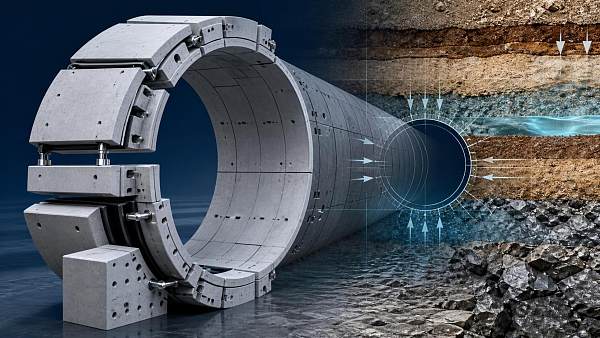
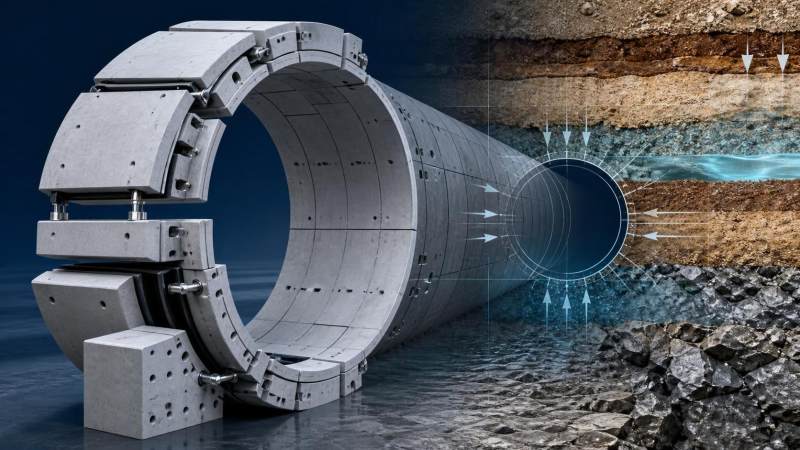
In early-stage tunnel planning, it is tempting to treat the segment ring as a standard product. The difficulty is that a segment lining is not working in isolation. It reacts to overcut, grout pressure, tail void closure, groundwater, uneven contact, local ground loss, and the stiffness of adjacent rings. In soft ground, the concern may be ovalization, joint opening, and water tightness. In mixed face or variable geology, the concern may shift toward uneven ring loading and localized stress concentration. In harder ground or squeezing conditions, thrust transfer, spalling risk, and segment edge damage can become more important than the nominal bending capacity shown in a simplified model.
Many evaluation mistakes start when the design team asks only whether the lining is “strong enough.” A better question is whether the segment system remains reliable across the expected range of installation and service conditions. That includes the concrete segment itself, the circumferential and longitudinal joints, bolts or dowels, gasket behavior, and how the ring interacts with the surrounding ground after backfill grouting and consolidation.
What usually goes wrong when tunnel boring machine segments are reviewed too narrowly
One common mistake is relying on a single representative ground profile. Actual tunnel drives often pass through transitions: weathered zones, mixed strata, local faulting, changing groundwater heads, or alternating soft and stiff materials. A segment design that works well in one section may become marginal in another because the load mechanism changes even if the tunnel diameter does not.
Another frequent issue is treating joints as fully rigid or ignoring the effect of construction tolerance. In practice, ring behavior is highly sensitive to joint stiffness, packing, bolt preload, and the accuracy of erection. Small deviations in alignment can alter bending distribution and contact pressure. A segment design may appear conservative in an idealized numerical check but have limited robustness once realistic joint behavior is introduced.
There is also a tendency to focus on ultimate capacity while underestimating serviceability. Cracking, leakage, gasket overstress, and recurring local repairs may not look critical in a high-level structural summary, but they can affect long-term durability, maintenance effort, and construction rhythm. For decision makers, these are not minor details. They directly influence delivery certainty and whole-life performance.
Start the evaluation with the ground model, not the segment drawing
When assessing tunnel boring machine segments, the first useful filter is the engineering ground model. That means identifying not just the soil or rock type, but the behavior that will matter to the lining. Is the tunnel likely to see uniform radial confinement, localized relaxation, swelling, high hydrostatic pressure, abrasive contact, or differential deformation? The design review should sort the alignment into loading zones rather than treating the whole drive as one average condition.
At this stage, it helps to classify the main design drivers:
- Ground stiffness contrast and how it may distort the ring.
- Expected groundwater head and long-term water tightness demand.
- Likelihood of settlement control requirements that increase sensitivity to lining deformation.
- Construction-induced loads during thrust, handling, storage, and erection.
- Potential for localized contact stress due to irregular excavation or annular gap closure.
This is where a technical intelligence source such as TF-Strategy can be useful as a reference path, not as a substitute for design. For teams reviewing segment options across different machine concepts or project environments, structured sector intelligence can help compare how geometry, material selection, cutterhead strategy, and construction method interact upstream of the segment design decision.
How to compare TBM segment geometry under different tunnel loads
Once the loading environment is reasonably defined, geometry becomes easier to judge. The main question is not which segment ring looks heavier, but which geometry produces stable behavior under expected bending, compression, joint rotation, and handling constraints.
Key geometry checks usually include ring thickness, segment width, number of pieces per ring, taper arrangement for curves, and the shape of the circumferential joint faces. A thicker lining may improve capacity, but it also affects weight, handling, erection speed, and TBM backup logistics. A wider ring can improve advance efficiency, but it may increase sensitivity to erection tolerance and local load redistribution. More segments per ring can reduce individual piece weight but increase the number of joints that must remain aligned and watertight.
For decision-making, compare geometry against the actual failure concerns:
- If groundwater control is severe, joint layout and gasket continuity deserve as much attention as section thickness.
- If variable loading is expected, the design should tolerate uneven contact and joint rotation without relying on ideal fit.
- If the drive includes tight curves or demanding alignment corrections, taper strategy and erection practicality become major design factors.
- If handling damage is a known risk, corner detailing and reinforcement anchorage deserve closer review than nominal section area alone.
Reinforcement and joint design should be checked as a system
Segment reinforcement is often discussed as if it were separate from the joint design. In reality, the two have to be evaluated together. Reinforcement is not only there to resist in-service bending. It also helps the segment survive demoulding, storage, transport, lifting, thrust jacking, and erection impacts. If a design has narrow safety margins during handling, the site may start seeing chipped edges, cracked corners, or hidden damage before the lining ever reaches its long-term loading state.
Joint design deserves a dedicated review because many lining problems originate there. Circumferential joints and longitudinal joints influence stiffness, leakage resistance, and force transfer. Questions worth asking include:
- How much rotation can the joint accommodate before contact stress becomes excessive?
- Are bolts or dowels being asked to do alignment work, structural work, or both?
- Does the joint face geometry promote stable load transfer under realistic tolerance conditions?
- Will gasket compression remain effective if the ring deforms non-uniformly?
- Is there a risk that local spalling near joint pockets will control performance before section capacity does?
It is common to find segment designs that appear adequate in global lining analysis but become less convincing when these local checks are examined closely. That is why a segment review should move back and forth between whole-ring behavior and local detailing rather than stopping at one scale.
A practical decision process for evaluating tunnel boring machine segments
If you need a working method for selection or design review, use a staged comparison instead of trying to judge every parameter at once.
- Define the controlling ground scenarios. Separate uniform conditions from transition zones, high water pressure sections, settlement-sensitive reaches, and any section where unusual deformation may occur.
- Identify the critical load cases. Include not only long-term ground and water loads, but also temporary loads from jacking, lifting, storage, tail brush interaction, and grout pressure.
- Review ring geometry against constructability. Check whether segment size, piece count, taper arrangement, and weight are realistic for the TBM setup and site handling process.
- Evaluate joint behavior explicitly. Ask for assumptions on joint stiffness, allowable opening, rotation, bolt action, and gasket performance rather than accepting a generic statement that the joints are standard.
- Check reinforcement for both service and handling states. A design with efficient in-service capacity can still be vulnerable during production and installation.
- Test sensitivity to tolerance and uneven loading. If performance changes sharply with small deviations, the design may be too fragile for actual site conditions.
- Compare options on robustness, not just weight or material volume. The preferred lining is often the one that tolerates variation better, even if it is not the lightest option on paper.
How to tell whether a segment design is robust enough for the job
A robust segment design usually shows balanced performance across several checks. It does not depend on unusually precise erection to remain watertight. It does not push reinforcement demand into congested details that are difficult to cast consistently. It does not assume perfectly uniform ring loading where the geology suggests otherwise. And it does not transfer too much risk into local joint zones that are hard to inspect or repair later.
Another useful sign is whether the design team can explain the governing assumptions clearly. If the segment thickness, joint arrangement, or reinforcement layout only works because of one optimistic assumption about ground support, grout effectiveness, or boundary stiffness, that should be treated as a decision risk. In contrast, a stronger evaluation will show how the lining behaves if actual site conditions vary within a realistic range.
This is often where experienced reviewers separate a merely compliant design from a dependable one. For procurement and delivery planning, dependability matters more than theoretical neatness.
What to document before approving the segment option
Before a segment design is accepted for detailed execution, the review record should be specific enough that later teams can understand why the choice was made. That means documenting the controlling geotechnical assumptions, the key structural load cases, joint behavior assumptions, water tightness criteria, construction tolerance expectations, and any known interfaces with the TBM or ring-building process.
A short decision note is often more valuable than a broad approval statement. It should capture where the design has margin, where it is sensitive, and what field controls will be needed to keep performance within expectation. For example, if the selected segment system depends on tight control of annular grouting or careful management of ring build tolerance, that should be visible in the decision basis rather than left to interpretation later.
Frequently Asked Questions
Are thicker TBM segments always safer?
No. More thickness can improve some structural checks, but it also increases weight, handling demands, and sometimes cost and erection complexity. The safer choice is the design that performs reliably under the actual load cases and construction conditions, not simply the thickest lining.
What matters more, segment concrete strength or joint design?
Neither should be isolated. Concrete strength matters, but many service issues appear first at the joints through opening, rotation, leakage, or local stress concentration. A sound evaluation considers concrete, reinforcement, and joints as one system.
How early should groundwater pressure be considered in segment selection?
At the start. Water pressure influences joint behavior, gasket demand, crack control, and long-term durability. If it is added late in the review, teams often end up revisiting geometry or joint details that seemed settled earlier.
Can a standard segment design be reused across different tunnel sections?
Sometimes, but only after checking whether the controlling ground conditions and load cases remain comparable. Reuse is practical when the design has enough robustness for the full range of expected conditions. It becomes risky when geology or water conditions vary sharply along the alignment.
What is the biggest warning sign in a segment design review?
A design that looks efficient only under ideal assumptions is a warning sign. If small changes in tolerance, joint stiffness, groundwater, or uneven loading create large performance changes, the segment option may not be dependable in the field.
Conclusion
Evaluating tunnel boring machine segments is really a decision about fit: fit to the ground, fit to the tunnel loads, and fit to the way the TBM will actually build the lining. The most reliable reviews start with the loading environment, test geometry and joints against realistic construction conditions, and check whether the design remains stable when assumptions become less tidy. That approach usually leads to better segment choices, fewer late-stage surprises, and a clearer basis for tunnel delivery.